


Page 1370 - Hematology_ Basic Principles and Practice ( PDFDrive )
P. 1370
1216   Part VII  Hematologic Malignancies


                                  A                           B

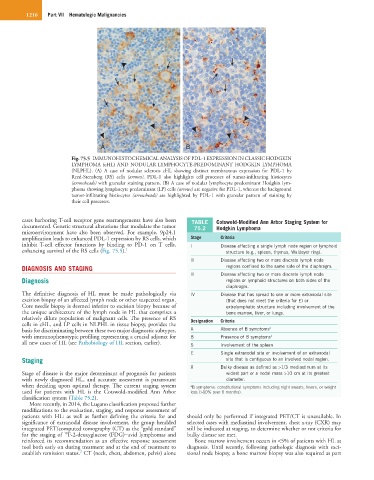
                        Fig. 75.5  IMMUNOHISTOCHEMICAL ANALYSIS OF PDL-1 EXPRESSION IN CLASSIC HODGKIN
                        LYMPHOMA (cHL) AND NODULAR LYMPHOCYTE-PREDOMINANT HODGKIN LYMPHOMA
                        (NLPHL).  (A)  A  case  of  nodular  sclerosis  cHL  showing  distinct  membranous  expression  for  PDL-1  by
                        Reed-Sternberg  (RS)  cells  (arrows).  PDL-1  also  highlights  cell  processes  of  tumor-infiltrating  histiocytes
                        (arrowheads) with granular staining pattern. (B) A case of nodular lymphocyte predominant Hodgkin lym-
                        phoma showing lymphocyte predominant (LP) cells (arrows) are negative for PDL-1, whereas the background
                        tumor-infiltrating  histiocytes  (arrowheads)  are  highlighted  by  PDL-1  with  granular  pattern  of  staining  by
                        their cell processes.


        cases harboring T-cell receptor gene rearrangements have also been   TABLE   Cotswold-Modified Ann Arbor Staging System for
        documented. Genetic structural alterations that modulate the tumor   75.2  Hodgkin Lymphoma
        microenvironment  have  also  been  observed.  For  example,  9p24.1
        amplification leads to enhanced PDL-1 expression by RS cells, which   Stage  Criteria
        inhibit  T-cell  effector  functions  by  binding  to  PD-1  on  T  cells,   I  Disease affecting a single lymph node region or lymphoid
        enhancing survival of the RS cells (Fig. 75.5). 1                  structure (e.g., spleen, thymus, Waldeyer ring).
                                                               II        Disease affecting two or more discrete lymph node
        DIAGNOSIS AND STAGING                                              regions confined to the same side of the diaphragm.
                                                               II        Disease affecting two or more discrete lymph node
        Diagnosis                                                          regions or lymphoid structures on both sides of the
                                                                           diaphragm.
        The  definitive  diagnosis  of  HL  must  be  made  pathologically  via   IV  Disease that has spread to one or more extranodal site
        excision biopsy of an affected lymph node or other suspected organ.   (that does not meet the criteria for E) or
        Core needle biopsy is deemed inferior to excision biopsy because of   extralymphatic structure including involvement of the
        the unique architecture of the lymph node in HL that comprises a   bone marrow, liver, or lungs.
        relatively dilute population of malignant cells. The presence of RS   Designation  Criteria
        cells in cHL, and LP cells in NLPHL in tissue biopsy, provides the
        basis for discriminating between these two major diagnostic subtypes,   A  Absence of B symptoms a
        with immunophenotypic profiling representing a crucial adjunct for   B  Presence of B symptoms a
        all new cases of HL (see Pathobiology of HL section, earlier).  S  Involvement of the spleen
                                                               E         Single extranodal site or involvement of an extranodal
        Staging                                                            site that is contiguous to an involved nodal region.
                                                               X         Bulky disease as defined as >1/3 mediastinum at its
        Stage of disease is the major determinant of prognosis for patients   widest part or a nodal mass >10 cm at its greatest
        with  newly  diagnosed  HL,  and  accurate  assessment  is  paramount   diameter.
        when  deciding  upon  optimal  therapy. The  current  staging  system   a B symptoms: constitutional symptoms including night sweats, fevers, or weight
        used  for  patients  with  HL  is  the  Cotswold-modified  Ann  Arbor   loss (>10% over 6 months).
        classification system (Table 75.2).
           More recently, in 2014, the Lugano classification proposed further
        modifications to the evaluation, staging, and response assessment of
        patients  with  HL:  as  well  as  further  defining  the  criteria  for  and   should only be performed if integrated PET/CT is unavailable. In
        significance  of  extranodal  disease  involvement,  the  group  heralded   selected cases with mediastinal involvement, chest x-ray (CXR) may
        integrated PET/computed tomography (CT) as the “gold standard”   still be indicated at staging, to determine whether or not criteria for
                      18
        for the staging of  F-2-deoxyglucose (FDG)−avid lymphomas and   bulky disease are met.
        reinforced  its  recommendation  as  an  effective  response  assessment   Bone marrow involvement occurs in <5% of patients with HL at
        tool both early on during treatment and at the end of treatment to   diagnosis. Until recently, following pathologic diagnosis with exci-
                           2
        establish remission status.  CT (neck, chest, abdomen, pelvis) alone   sional node biopsy, a bone marrow biopsy was also required as part

