


Page 1372 - Hematology_ Basic Principles and Practice ( PDFDrive )
P. 1372
1218   Part VII  Hematologic Malignancies


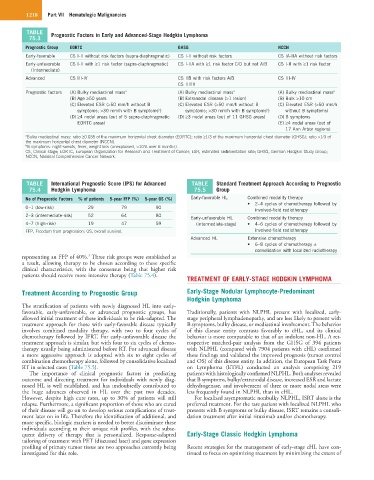
          TABLE   Prognostic Factors in Early and Advanced-Stage Hodgkin Lymphoma
          75.3
         Prognostic Group  EORTC                           GHSG                             NCCN
         Early-favorable  CS I-II without risk factors (supra-diaphragmatic)  CS I-II without risk factors  CS IA-IIA without risk factors
         Early-unfavorable   CS I-II with ≥1 risk factor (supra-diaphragmatic)  CS I-IIA with ≥1 risk factor C/D but not A/B  CS I-II with ≥1 risk factor
           (Intermediate)
         Advanced       CS III-IV                          CS IIB with risk factors A/B     CS III-IV
                                                           CS III/IV
         Prognostic factors   (A) Bulky mediastinal mass a   (A) Bulky mediastinal mass a    (A) Bulky mediastinal mass a
                         (B) Age ≥50 years                  (B) Extranodal disease (>1 lesion)   (B) Bulk >10 cm
                         (C) Elevated ESR (>50 mm/h without B    (C) Elevated ESR (>50 mm/h without B    (C) Elevated ESR (>50 mm/h
                                                                                        b
                          symptoms; >30 mm/h with B symptoms )  symptoms; >30 mm/h with B symptoms )  without B symptoms)
                                                     b
                         (D) ≥4 nodal areas (out of 5 supra-diaphragmatic    (D) ≥3 nodal areas (out of 11 GHSG areas)   (D) B symptoms
                          EORTC areas)                                                       (E) ≥4 nodal areas (out of
                                                                                              17 Ann Arbor regions)
         a Bulky mediastinal mass: ratio ≥0.035 of the maximum horizontal chest diameter (EORTC); ratio ≥1/3 of the maximum horizontal chest diameter (GHSG); ratio >1/3 of
         the maximum horizontal chest diameter (NCCN).
         b B symptoms: night-sweats, fever, weight loss (unexplained, >10% over 6 months).
         CS, Clinical stage; EORTC, European Organization for Research and Treatment of Cancer; ESR, estimated sedimentation rate; GHSG, German Hodgkin Study Group;
         NCCN, National Comprehensive Cancer Network.


          TABLE   International Prognostic Score (IPS) for Advanced   TABLE   Standard Treatment Approach According to Prognostic
          75.4    Hodgkin Lymphoma                              75.5    Group
         No of Prognostic Factors  % of patients  5-year FFP (%)  5-year OS (%)  Early-favorable HL  Combined modality therapy
                                                                                  •  2−4 cycles of chemotherapy followed by
         0−1 (low-risk)       29         79         90
                                                                                    involved-field radiotherapy
         2−3 (intermediate-risk)  52     64         80
                                                               Early-unfavorable HL   Combined modality therapy
         4−7 (high-risk)      19         47         59           (intermediate-stage)  •  4−6 cycles of chemotherapy followed by
         FFP, Freedom from progression; OS, overall survival.                       involved-field radiotherapy
                                                               Advanced HL        Extensive chemotherapy
                                                                                  •  6−8 cycles of chemotherapy ±
                                                                                    consolidation with localized radiotherapy
                              3
        representing an FFP of 40%.  Three risk groups were established as
        a result, allowing therapy to be chosen according to these specific
        clinical  characteristics,  with  the  consensus  being  that  higher  risk
        patients should receive more intensive therapy (Table 75.4).
                                                              TREATMENT OF EARLY-STAGE HODGKIN LYMPHOMA
        Treatment According to Prognostic Group               Early-Stage Nodular Lymphocyte-Predominant
                                                              Hodgkin Lymphoma
        The stratification of patients with newly diagnosed HL into early-
        favorable,  early-unfavorable,  or  advanced  prognostic  groups,  has   Traditionally,  patients  with  NLPHL  present  with  localized,  early-
        allowed initial treatment of these individuals to be risk-adapted. The   stage peripheral lymphadenopathy, and are less likely to present with
        treatment  approach  for  those  with  early-favorable  disease  typically   B symptoms, bulky disease, or mediastinal involvement. The behavior
        involves  combined  modality  therapy,  with  two  to  four  cycles  of   of  this  disease  entity  contrasts  favorably  to  cHL,  and  its  clinical
        chemotherapy followed by IFRT. For early-unfavorable disease the   behavior is more comparable to that of an indolent non-HL. A ret-
        treatment approach is similar, but with four to six cycles of chemo-  rospective  matched-pair  analysis  from  the  GHSG  of  394  patients
        therapy usually being administered before RT. For advanced disease   with NLPHL (compared with 7904 patients with cHL) confirmed
        a  more  aggressive  approach  is  adopted  with  six  to  eight  cycles  of   these findings and validated the improved prognosis (tumor control
        combination chemotherapy alone, followed by consolidative localized   and OS) of this disease entity. In addition, the European Task Force
        RT in selected cases (Table 75.5).                    on  Lymphoma  (ETFL)  conducted  an  analysis  comprising  219
           The  importance  of  clinical  prognostic  factors  in  predicting   patients with histologically confirmed NLPHL. Both analyses revealed
        outcome  and  directing  treatment  for  individuals  with  newly  diag-  that B symptoms, bulky/extranodal disease, increased ESR and lactate
        nosed HL is well established, and has undoubtedly contributed to   dehydrogenase, and involvement of three or more nodal areas were
        the  huge  advances  observed  in  HL  over  the  past  two  decades.   less frequently found in NLPHL than in cHL.
        However,  despite  high  cure  rates,  up  to  30%  of  patients  will  still   For localized asymptomatic nonbulky NLPHL, ISRT alone is the
        relapse. Furthermore, a significant proportion of those who are cured   preferred treatment. For the rare patient with localized NLPHL who
        of their disease will go on to develop serious complications of treat-  presents with B symptoms or bulky disease, ISRT remains a consoli-
        ment later on in life. Therefore the identification of additional, and   dation treatment after initial rituximab and/or chemotherapy.
        more specific, biologic markers is needed to better discriminate these
        individuals according to their unique risk profiles, with the subse-
        quent  delivery  of  therapy  that  is  personalized.  Response-adapted   Early-Stage Classic Hodgkin Lymphoma
        tailoring of treatment with PET (discussed later) and gene expression
        profiling of primary tumor tissue are two approaches currently being   Recent strategies for the management of early-stage cHL have con-
        investigated for this role.                           tinued to focus on optimizing treatment by minimizing the extent of

