


Page 1433 - Hematology_ Basic Principles and Practice ( PDFDrive )
P. 1433
Chapter 79  Marginal Zone Lymphomas (Extranodal/Malt, Splenic, and Nodal)  1279


            autoimmune disorders 60–64  (Table 79.2), although the strength of this   similar to those of centrocytes and having relatively abundant pale
            correlation  for  some  primary  sites  of  disease  is  discordant  among   cytoplasm (leading possibly to a monocytoid appearance). These cells
            studies,  suggesting  a  possible  geographic  variation.  The  common   are located in the outer zone of reactive lymphoid follicles, extend
            assumption about this association is that continual immune stimula-  into the interfollicular region, and may sometimes colonize the ger-
            tion  by  bacterial  or  self-antigens  leads  to  expansion  of  lymphoid   minal centers. Larger, immunoblast- or centroblast-like cells may be
            elements in the connective tissue adjacent to the epithelium involved,   present in small numbers, but an abundance of these should raise
            initially leading to a process of reactive lymphoid hyperplasia. Persis-  suspicion for diffuse large B-cell lymphoma (DLBCL), which requires
            tent  lymphocytic  activation  and  proliferation  predisposes  to  the   different management. According to the newest WHO classification,
            accumulation of genetic errors that ultimately may result in antigen-  the term high-grade MALT lymphoma, denoting the presence of sheets
            independent  growth  and,  consequently,  lymphoma  emergence. 65,66    of transformed cells, should not be used and instead these tumors
            The histologic distinction between the reactive inflammatory process   should be diagnosed as DLBCL.
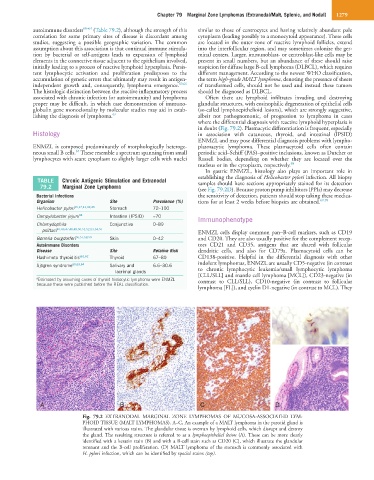
            associated with chronic infection (or autoimmunity) and lymphoma   Often  there  are  lymphoid  infiltrates  invading  and  destroying
            proper may be difficult, in which case demonstration of immuno-  glandular structures, with eosinophilic degeneration of epithelial cells
            globulin gene monoclonality by molecular studies may aid in estab-  (so-called lymphoepithelioid lesions), which are strongly suggestive,
            lishing the diagnosis of lymphoma. 67                 albeit  not  pathognomonic,  of  progression  to  lymphoma  in  cases
                                                                  where the differential diagnosis with reactive lymphoid hyperplasia is
                                                                  in doubt (Fig. 79.2). Plasmacytic differentiation is frequent, especially
            Histology                                             in  association  with  cutaneous,  thyroid,  and  intestinal  (IPSID)
                                                                  ENMZL and may pose differential diagnosis problems with lympho-
            ENMZL is composed predominantly of morphologically heteroge-  plasmacytic  lymphoma.  These  plasmacytoid  cells  often  contain
                          67
            neous small B cells.  These resemble a spectrum spanning from small   periodic acid–Schiff (PAS)–positive inclusions, known as Dutcher or
            lymphocytes with scant cytoplasm to slightly larger cells with nuclei   Russell  bodies,  depending  on  whether  they  are  located  over  the
                                                                  nucleus or in the cytoplasm, respectively. 68
                                                                    In  gastric  ENMZL,  histology  also  plays  an  important  role  in
                                                                  establishing the diagnosis of Helicobacter pylori infection. All biopsy
             TABLE   Chronic Antigenic Stimulation and Extranodal   samples should have sections appropriately stained for its detection
              79.2   Marginal Zone Lymphoma                       (see Fig. 79.2D). Because proton pump inhibitors (PPIs) may decrease
             Bacterial Infections                                 the sensitivity of detection, patients should stop taking these medica-
             Organism                Site          Prevalence (%)  tions for at least 2 weeks before biopsies are obtained. 69,70
             Helicobacter pylori 15,17,41,42,43  Stomach  72–100
             Campylobacter jejuni 44  Intestine (IPSID)  ≈70      Immunophenotype
             Chlamydophila           Conjunctiva   0–89
               psittaci 45,46,47,48,49,50,51,52,53,54,55          ENMZL cells display common pan–B-cell markers, such as CD19
             Borrelia burgdorferi 56,57,58,59  Skin  0–42         and CD20. They are also usually positive for the complement recep-
             Autoimmune Disorders                                 tors  CD21  and  CD35,  antigens  that  are  shared  with  follicular
             Disease                 Site          Relative Risk  dendritic  cells,  and  also  for  CD79a.  Plasmacytoid  cells  can  be
             Hashimoto thyroiditis a61,62  Thyroid  67–80         CD138-positive.  Helpful  in  the  differential  diagnosis  with  other
             Sjögren syndrome 60,63,64  Salivary and   6.6–30.6   indolent lymphomas, ENMZL are usually CD5-negative (in contrast
                                       lacrimal glands            to  chronic  lymphocytic  leukemia/small  lymphocytic  lymphoma
             a Estimated by assuming cases of thyroid histiocytic lymphoma were ENMZL   [CLL/SLL] and mantle cell lymphoma [MCL]), CD23-negative (in
                                                                  contrast  to  CLL/SLL),  CD10-negative  (in  contrast  to  follicular
             because these were published before the REAL classification.
                                                                  lymphoma [FL]), and cyclin D1-negative (in contrast to MCL). They


              A                         B                          C                       D
                            Fig.  79.2  EXTRANODAL  MARGINAL  ZONE  LYMPHOMAS  OF  MUCOSA-ASSOCIATED  LYM-
                            PHOID TISSUE (MALT LYMPHOMAS). A–C, An example of a MALT lymphoma in the parotid gland is
                            illustrated with various stains. The glandular tissue is overrun by lymphoid cells, which disrupt and destroy
                            the gland. The resulting structure is referred to as a lymphoepithelial lesion (A). These can be more clearly
                            identified with a keratin stain (B) and with a B-cell stain such as CD20 (C), which illustrate the glandular
                            remnant and the B-cell proliferation. (D) MALT lymphoma of the stomach is commonly associated with
                            H. pylori infection, which can be identified by special stains (top).

