


Page 1499 - Hematology_ Basic Principles and Practice ( PDFDrive )
P. 1499
Chapter 84  Malignant Lymphomas in Childhood  1331


            Patients with a mass and less than 25% bone marrow (BM) lympho-  Epidemiology
            blasts are designated as having LBL, whereas patients with at least   LBL constitutes 22% to 28% of childhood NHL. There is a 2 : 1 male
            25% BM involvement have ALL. In contrast to ALL, more than 75%   predominance for LBL, but the incidence of LBL remains constant
            of patients with LBL demonstrate a precursor T-cell immunopheno-  across the pediatric age group for both boys and girls. 14
            type  (T-LBL),  with  the  remainder  showing  a  precursor  B-cell
            immunophenotype (pB-LBL). 11–13                       Pathobiology
                                                                  LBL arises from precursor T or B lymphoblasts at varying stages of
                                                                  differentiation.  The  morphology  is  similar  to  that  of  ALL,  with
                                                                  lymphoblasts  of  small  or  medium  size  and  with  scant  cytoplasm,
                                                                  round or convoluted nuclei, fine chromatin, and indistinct or small
             TABLE   Characteristics of Non-Hodgkin Lymphoma in Children  nucleoli.  Immunophenotyping  shows  terminal  deoxynucleotidyl
              84.1                                                transferase (TdT) positivity. T-LBL are usually positive for CD7 and
                         Proportion of                            surface or cytoplasmic CD3, with variable expression of CD2, CD5,
                         Cases in BFM                             CD1a, CD4, and CD8. Staining for TdT, CD3, myeloperoxidase,
             Subtype     Studies (%) 11  Phenotype  Primary Site  and a B-cell marker–like pax5 or CD79a are recommended parts of
                                                                                                   15
                                                                  a  resource-saving  diagnostic  staining  panel.   CD10  expression  is
             Lymphoblastic   26     T cell;     Mediastinum or    more  frequent  in  T-LBL  (40%)  than  in  T-ALL  (less  than  10%),
                                    B cell        head and neck;  possibly related to maturational stage, with T-ALL more frequently
                                                lymph nodes, skin,   demonstrating an immature phenotype. 13,16,17  B-lineage markers are
                                                  soft tissue, bone
                                                                  positive  in  pB-LBL.  Unlike  ALL,  there  are  no  known  cytogenetic
             Burkitt         49     B cell      Abdomen or head   prognostic factors for LBL. Recurrent cytogenetic anomalies are seen
                                                  and neck        in about half of childhood T-ALL but have not been well-defined in
             DLBCL           13     B cell      Lymph nodes,      T-LBL.  Literature  is  scarce  regarding  typical  chromosomal  aberra-
                                                  mediastinum,    tions  for T-LBL. The  commonest  chromosomal  translocations  for
                                                  abdomen, head   both T-LBL and T-ALL involve the T-cell receptor (TCR) gene loci
                                                  and neck        at chromosome 14q11 or 7q34, resulting in the juxtaposition of an
             ALCL            13     T cell      Mediastinum,      oncogenic partner gene with the regulatory region of one of the TCR
                                    indeterminate  abdomen, head   gene loci and subsequent deregulation of a reciprocal partner gene,
                                                  and neck, bone,   such as TAL1, MYC, HOXA gene cluster, and MYB. Certain molecu-
                                                  soft tissue, or   lar  genetic  alterations  were  analyzed  in  relevant  patient  series  of
                                                  skin            pediatric T-LBL,  including  NOTCH1,  FBXW7  mutations,  altera-
                                                                  tions of chromosome 9p containing CDKN2A/CDKN2B loci, and
             ALCL, Anaplastic large-cell lymphoma; BFM, Berlin-Frankfurt-Münster; DLBCL,   chromosome 6q. 18,19  Prospective systematic validation is required to
             diffuse large B-cell lymphoma; Ig, immunoglobulin.
                                                                  evaluate whether one of these markers or a combination of molecular


                          A A                       B B                       C C


                          D                         E                         F

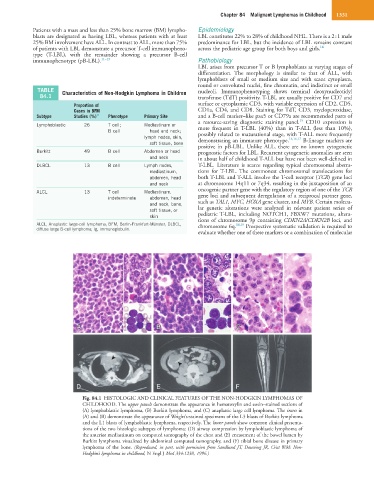
                            Fig. 84.1  HISTOLOGIC AND CLINICAL FEATURES OF THE NON-HODGKIN LYMPHOMAS OF
                            CHILDHOOD. The upper panels demonstrate the appearance in hematoxylin and eosin–stained sections of
                            (A) lymphoblastic lymphoma, (B) Burkitt lymphoma, and (C) anaplastic large cell lymphoma. The insets in
                            (A) and (B) demonstrate the appearance of Wright’s-stained specimens of the L3 blasts of Burkitt lymphoma
                            and the L1 blasts of lymphoblastic lymphoma, respectively. The lower panels show common clinical presenta-
                            tions of the two histologic subtypes of lymphoma: (D) airway compression by lymphoblastic lymphoma of
                            the anterior mediastinum on computed tomography of the chest and (E) encasement of the bowel lumen by
                            Burkitt lymphoma visualized by abdominal computed tomography, and (F) tibial bone disease in primary
                            lymphoma  of  the  bone.  (Reproduced,  in  part,  with  permission  from  Sandlund  JT,  Downing  JR,  Crist WM:  Non-
                            Hodgkin’s lymphoma in childhood, N Engl J Med 334:1238, 1996.)

