


Page 1504 - Hematology_ Basic Principles and Practice ( PDFDrive )
P. 1504
1336   Part VII  Hematologic Malignancies

                                       68
        and the treatment is identical in children.  Outcomes for pediatric
        DLBCL are superior to those for adults, with 5-year overall survival
        (OS)  of  90%  for  current  therapies.  Adolescent  girls  fared  worse
                                                         28
        than  adolescent  boys  with  DLBCL  on  NHL-BFM  protocols.
        BCL2 expression is not an unfavorable prognostic factor in children
                                                69
        with  DLBCL,  in  contrast  to  adults  with  DLBCL.   Prognosis  is
        poorer  for  children  and  adolescents  with  PMBCL  (5-year  EFS  of
        65%  to  75%). 48,75   In  the  setting  of  PMBCL,  LDH  of  500 U/L
                                75
        or more has a worse prognosis.  For adult patients with PMBCL,
        favorable  outcome  was  reported  using  a  dose-adjusted  EPOCH-
        rituximab  regimen  with  continuous  infusions  of  etoposide,  doxo-
        rubicin, vincristine, and bolus administrations of cyclophosphamide
                     77
        and  prednisone.   In  a  small  pediatric  series,  similar  excellent
        results  were  observed,  but  they  require  systematic  prospective
        validation. 78
        Therapy
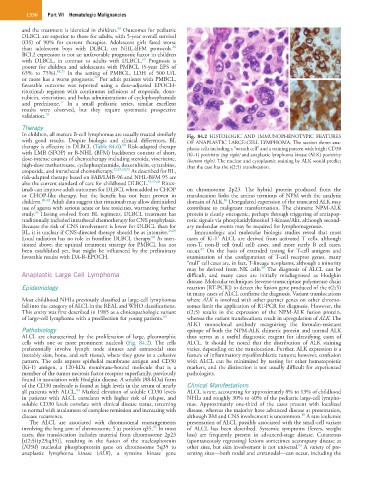
        In children, all mature B-cell lymphomas are usually treated similarly   Fig.  84.2  HISTOLOGIC  AND  IMMUNOPHENOTYPIC  FEATURES
        with  good  results.  Despite  biologic  and  clinical  differences,  BL   OF ANAPLASTIC LARGE-CELL LYMPHOMA. The section shows ana-
                                         68
        therapy is effective in DLBCL (Table 84.6).  Risk-adapted therapy   plastic cells including a “wreath cell” and a staining pattern with bright CD30
        with LMB (SFOP) or B-NHL (BFM) backbones consists of short,   (Ki-1) positivity (top right) and anaplastic lymphoma kinase (ALK) positivity
        dose-intense courses of chemotherapy including steroids, vincristine,   (bottom right). The nuclear and cytoplasmic staining by ALK would predict
        high-dose methotrexate, cyclophosphamide, doxorubicin, cytarabine,   that the case has the t(2;5) translocation.
        etoposide, and intrathecal chemotherapy. 42,57,60,79  As described for BL,
        risk-adapted therapy based on FAB/LMB-96 and NHL-BFM 95 are
        also the current standard of care for childhood DLBCL. 57,59,60  Ritux-
        imab can improve adult outcomes for DLBCL when added to CHOP   on  chromosome  2p23.  The  hybrid  protein  produced  from  the
        or  CHOP-like  therapy,  but  the  benefit  has  not  been  proven  in   translocation links the amino terminus of NPM with the catalytic
                                                                          86
        children. 80–82  Adult data suggest that rituximab may allow diminished   domain of ALK.  Deregulated expression of the truncated ALK may
        use of agents with serious acute or late toxicities, warranting further   contribute  to  malignant  transformation. The  chimeric  NPM-ALK
            80
        study.  Having evolved from BL regimens, DLBCL treatment has   protein is clearly oncogenic, perhaps through triggering of antiapop-
        traditionally included intrathecal chemotherapy for CNS prophylaxis.   totic signals via phosphatidylinositol 3-kinase/Akt, although second-
        Because the risk of CNS involvement is lower for DLBCL than for   ary molecular events may be required for lymphomagenesis.
        BL, it is unclear if CNS-directed therapy should be as intensive. 24,68    Immunologic  and  molecular  biologic  studies  reveal  that  most
                                                                        +
                                                   68
        Local radiation has no role in frontline DLBCL therapy.  As men-  cases  of  Ki-1   ALCL  are  derived  from  activated T  cells,  although
        tioned  above,  the  optimal  treatment  strategy  for  PMBCL  has  not   non-T,  non-B  cell  (null  cell)  cases,  and  more  rarely  B  cell  cases,
                                                                   87
        been  established  yet,  but  might  be  influenced  by  the  preliminary   occur.   On  the  basis  of  extended  testing  for  T-cell  antigens  and
        favorable results with DA-R-EPOCH.                    examination  of  the  configuration  of  T-cell  receptor  genes,  many
                                                              “null” cell cases are, in fact, T-lineage neoplasms, although a minority
                                                                                      88
                                                              may  be  derived  from  NK  cells.   The  diagnosis  of  ALCL  can  be
        Anaplastic Large Cell Lymphoma                        difficult,  and  many  cases  are  initially  misdiagnosed  as  Hodgkin
                                                              disease. Molecular techniques (reverse-transcriptase polymerase chain
        Epidemiology                                          reaction [RT-PCR]) to detect the fusion gene produced of the t(2;5)
                                                              in many cases of ALCL confirms the diagnosis. Variant translocations
        Most childhood NHLs previously classified as large-cell lymphomas   where ALK is involved with other partner genes on other chromo-
        fall into the category of ALCL in the REAL and WHO classifications.   somes limit the application of RT-PCR for diagnosis. However, the
        This entity was first described in 1985 as a clinicopathologic variant   t(2;5)  results  in  the  expression  of  the  NPM-ALK  fusion  protein,
        of large-cell lymphoma with a predilection for young patients. 83  whereas the variant translocations result in upregulation of ALK. The
                                                              ALK1  monoclonal  antibody  recognizing  the  formalin-resistant
        Pathobiology                                          epitope of both the NPM-ALK chimeric protein and normal ALK
        ALCL  are  characterized  by  the  proliferation  of  large,  pleomorphic   thus  serves  as  a  useful  diagnostic  reagent  for  identifying  cases  of
        cells  with  one  or  more  prominent  nucleoli  (Fig.  84.2).  The  cells   ALCL.  It  should  be  noted  that  the  distribution  of  ALK  staining
        preferentially  involve  lymph  node  sinuses  and  extranodal  sites   varies, depending on the translocation. Further, ALK expression is a
        (notably skin, bone, and soft tissue), where they grow in a cohesive   feature of inflammatory myofibroblastic tumors; however, confusion
        pattern. The  cells  express  epithelial  membrane  antigen  and  CD30   with  ALCL  can  be  minimized  by  testing  for  other  hematopoietic
        (Ki-1)  antigen,  a  120-kDa  membrane-bound  molecule  that  is  a   markers, and the distinction is not usually difficult for experienced
        member of the tumor necrosis factor receptor superfamily, previously   pathologists.
        found in association with Hodgkin disease. A soluble (88-kDa) form
        of the CD30 molecule is found at high levels in the serum of nearly   Clinical Manifestations
                          84
        all patients with ALCL.  Marked elevation of soluble CD30 levels   ALCL is rare, accounting for approximately 8% to 13% of childhood
        in  patients  with  ALCL  correlates  with  higher  risk  of  relapse,  and   NHLs and roughly 30% to 40% of the pediatric large-cell lympho-
        soluble CD30 levels correlate with clinical disease status, returning   mas.  Approximately  one-third  of  the  cases  present  with  localized
        to normal with attainment of complete remission and increasing with   disease, whereas the majority have advanced disease at presentation,
                                                                                                    89
        disease recurrence.                                   although BM and CNS involvement is uncommon.  A rare leukemic
           The  ALCL  are  associated  with  chromosomal  rearrangements   presentation of ALCL possibly associated with the small-cell variant
                                                   85
        involving the long arm of chromosome 5 at position q35.  In most   of  ALCL  has  been  described.  Systemic  symptoms  (fevers,  weight
        cases,  this  translocation  includes  material  from  chromosome  2p23   loss)  are  frequently  present  in  advanced-stage  disease.  Cutaneous
        [t(2;5)(p23;q35)],  resulting  in  the  fusion  of  the  nucleophosmin   (spontaneously regressing) lesions sometimes accompany disease at
                                                                                                   83
        (NPM)  nucleolar  phosphoprotein  gene  on  chromosome  5q35  to   other sites, but skin involvement is not universal.  A variety of pre-
        anaplastic  lymphoma  kinase  (ALK),  a  tyrosine  kinase  gene   senting sites—both nodal and extranodal—can occur, including the

