


Page 1500 - Hematology_ Basic Principles and Practice ( PDFDrive )
P. 1500
1332   Part VII  Hematologic Malignancies

                                                                                     26
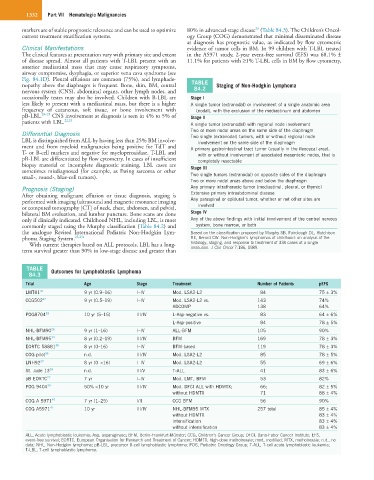
        markers are of stable prognostic relevance and can be used to optimize   80% in advanced-stage disease  (Table 84.3). The Children’s Oncol-
        current treatment stratification systems.             ogy Group (COG) demonstrated that minimal disseminated disease
                                                              at  diagnosis  has  prognostic  value,  as  indicated  by  flow  cytometric
        Clinical Manifestations                               evidence of tumor cells in BM. In 99 children with T-LBL treated
        The clinical features at presentation vary with primary site and extent   in the A5971 study, 2-year event-free survival (EFS) was 68.1% ±
        of  disease  spread.  Almost  all  patients  with T-LBL  present  with  an   11.1% for patients with ≥1% T-LBL cells in BM by flow cytometry,
        anterior  mediastinal  mass  that  may  cause  respiratory  symptoms,
        airway compromise, dysphagia, or superior vena cava syndrome (see
        Fig. 84.1D). Pleural effusions are common (75%), and lymphade-  TABLE
        nopathy above the diaphragm is frequent. Bone, skin, BM, central   84.2  Staging of Non-Hodgkin Lymphoma
        nervous system (CNS), abdominal organs, other lymph nodes, and
        occasionally testes may also be involved. Children with B-LBL are   Stage I
        less likely to present with a mediastinal mass, but there is a higher   A single tumor (extranodal) or involvement of a single anatomic area
        frequency  of  cutaneous,  soft  tissue,  or  bone  involvement  with   (nodal), with the exclusion of the mediastinum and abdomen
        pB-LBL. 20–23  CNS involvement at diagnosis is seen in 4% to 5% of   Stage II
        patients with LBL. 22,24                               A single tumor (extranodal) with regional node involvement
                                                               Two or more nodal areas on the same side of the diaphragm
        Differential Diagnosis                                 Two single (extranodal) tumors, with or without regional node
        LBL is distinguished from ALL by having less than 25% BM involve-  involvement on the same side of the diaphragm
        ment  and  from  myeloid  malignancies  being  positive  for TdT  and   A primary gastrointestinal tract tumor (usually in the ileocecal area),
        T- or B-cell markers and negative for myeloperoxidase. T-LBL and   with or without involvement of associated mesenteric nodes, that is
        pB-LBL are differentiated by flow cytometry. In cases of insufficient   completely resectable
        biopsy  material  or  incomplete  diagnostic  staining,  LBL  cases  are   Stage III
        sometimes  misdiagnosed  (for  example,  as  Ewing  sarcoma  or  other
        small-, round-, blue-cell tumors).                     Two single tumors (extranodal) on opposite sides of the diaphragm
                                                               Two or more nodal areas above and below the diaphragm
        Prognosis (Staging)                                    Any primary intrathoracic tumor (mediastinal, pleural, or thymic)
        After  obtaining  malignant  effusion  or  tissue  diagnosis,  staging  is   Extensive primary intraabdominal disease
        performed with imaging (ultrasound and magnetic resonance imaging   Any paraspinal or epidural tumor, whether or not other sites are
        or computed tomography [CT] of neck, chest, abdomen, and pelvis),   involved
        bilateral BM evaluation, and lumbar puncture. Bone scans are done   Stage IV
        only if clinically indicated. Childhood NHL, including LBL, is most   Any of the above findings with initial involvement of the central nervous
        commonly staged using the Murphy classification (Table 84.2) and   system, bone marrow, or both
        the  analogue  Revised  International  Pediatric  Non-Hodgkin  Lym-  Based on the classification proposed by Murphy SB, Fairclough DL, Hutchison
        phoma Staging System. 25,25a                           RE, Berard CW: Non-Hodgkin’s lymphomas of childhood: an analysis of the
           With current therapies based on ALL protocols, LBL has a long-  histology, staging, and response to treatment of 338 cases at a single
        term survival greater than 90% in low-stage disease and greater than   institution. J Clin Oncol 7:186, 1989.


          TABLE   Outcomes for Lymphoblastic Lymphoma
          84.3
         Trial               Age              Stage      Treatment                   Number of Patients  pEFS
         LMT81 31            9 yr (0.9–16)    I–IV       Mod. LSA2-L2                 84                 75 ± 3%
         CCG502 32           9 yr (0.5–19)    I–IV       Mod. LSA2-L2 vs.            143                 74%
                                                         ADCOMP                      138                 64%
         POG8704 33          10 yr (5–15)     III/IV     L-Asp-negative vs.           83                 64 ± 6%
                                                         L-Asp-positive               84                 78 ± 5%
         NHL-BFM90 26        9 yr (1–16)      I–IV       ALL-BFM                     105                 90%
         NHL-BFM95 34        8 yr (0.2–19)    III/IV     BFM                         169                 78 ± 3%
         EORTC 58881 35      8 yr (0–16)      I–IV       BFM-based                   119                 78 ± 3%
         COG pilot 36        n.d.             III/IV     Mod. LSA2-L2                 85                 78 ± 5%
         LNH92 37            8 yr (0–<16)     I–IV       Mod. LSA2-L2                 55                 69 ± 6%
         St. Jude 13 38      n.d.             III/V      T-ALL                        41                 83 ± 6%
         pB EORTC 22         7 yr             I–IV       Mod. LMT, BFM                53                 82%
         POG 9404 39         50% <10 yr       III/IV     Mod. DFCI ALL with HDMTX;    66;                82 ± 5%
                                                         without HDMTX                71                 88 ± 4%
         COG A 5971 40       7 yr (1–25)      I/II       CCG BFM                      56                 90%
         COG A5971 41        10 yr            III/IV     NHL-BFM95 MTX               257 total           85 ± 4%
                                                         without HDMTX                                   83 ± 4%
                                                         intensification                                 83 ± 4%
                                                         without intensification                         83 ± 4%
         ALL, Acute lymphoblastic leukemia; Asp, asparaginase; BFM, Berlin-Frankfurt-Münster; CCG, Children’s Cancer Group; DFCI, Dana-Faber Cancer Institute; EFS,
         event-free survival; EORTC, European Organisation for Research and Treatment of Cancer; HDMTX, high-dose methotrexate; mod, modified; MTX, methotrexate; n.d., no
         data; NHL, Non-Hodgkin lymphoma; pB-LBL, precursor B-cell lymphoblastic lymphoma; POG, Pediatric Oncology Group; T-ALL, T-cell acute lymphoblastic leukemia;
         T-LBL, T-cell lymphoblastic lymphoma.

