


Page 1503 - Hematology_ Basic Principles and Practice ( PDFDrive )
P. 1503
Chapter 84  Malignant Lymphomas in Childhood  1335


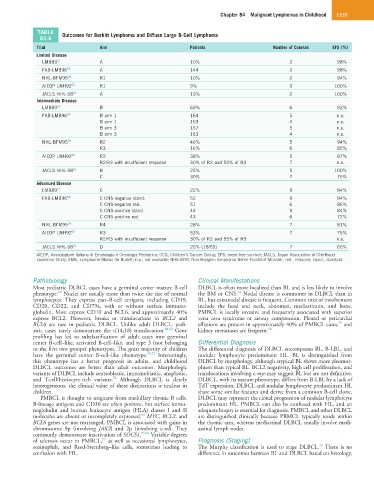
             TABLE   Outcomes for Burkitt Lymphoma and Diffuse Large B-Cell Lymphoma
              84.6
             Trial                Arm                          Patients                   Number of Courses   EFS (%)
             Limited Disease
               LMB89 57           A                            10%                              2              98%
               FAB-LMB96 62       A                            144                              2              98%
               NHL-BFM95 59       R1                           10%                              2              94%
               AIEOP LNH92 63     R1                           9%                               3             100%
               JACLS NHL-98  61   A                            19%                              2             100%
             Intermediate Disease
               LMB89 57           B                            69%                              6              92%
               FAB-LMB96 60       B arm 1                      164                              5              n.a.
                                  B arm 1                      163                              4              n.a.
                                  B arm 3                      167                              5              n.a.
                                  B arm 3                      163                              4              n.a.
               NHL-BFM95 59       R2                           46%                              5              94%
                                  R3                           16%                              6              85%
               AIEOP LNH92 63     R2                           38%                              5              87%
                                  R2/R3 with insufficient response  30% of R2 and 55% of R3     7              n.a.
               JACLS NHL-98 61    B                            25%                              5             100%
                                  C                            30%                              7              75%
             Advanced Disease
               LMB89 57           C                            22%                              9              84%
               FAB-LMB96 58       C CNS-negative stand.        52                               9              94%
                                  C CNS-negative red.          51                               6              86%
                                  C CNS-positive stand.        44                               9              84%
                                  C CNS-positive red.          43                               6              72%
               NHL-BFM95 59       R4                           28%                              7              81%
               AIEOP LNH92 63     R3                           53%                              7              75%
                                  R2/R3 with insufficient response  30% of R2 and 55% of R3                    n.a.
               JACLS NHL-98  61   D                            26% (18/69)                      7              66%
             AIEOP, Associazione Italiana di Ematologia e Oncologia Pediatrica; CCG, Children’s Cancer Group; EFS, event-free survival; JACLS, Japan Association of Childhood
             Leukemia Study; LMB, Lymphome Malins de Burkitt; n.a., not available; NHL-BFM, Non-Hodgkin lymphoma Berlin-Frankfurt-Münster; red., reduced; stand., standard.


            Pathobiology                                          Clinical Manifestations
            Most pediatric DLBCL cases have a germinal center mature B-cell   DLBCL is often more localized than BL and is less likely to involve
                                                                               24
                    69
            phenotype.  Nuclei are usually more than twice the size of normal   the BM or CNS.  Nodal disease is commoner in DLBCL than in
            lymphocytes.  They  express  pan–B-cell  antigens,  including  CD19,   BL, but extranodal disease is frequent. Common sites of involvement
            CD20,  CD22,  and  CD79a,  with  or  without  surface  immuno-  include  the  head  and  neck,  abdomen,  mediastinum,  and  bone.
            globulin. Most express CD10 and BCL6, and approximately 40%   PMBCL is locally invasive and frequently associated with superior
            express  BCL2.  However,  breaks  or  translocations  in  BCL2  and   vena  cava  syndrome  or  airway  compression.  Pleural  or  pericardial
                                                                                                                75
            BCL6  are  rare  in  pediatric  DLBCL.  Unlike  adult  DLBCL,  pedi-  effusions are present in approximately 40% of PMBCL cases,  and
            atric  cases  rarely  demonstrate  the  t(14;18)  translocation. 68,69   Gene   kidney metastases are frequent. 68
            profiling  has  led  to  subclassification  of  adult  cases  into  germinal
            center B-cell–like, activated B-cell–like, and type 3 (not belonging   Differential Diagnosis
            to the first two groups) phenotypes. The great majority of children   The differential diagnosis of DLBCL encompasses BL, B-LBL, and
            have  the  germinal  center  B-cell–like  phenotype. 69,71   Interestingly,   nodular  lymphocyte  predominant  HL.  BL  is  distinguished  from
            this  phenotype  has  a  better  prognosis  in  adults,  and  childhood   DLBCL by morphology, although atypical BL shows more pleomor-
            DLBCL  outcomes  are  better  than  adult  outcomes.  Morphologic   phism than typical BL. BCL2 negativity, high cell proliferation, and
            variants of DLBCL include centroblastic, immunoblastic, anaplastic,   translocations involving c-myc may suggest BL but are not definitive.
                                      72
            and  T-cell/histiocyte-rich  variants.   Although  DLBCL  is  clearly   DLBCL, with its mature phenotype, differs from B-LBL by a lack of
            heterogeneous, the clinical value of these distinctions is unclear in    TdT expression. DLBCL and nodular lymphocyte predominant HL
            children.                                             share some similar features and derive from a common B-cell clone.
              PMBCL is thought to originate from medullary thymic B cells.   DLBCL may represent the clonal progression of nodular lymphocyte
            B-lineage antigens and CD30 are often positive, but surface immu-  predominant HL. PMBCL can also be confused with HL, and an
            noglobulin  and  human  leukocyte  antigen  (HLA)  classes  I  and  II   adequate biopsy is essential for diagnosis. PMBCL and other DLBCL
                                               68
            molecules are absent or incompletely expressed.  MYC, BCL2, and   are distinguished clinically because PBMCL typically reside within
            BCL6 genes are not rearranged. PMBCL is associated with gains in   the thymic area, whereas mediastinal DLBCL usually involve medi-
            chromosome  9p  (involving  JAK2)  and  2p  (involving  c-rel).  They   astinal lymph nodes.
            commonly demonstrate inactivation of SOCS1. 73,74  Variable degrees
                                  75
            of sclerosis occur in PMBCL,  as well as occasional lymphocytes,   Prognosis (Staging)
                                                                                                         76
            eosinophils,  and  Reed-Sternberg–like  cells,  sometimes  leading  to   The  Murphy  classification  is  used  to  stage  DLBCL.  There  is  no
            confusion with HL.                                    difference in outcomes between BL and DLBCL based on histology,

