


Page 1508 - Hematology_ Basic Principles and Practice ( PDFDrive )
P. 1508
1340   Part VII  Hematologic Malignancies


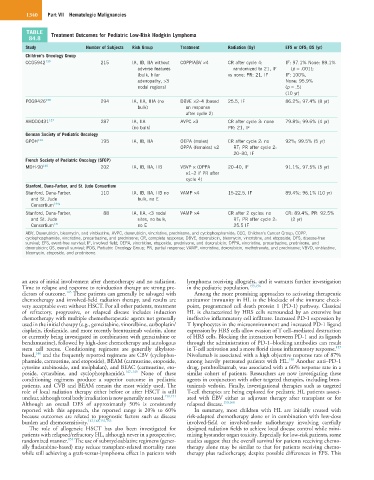
          TABLE   Treatment Outcomes for Pediatric Low-Risk Hodgkin Lymphoma
          84.8
         Study               Number of Subjects  Risk Group  Treatment      Radiation (Gy)    EFS or DFS; OS (yr)
         Children’s Oncology Group
         CCG5942 139              215       IA, IB, IIA without   COPP/ABV ×4  CR after cycle 4:   IF: 97.1% None: 89.1%
                                              adverse features               randomized to 21, IF  (p = .001);
                                              (bulk, hilar                  vs none; PR: 21, IF  IF: 100%,
                                              adenopathy, >3                                  None: 95.9%
                                              nodal regions)                                  (p = .5)
                                                                                              (10 yr)
         POG9426 138              294       IA, IIA, IIIA (no   DBVE ×2–4 (based   25.5, IF   86.2%; 97.4% (8 yr)
                                              bulk)           on response
                                                              after cycle 2)
         AHOD0431 137             287       IA, IIA         AVPC ×3         CR after cycle 3: none  79.8%; 99.6% (4 yr)
                                            (no bulk)                       PR: 21, IF
         German Society of Pediatric Oncology
         GPOH 134                 195       IA, IB, IIA     OEPA (males)    CR after cycle 2: no   92%; 99.5% (5 yr)
                                                            OPPA (females) ×2  RT; PR after cycle 2:
                                                                             20–30, IF
         French Society of Pediatric Oncology (SFOP)
         MDH-90 140               202       IA, IB, IIA, IIB  VBVP × (OPPA   20–40, IF        91.1%, 97.5% (5 yr)
                                                              ×1–2 if PR after
                                                              cycle 4)
         Stanford, Dana-Farber, and St. Jude Consortium
         Stanford, Dana-Farber,   110       IA, IB, IIA, IIB no   VAMP ×4   15-22.5, IF       89.4%; 96.1% (10 yr)
           and St. Jude                       bulk, no E
           Consortium 144a
         Stanford, Dana-Farber,    88       IA, IIA, <3 nodal   VAMP ×4     CR after 2 cycles: no   CR: 89.4%, PR: 92.5%
           and St. Jude                       sites, no bulk,                RT; PR after cycle 2:   (2 yr)
           Consortium 141                     no E                           25.5 IF
         ABV, Doxorubicin, bleomycin, and vinblastine; AVPC, doxorubicin, vincristine, prednisone, and cyclophosphamide; CCG, Children’s Cancer Group; COPP,
         cyclophosphamide, vincristine, procarbazine, and prednisone; CR, complete response; DBVE, doxorubicin, bleomycin, vincristine, and etoposide; DFS, disease-free
         survival; EFS, event-free survival; IF, involved field; OEPA, vincristine, etoposide, prednisone, and doxorubicin; OPPA, vincristine, procarbazine, prednisone, and
         doxorubicin; OS, overall survival; POG, Pediatric Oncology Group; PR, partial response; VAMP, vincristine, doxorubicin, methotrexate, and prednisone; VBVD, vinblastine,
         bleomycin, etoposide, and prednisone.


        an area of initial involvement after chemotherapy and no radiation.   lymphoma receiving allografts, and it warrants further investigation
        Time to relapse and response to reinduction therapy are strong pre-  in the pediatric population. 155,156
                       145
        dictors of outcome.  These patients can generally be salvaged with   Among the more promising approaches to activating therapeutic
        chemotherapy  and  involved-field  radiation  therapy,  and  results  are   antitumor immunity in HL is the blockade of the immune check-
        very acceptable even without HSCT. For all other patients, treatment   point, programmed cell death protein 1 (PD-1) pathway. Classical
        of  refractory,  progressive,  or  relapsed  disease  includes  induction   HL  is  characterized  by  HRS  cells  surrounded  by  an  extensive  but
        chemotherapy with multiple chemotherapeutic agents not generally   ineffective inflammatory cell infiltrate. Increased PD-1 expression by
        used in the initial therapy (e.g., gemcitabine, vinorelbine, carboplatin/  T lymphocytes in the microenvironment and increased PD-1 ligand
        cisplatin, ifosfamide, and more recently brentuximab vedotin, alone   expression by HRS cells allow evasion of T cell–mediated destruction
        or currently being investigated in combination with gemcitabine or   of HRS cells. Blocking the interaction between PD-1 and its ligands
        bendamustine), followed by high-dose chemotherapy and autologous   through the administration of PD-1–blocking antibodies can result
                                                                                                               157
        stem  cell  rescue.  Conditioning  regimens  are  generally  alkylator-  in T-cell activation and a more florid tissue inflammatory response.
             146
        based,  and the frequently reported regimens are CBV (cyclophos-  Nivolumab is associated with a high objective response rate of 87%
                                                                                               158
        phamide, carmustine, and etoposide), BEAM (carmustine, etoposide,   among heavily pretreated patients with HL.  Another anti–PD-1
        cytosine arabinoside, and melphalan), and BEAC (carmustine, eto-  drug, pembrolizumab, was associated with a 66% response rate in a
        poside,  cytarabine,  and  cyclophosphamide). 147–149   None  of  these   similar  cohort  of  patients.  Researchers  are  now  investigating  these
        conditioning  regimens  produce  a  superior  outcome  in  pediatric   agents in conjunction with other targeted therapies, including bren-
        patients, and CVB and BEAM remain the most widely used. The   tuximab  vedotin.  Finally,  investigational  therapies  such  as  targeted
        role of local radiation therapy either before or after HSCT is still   T-cell therapies are being explored for pediatric HL patients associ-
        unclear, although total body irradiation is now generally not used. 150,151    ated  with  EBV  either  as  adjuvant  therapy  after  transplant  or  for
        Although  an  overall  DFS  of  approximately  50%  is  consistently   relapsed disease. 159,160
        reported  with  this  approach,  the  reported  range  is  20%  to  60%   In  summary,  most  children  with  HL  are  initially  treated  with
        because  outcomes  are  related  to  prognostic  factors  such  as  disease   risk-adapted chemotherapy alone or in combination with low-dose
        burden and chemosensitivity. 147,148,152,153          involved-field  or  involved-node  radiotherapy  involving  carefully
           The  role  of  allogeneic  HSCT  has  also  been  investigated  for   designed radiation fields to achieve local disease control while mini-
        patients with relapsed/refractory HL, although never in a prospective,   mizing bystander organ toxicity. Especially for low-risk patients, some
                       154
        randomized manner.  The use of submyeloablative regimens (gener-  studies suggest that the overall survival for patients receiving chemo-
        ally fludarabine-based) may reduce transplant-related mortality rates   therapy alone may be similar to that for patients receiving chemo-
        while still achieving a graft-versus-lymphoma effect in patients with   therapy plus radiotherapy, despite possible differences in EFS. This

