


Page 1505 - Hematology_ Basic Principles and Practice ( PDFDrive )
P. 1505
Chapter 84  Malignant Lymphomas in Childhood  1337


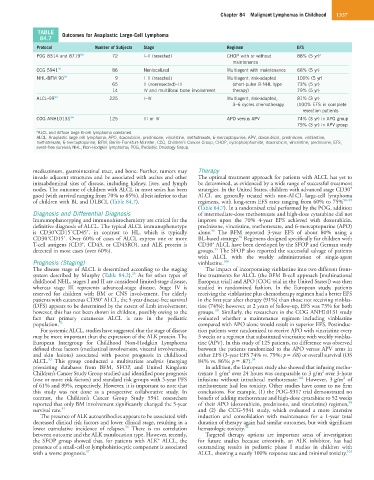
             TABLE   Outcomes for Anaplastic Large-Cell Lymphoma
              84.7
             Protocol           Number of Subjects  Stage                  Regimen                EFS
             POG 8314 and 8719 90     72        I–II (resected)            CHOP with or without   88% (5 yr) a
                                                                             maintenance
             CCG 5941 91              86        Nonlocalized               Multiagent with maintenance  68% (5 yr)
             NHL-BFM 90 92             9        I–II (resected)            Multiagent, risk-adapted   100% (5 yr)
                                      65        II (nonresected)–III         (short-pulse B-NHL type   73% (5 yr)
                                      14        IV and multifocal bone involvement  therapy)      79% (5 yr)
             ALCL-99 93              225        I–IV                       Multiagent, risk-adapted,   81% (3 yr)
                                                                             3–6 cycles chemotherapy  (100% EFS in complete
                                                                                                    resection patients
             COG ANHL0131 94         125        III or IV                  APO versus APV         74% (3 yr) in APO group
                                                                                                  79% (3 yr) in APV group
             a ALCL and diffuse large B-cell lymphoma combined.
             ALCL, Anaplastic large cell lymphoma; APO, doxorubicin, prednisone, vincristine, methotrexate, 6-mercaptopurine; APV, doxorubicin, prednisone, vinblastine,
             methotrexate, 6-mercaptopurine; BFM, Berlin-Frankfurt-Münster; CCG, Children’s Cancer Group; CHOP, cyclophosphamide, doxorubicin, vincristine, prednisone; EFS,
             event-free survival; NHL, Non-Hodgkin lymphoma; POG, Pediatric Oncology Group.


            mediastinum, gastrointestinal tract, and bone. Further, tumors may   Therapy
            invade adjacent structures and be associated with ascites and other   The optimal treatment approach for patients with ALCL has yet to
            intraabdominal sites of disease, including kidney, liver, and lymph   be determined, as evidenced by a wide range of successful treatment
                                                                                                                    +
            nodes. The outcome of children with ALCL in most series has been   strategies. In the United States, children with advanced stage CD30
            good (with survival ranging from 70% to 85%), albeit inferior to that   ALCL  are  generally  treated  with  non-ALCL  large-cell  lymphoma
            of children with BL and DLBCL (Table 84.7).           regimens, with long-term EFS rates ranging from 60% to 75% 90–93
                                                                  (Table 84.7). In a randomized trial performed by the POG, addition
            Diagnosis and Differential Diagnosis                  of intermediate-dose methotrexate and high-dose cytarabine did not
            Immunophenotyping and immunohistochemistry are critical for the   improve  upon  the  70%  4-year  EFS  achieved  with  doxorubicin,
            definitive diagnosis of ALCL. The typical ALCL immunophenotype   prednisone, vincristine, methotrexate, and 6-mercaptopurine (APO)
                        −
                             +
                   +
                                                                      98
            is  CD30 CD15 CD45 ,  in  contrast  to  HL,  which  is  typically   alone.   The  BFM  reported  3-year  EFS  of  about  80%  using  a
                 +
                      +
                                                                               92
            CD30 CD15 .  Over  60%  of  cases  of  ALCL  express  one  or  more   BL-based strategy.  Regimens designed specifically for children with
                                                                       +
                            +
            T-cell  antigens  (CD3 ,  CD43,  or  CD45RO),  and  ALK  protein  is   CD30  ALCL have been developed by the SFOP and German study
                                                                       99
            detected in most cases (over 60%).                    groups.  The SFOP also reported the successful salvage of patients
                                                                  with  ALCL  with  the  weekly  administration  of  single-agent
            Prognosis (Staging)                                   vinblastine. 100
            The disease stage of ALCL is determined according to the staging   The impact of incorporating vinblastine into two different front-
                                            25
            system  described  by  Murphy  (Table  84.2).   As  for  other  types  of   line treatments for ALCL (the BFM B-cell approach [multinational
            childhood NHL, stages I and II are considered limited-stage disease,   European trial] and APO [COG trial in the United States]) was then
            whereas  stage  III  represents  advanced-stage  disease.  Stage  IV  is   studied  in  randomized  fashion.  In  the  European  study,  patients
            reserved  for  children  with  BM  or  CNS  involvement.  For  elderly   receiving the vinblastine plus chemotherapy regimen had a better EFS
                                  +
            patients with cutaneous CD30  ALCL, the 5-year disease-free survival   in the first year after therapy (91%) than those not receiving vinblas-
            (DFS) appears to be determined by the extent of limb involvement;   tine (74%); however, at 2 years of follow-up, EFS was 73% for both
                                                                       101
            however, this has not been shown in children, possibly owing to the   groups.  Similarly, the researchers in the COG ANHL0131 study
            fact  that  primary  cutaneous  ALCL  is  rare  in  the  pediatric   evaluated  whether  a  maintenance  regimen  including  vinblastine
            population. 95                                        compared with APO alone would result in superior EFS. Postinduc-
              For systemic ALCL, studies have suggested that the stage of disease   tion patients were randomized to receive APO with vincristine every
            may be more important than the expression of the ALK protein. The   3 weeks or a regimen that substituted vincristine with weekly vinblas-
            European  Intergroup  for  Childhood  Non-Hodgkin  Lymphoma   tine (APV). In this study of 125 patients, no difference was observed
            defined three factors (mediastinal involvement, visceral involvement,   between the patients randomized to the APO versus APV arms in
            and  skin  lesions)  associated  with  poorer  prognosis  in  childhood   either EFS (3-year EFS 74% vs. 79%; p = .68) or overall survival (OS
                 93
            ALCL.   This  group  conducted  a  multivariate  analysis  (merging   84% vs. 86%; p = .87). 94
            preexisting  databases  from  BFM,  SFOP,  and  United  Kingdom   In addition, the European study also showed that infusing metho-
                                                                            2
                                                                                                          2
            Children’s Cancer Study Group studies) and identified poor prognosis   trexate 1 g/m  over 24 hours was comparable to 3 g/m  over 3-hour
                                                                                                   102
                                                                                                                 2
            (one or more risk factors) and standard risk groups with 5-year PFS   infusions  without  intrathecal  methotrexate.   However,  3 g/m   of
            of 61% and 89%, respectively. However, it is important to note that   methotrexate had less toxicity. Other studies have come to no firm
            this  study  was  not  done  as  a  prospective  collaborative  study.  In   conclusions. For example, (1) the POG-9317 trial demonstrated no
            contrast,  the  Children’s  Cancer  Group  Study  5941  researchers   benefit of adding methotrexate and high-dose cytarabine to 52 weeks
                                                                                                                   98
            reported that only BM involvement significantly changed the 5-year   of their APO (doxorubicin, prednisone, and vincristine) regimen,
            survival rate. 91                                     and  (2)  the  CCG-5941  study,  which  evaluated  a  more  intensive
              The presence of ALK autoantibodies appears to be associated with   induction  and  consolidation  with  maintenance  for  a  1-year  total
            decreased clinical risk factors and lower clinical stage, resulting in a   duration of therapy again had similar outcomes, but with significant
                                          96
            lower  cumulative  incidence  of  relapses.   There  is  no  correlation   hematologic toxicity. 92
            between outcome and the ALK translocation type. However, recently,   Targeted  therapy  options  are  important  areas  of  investigation
                                                     +
            the  SFOP  group  showed  that,  for  patients  with  ALK   ALCL,  the   for  future  studies  because  crizotinib,  an  ALK  inhibitor,  has  had
            presence of a small-cell or lymphohistiocytic component is associated   outstanding  results  in  pediatric  phase  I  studies  in  children  with
                                                                                                                  103
            with a worse prognosis. 97                            ALCL, showing a nearly 100% response rate and minimal toxicity.

