


Page 1530 - Hematology_ Basic Principles and Practice ( PDFDrive )
P. 1530
Chapter 85  T-Cell Lymphomas  1357


            status  was  not  available)  with  superior  overall  survival  compared     In  conclusion,  aSCT  can  be  offered  in  relapsed  and  refractory
            with aSCT.                                            PTCL based on the following observations: (1) in all studies survival
              During the last 15 years, RIC regimens have been increasingly   curves seem to reach a plateau after 24–36 months, suggesting the
            used in patients with relapsed lymphomas in order to reduce NRM,   potential curability of the disease; (2) delaying aSCT too long from
            thus making this strategy feasible in older adults or heavily pretreated   the  time  of  diagnosis  may  significantly  compromise  the  outcome,
            patients.  In  2004  one  of  the  first  reports  of  RIC  aSCT  in  PTCL   thus aSCT should be performed during a chemosensitive relapse; (3)
            patients reported that 56% of patients were alive and in CR after 1.4   RIC regimens have increased the feasibility of performing aSCT by
            years. The first prospective study evaluated the outcome of 17 relapsed   reducing NRM, and aSCT may be used in older and heavily pre-
            PTCL  patients  after  a  fludarabine-based  RIC  regimen:  14  of  17   treated patients. Hopefully in the future we will see if the combination
            enrolled patients were alive (12 in CR) after a median follow-up of   of new agents with aSCT can improve the outcomes of a significant
            28 months, with an estimated 3-year NRM, OS, and PFS of 6%,   proportion of patients with refractory disease.
            81%, and 64%, respectively.
              In this study, there were some data suggesting the existence of a
            GvL effect, based on the following observations: (1) the achievement   Emerging New Drugs for PTCL
            of durable responses with aSCT in patients who had already failed a
            prior autologous SCT; and (2) the demonstration of clinical responses   There is little question that one of the most promising new areas in
            to donor lymphocyte infusions. These preliminary results were sup-  PTCL research is new drug development. Over the past several years,
            ported by a larger Italian multicenter retrospective study with a longer   four new drugs, all with relatively unique mechanisms of action, have
            follow-up. In this study, the 5-year outcomes showed a NRM, OS,   been approved for the treatment of patients with relapsed or refrac-
            and PFS of 12%, 50%, and 40%, respectively, and a plateau in the   tory disease. These drugs, which all now have substantial data dem-
            survival curves after 36 months, suggesting a probable cure for these   onstrating their marked single-agent activity in these diseases, have
            patients. Following multivariate analysis, being older than 45 years   created a unique opportunity to build non-CHOP–based platforms
            and having refractory disease were independent prognostic factors,   for treatment. In addition to the four drugs already approved, many
            highlighting that timing of an aSCT can significantly influence the   new drugs are in various stages of clinical development, with very
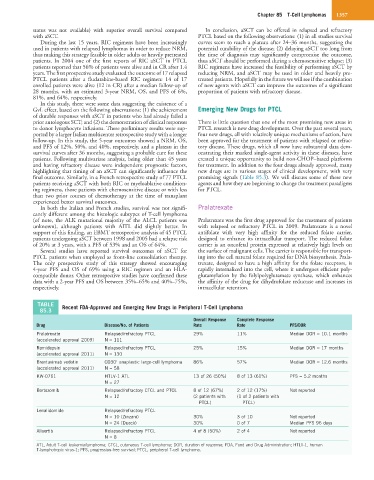
            final outcome. Similarly, in a French retrospective study of 77 PTCL   promising signals (Table 85.3). We will discuss some of these new
            patients receiving aSCT with both RIC or myeloablative condition-  agents and how they are beginning to change the treatment paradigms
            ing regimens, those patients with chemosensitive disease or with less   for PTCL.
            than  two  prior  courses  of  chemotherapy  at  the  time  of  transplant
            experienced better survival outcomes.
              In both the Italian and French studies, survival was not signifi-  Pralatrexate
            cantly different among the histologic subtypes of T-cell lymphoma
            (of  note,  the  ALK  mutational  majority  of  the  ALCL  patients  was   Pralatrexate was the first drug approved for the treatment of patients
            unknown),  although  patients  with  AITL  did  slightly  better.  In   with  relapsed  or  refractory  PTCL  in  2009.  Pralatrexate  is  a  novel
            support of this finding, an EBMT retrospective analysis of 45 PTCL   antifolate  with  very  high  affinity  for  the  reduced  folate  carrier,
            patients undergoing aSCT between 1998 and 2005 had a relapse risk   designed  to  enhance  its  intracellular  transport. The  reduced  folate
            of 20% at 3 years, with a PFS of 53% and an OS of 64%.  carrier is an oncofetal protein expressed at relatively high levels on
              Several  studies  have  reported  survival  outcomes  of  aSCT  for   the surface of malignant cells. The carrier is responsible for transport-
            PTCL patients when employed as front-line consolidation therapy.   ing into the cell natural folate required for DNA biosynthesis. Prala-
            The  only  prospective  study  of  this  strategy  showed  encouraging   trexate, designed to have a high affinity for the folate receptors, is
            4-year  PFS  and  OS  of  69%  using  a  RIC  regimen  and  an  HLA-  rapidly internalized into the cell, where it undergoes efficient poly-
            compatible donor. Other retrospective studies have confirmed these   glutamylation  by  the  folylpolyglutamate  synthase,  which  enhances
            data with a 2-year PFS and OS between 35%–65% and 40%–75%,   the affinity of the drug for dihydrofolate reductase and increases its
            respectively.                                         intracellular retention.

             TABLE   Recent FDA-Approved and Emerging New Drugs in Peripheral T-Cell Lymphoma
              85.3
                                                                Overall Response   Complete Response
             Drug                  Disease/No. of Patients      Rate           Rate             PFS/DOR
             Pralatrexate          Relapsed/refractory PTCL     29%            11%              Median DOR = 10.1 months
             (accelerated approval 2009)  N = 111
             Romidepsin            Relapsed/refractory PTCL     25%            15%              Median DOR = 17 months
             (accelerated approval 2011)  N = 130
                                       +
             Brentuximab vedotin   CD30  anaplastic large-cell lymphoma  86%   57%              Median DOR = 12.6 months
             (accelerated approval 2011)  N = 58
             KW-0761               HTLV-1 ATL                   13 of 26 (50%)  8 of 13 (61%)   PFS = 5.2 months
                                   N = 27
             Bortezomib            Relapsed/refractory CTCL and PTCL  8 of 12 (67%)  2 of 12 (17%)  Not reported
                                   N = 12                       (2 patients with   (1 of 2 patients with
                                                                  PTCL)         PTCL)
             Lenalidomide          Relapsed/refractory PTCL
                                   N = 10 (Zinzani)             30%            3 of 10          Not reported
                                   N = 24 (Dueck)               30%            0 of 7           Median PFS 96 days
             Alisertib             Relapsed/refractory PTCL     4 of 8 (50%)   2 of 4           Not reported
                                   N = 8
             ATL, Adult T-cell leukemia/lymphoma; CTCL, cutaneous T-cell lymphoma; DOR, duration of response; FDA, Food and Drug Administration; HTLV-1, human
             T-lymphotropic virus-1; PFS, progression-free survival; PTCL, peripheral T-cell lymphoma.

