


Page 1535 - Hematology_ Basic Principles and Practice ( PDFDrive )
P. 1535
1362   Part VII  Hematologic Malignancies


        may influence disease activity. Several reports suggested that exposure
        to metals or their salts, pesticides or herbicides, and organic solvents
        (halogenated  or  aromatic  hydrocarbons)  could  be  related  to  the
        development  of  MF/SS.  However,  two  well-designed  case-control
        studies have failed to support these observations.
           Various theories have been advanced to explain the epidermotro-
        pism of malignant T cells in MF/SS. Organ-specific affinity to skin
        and other organs has been recognized in subsets of normal T cells.
        Homing of CTCL cells to the skin is probably mediated by more
        than one adhesion receptor mechanism. CTCL cells express cutane-
        ous lymphocyte antigen, a skin-homing receptor that interacts with
        E-selectin expressed by dermal venules. Furthermore, the cutaneous
        lymphocyte antigens T lymphocytes also typically express the CCR4
        chemokine  receptor,  which  binds  to  chemokines  produced  by  the
        skin, such as the CC-chemokine ligands 17 and 22. Peripheral blood
        mononuclear cells bind to cultured keratinocytes exposed to IFN-γ.
        The major histocompatibility complex class II proteins along with
        intercellular  adhesion  molecule  1  present  on  keratinocytes,  and
        attract and bind lymphocytes. Additional chemokine receptors, such
        as CXC chemokine receptors 3 and 4, as well as unique integrins,
        have been shown to have corresponding ligands or integrin receptors
        on  dermal  Langerhans  cells,  suggesting  a  relationship  between  the
        malignant T cells and host immune cells. The chemokine receptor
        CCR4 is expressed by a spectrum of CTCL cells, and an anti-CCR4
        monoclonal antibody has significant activity against these diseases.
           An  additional  feature  of  MF/SS  cells  is  the  production  of  a
        cytokine profile consistent with Th2 cells. Th2 cells produce IL-4,
        IL-5, and IL-6, and they are inhibited by IFN-γ. The expression of
        immunomodulatory molecule IL-17 is also increased in MF and SS.
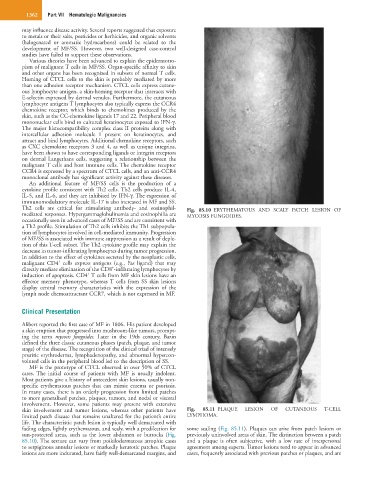
        Th2  cells  are  critical  for  stimulating  antibody-  and  eosinophil-  Fig.  85.10  ERYTHEMATOUS  AND  SCALY  PATCH  LESION  OF
        mediated responses. Hypergammaglobulinemia and eosinophilia are   MYCOSIS FUNGOIDES.
        occasionally seen in advanced cases of MF/SS and are consistent with
        a Th2 profile. Stimulation of Th2 cells inhibits the Th1 subpopula-
        tion of lymphocytes involved in cell-mediated immunity. Progression
        of MF/SS is associated with immune suppression as a result of deple-
        tion of this T-cell subset. The Th2 cytokine profile may explain the
        decrease in tumor-infiltrating lymphocytes during tumor progression.
        In addition to the effect of cytokines secreted by the neoplastic cells,
                    +
        malignant  CD4   cells  express  antigens  (e.g.,  Fas  ligand)  that  may
                                      +
        directly mediate elimination of the CD8 -infiltrating lymphocytes by
                              +
        induction of apoptosis. CD4  T cells from MF skin lesions have an
        effector  memory  phenotype,  whereas T  cells  from  SS  skin  lesions
        display  central  memory  characteristics  with  the  expression  of  the
        lymph node chemoattractant CCR7, which is not expressed in MF.
        Clinical Presentation

        Alibert reported the first case of MF in 1806. His patient developed
        a skin eruption that progressed into mushroom-like tumors, prompt-
        ing  the  term  mycosis  fungoides.  Later  in  the  19th  century,  Bazin
        defined the three classic cutaneous phases (patch, plaque, and tumor
        stage) of the disease. The recognition of the clinical triad of intensely
        pruritic erythroderma, lymphadenopathy, and abnormal hypercon-
        voluted cells in the peripheral blood led to the description of SS.
           MF is the prototype of CTCL observed in over 50% of CTCL
        cases. The  initial  course  of  patients  with  MF  is  usually  indolent.
        Most patients give a history of antecedent skin lesions, usually non-
        specific  erythematous  patches  that  can  mimic  eczema  or  psoriasis.
        In many cases, there is an orderly progression from limited patches
        to more generalized patches, plaques, tumors, and nodal or visceral
        involvement.  However,  some  patients  may  present  with  extensive
        skin  involvement  and  tumor  lesions,  whereas  other  patients  have   Fig.   85.11  PLAQUE   LESION   OF   CUTANEOUS   T-CELL
        limited patch disease that remains unaltered for the patient’s entire   LYMPHOMA.
        life. The characteristic patch lesion is typically well demarcated with
        fading edges, lightly erythematous, and scaly, with a predilection for   some scaling (Fig. 85.11). Plaques can arise from patch lesions or
        sun-protected  areas,  such  as  the  lower  abdomen  or  buttocks  (Fig.   previously uninvolved areas of skin. The distinction between a patch
        85.10). The texture can vary from poikilodermatous atrophic cases   and  a  plaque  is  often  subjective,  with  a  low  rate  of  interpersonal
        to serpiginous annular lesions or markedly keratotic patches. Plaque   agreement among experts. Tumor lesions tend to appear in advanced
        lesions are more indurated, have fairly well-demarcated margins, and   cases, frequently associated with previous patches or plaques, and are

