


Page 1525 - Hematology_ Basic Principles and Practice ( PDFDrive )
P. 1525
1352   Part VII  Hematologic Malignancies


                                       PERIPHERAL T-CELL LYMPHOMA NOT OTHERWISE SPECIFIED
                                                             Prognostic Index for PTCL-NOS
                                    100
                                                                         0
                                    90                                   1
                                    80                                   2 3/4
                                   Overall survival (%)  60
                                    70
                                    50
                                    40
                                    30
                                    20
                                    10
                                     0
                                  A     0  1  2  3  4  5  6  7  8  9 10 11 12 13 14 15 16 17 18

                                                           Time (years)
                                       PERIPHERAL T-CELL LYMPHOMA NOT OTHERWISE SPECIFIED
                                    100
                                    90
                                                             Prognostic Index for PTCL-NOS
                                    80
                                   Failure-free survival (%)  60        1 2 3/4
                                                                        0
                                    70
                                    50
                                    40
                                    30
                                    20
                                    10
                                     0
                                        0  1  2  3  4  5  6  7  8  9 10 11 12 13 14 15 16 17 18
                                  B                        Time (years)
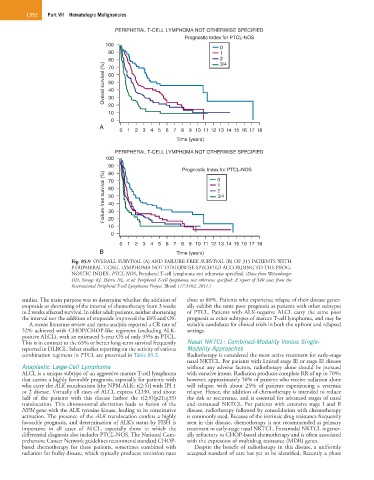
                        Fig. 85.9  OVERALL SURVIVAL (A) AND FAILURE-FREE SURVIVAL (B) OF 315 PATIENTS WITH
                        PERIPHERAL T-CELL LYMPHOMA NOT OTHERWISE SPECIFIED ACCORDING TO THE PROG-
                        NOSTIC INDEX. PTCL-NOS, Peripheral T-cell lymphoma not otherwise specified. (Data from Weisenburger
                        DD, Savage KJ, Harris NL, et al: Peripheral T-cell lymphoma, not otherwise specified: A report of 340 cases from the
                        International Peripheral T-cell Lymphoma Project. Blood 117:3402, 2011.)
        studies. The main purpose was to determine whether the addition of   close to 80%. Patients who experience relapse of their disease gener-
        etoposide or shortening of the interval of chemotherapy from 3 weeks   ally exhibit the same poor prognosis as patients with other subtypes
        to 2 weeks affected survival. In older adult patients, neither shortening   of  PTCL.  Patients  with  ALK-negative  ALCL  carry  the  same  poor
        the interval nor the addition of etoposide improved the EFS and OS.  prognosis as other subtypes of mature T-cell lymphoma, and may be
           A recent literature review and meta-analysis reported a CR rate of   suitable candidates for clinical trials in both the upfront and relapsed
        52% achieved with CHOP/CHOP-like regimens (excluding ALK-  settings.
        positive ALCL), with an estimated 5-year OS of only 35% in PTCL.
        This is in contrast to the 65% or better long-term survival frequently   Nasal NKTCL: Combined-Modality Versus Single-
        reported in DLBCL. Select studies reporting on the activity of various   Modality Approaches
        combination regimens in PTCL are presented in Table 85.2.  Radiotherapy is considered the most active treatment for early-stage
                                                              nasal NKTCL. For patients with limited stage IE or stage IE disease
        Anaplastic Large-Cell Lymphoma                        without any adverse factors, radiotherapy alone should be pursued
        ALCL is a unique subtype of an aggressive mature T-cell lymphoma   with curative intent. Radiation produces complete RR of up to 70%;
        that carries a highly favorable prognosis, especially for patients with   however, approximately 50% of patients who receive radiation alone
        who carry the ALK translocation [the NPM-ALK; t(2:5)] with IPI 1   will  relapse,  with  about  25%  of  patients  experiencing  a  systemic
        or 2 disease. Virtually all cases of ALCL express CD30, and about   relapse. Hence, the addition of chemotherapy is intended to reduce
        half  of  the  patients  with  this  disease  harbor  the  t(2;5)(p21;q35)   the risk or recurrence, and is essential for advanced stages of nasal
        translocation. This  chromosomal  aberration  leads  to  fusion  of  the   and extranasal NKTCL. For patients with extensive stage I and II
        NPM gene with the ALK tyrosine kinase, leading to its constitutive   disease, radiotherapy followed by consolidation with chemotherapy
        activation. The presence of the ALK translocation confers a highly   is commonly used. Because of the intrinsic drug resistance frequently
        favorable prognosis, and determination of ALK’s status by FISH is   seen in this disease, chemotherapy is not recommended as primary
        imperative  in  all  cases  of  ALCL,  especially  those  in  which  the    treatment in early-stage nasal NKTCL. Extranodal NKTCL is gener-
        differential diagnosis also includes PTCL-NOS. The National Com-  ally refractory to CHOP-based chemotherapy and is often associated
        prehensive Cancer Network guidelines recommend standard CHOP-  with the expression of multidrug resistance (MDR) genes.
        based  chemotherapy  for  these  patients,  sometimes  combined  with   Despite the benefit of radiotherapy in this disease, a uniformly
        radiation for bulky disease, which typically produces remission rates   accepted standard of care has yet to be identified. Recently a phase

