


Page 1533 - Hematology_ Basic Principles and Practice ( PDFDrive )
P. 1533
1360   Part VII  Hematologic Malignancies


        PFS  and  duration  of  response  were  3.6  and  3.5  months,   marked activity. It is likely that a systematic analysis of agents with
        respectively.                                         lineage-specific activity in PTCL will form the basis of novel, PTCL-
                                                              specific treatment platforms that will create future non-CHOP–based
        Sorafenib                                             opportunities for front-line care.
        Sorafenib is a multikinase inhibitor that modulates multiple intracel-
        lular pathways, including PDGFR/VEGFR and MAP kinase signal-
        ing.  One  report  evaluated  sorafenib  in  12  patients  with  T-cell   CUTANEOUS T-CELL LYMPHOMAS
        lymphomas  (three  with  PTCL  and  nine  with  CTCL).  While  the
        population  was  not  that  heavily  treated  (median  number  or  prior   This portion of the chapter focuses on the disorders that would be
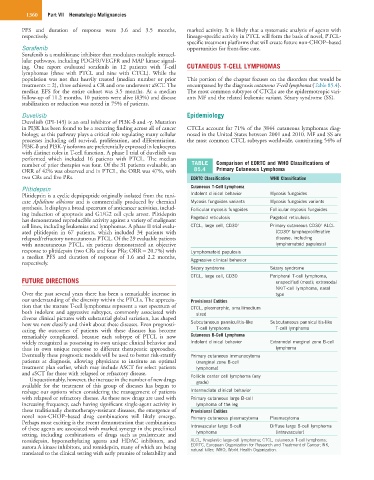
        treatments = 2), three achieved a CR and one underwent aSCT. The   encompassed by the diagnosis cutaneous T-cell lymphoma (Table 85.4).
        median  EFS  for  the  entire  cohort  was  3.5  months.  At  a  median   The most common subtypes of CTCLs are the epidermotropic vari-
        follow-up of 11.2 months, 10 patients were alive (83%) and disease   ants MF and the related leukemic variant, Sézary syndrome (SS).
        stabilization or reduction was noted in 75% of patients.

        Duvelisib                                             Epidemiology
        Duvelisib (IPI-145) is an oral inhibitor of PI3K-δ and -γ. Mutation
        in PI3K has been found to be a recurring finding across all of cancer   CTCLs account for 71% of the 3844 cutaneous lymphomas diag-
        biology, as this pathway plays a critical role regulating many cellular   nosed in the United States between 2001 and 2010. MF and SS are
        processes  including  cell  survival,  proliferation,  and  differentiation.   the most common CTCL subtypes worldwide, constituting 54% of
        PI3K-δ and PI3K-γ isoforms are preferentially expressed in leukocytes
        with distinct roles in T-cell function. A phase I trial of duvelisib was
        performed  which  included  16  patients  with  PTCL.  The  median
        number of prior therapies was four. Of the 31 patients evaluable, an   TABLE   Comparison of EORTC and WHO Classifications of
        ORR of 42% was observed and in PTCL, the ORR was 47%, with   85.4  Primary Cutaneous Lymphoma
        two CRs and five PRs.                                  EORTC Classification      WHO Classification
        Plitidepsin                                            Cutaneous T-Cell Lymphoma
        Plitidepsin is a cyclic depsipeptide originally isolated from the tuni-  Indolent clinical behavior  Mycosis fungoides
        cate  Aplidium  albicans  and  is  commercially  produced  by  chemical   Mycosis fungoides variants  Mycosis fungoides variants
        synthesis. It displays a broad spectrum of anticancer activities, includ-  Follicular mycosis fungoides  Follicular mycosis fungoides
        ing induction of apoptosis and G1/G2 cell cycle arrest. Plitidepsin
        has demonstrated reproducible activity against a variety of malignant   Pagetoid reticulosis  Pagetoid reticulosis
                                                                                                          +
        cell lines, including leukemias and lymphomas. A phase II trial evalu-  CTCL, large cell, CD30 +  Primary cutaneous CD30  ALCL
                                                                                               +
        ated  plitidepsin  in  67  patients,  which  included  34  patients  with          (CD30  lymphoproliferative
        relapsed/refractory noncutaneous PTCL. Of the 29 evaluable patients                disease, including
        with  noncutaneous  PTCL,  six  patients  demonstrated  an  objective              lymphomatoid papulosis)
        response to plitidepsin (two CRs and four PRs; ORR = 20.7%) with   Lymphomatoid papulosis
        a  median  PFS  and  duration  of  response  of  1.6  and  2.2  months,   Aggressive clinical behavior
        respectively.
                                                               Sézary syndrome           Sézary syndrome
                                                               CTCL, large cell, CD30 −  Peripheral T-cell lymphoma,
        FUTURE DIRECTIONS                                                                  unspecified (most); extranodal
                                                                                           NK/T-cell lymphoma, nasal
        Over the past several years there has been a remarkable increase in                type
        our understanding of the diversity within the PTCLs. The apprecia-  Provisional Entities
        tion that the mature T-cell lymphomas represent a vast spectrum of   CTCL, pleomorphic, small/medium
        both  indolent  and  aggressive  subtypes,  commonly  associated  with   sized
        diverse clinical pictures with substantial global variation, has shaped
        how we now classify and think about these diseases. Even prognosti-  Subcutaneous panniculitis-like   Subcutaneous panniculitis-like
        cating  the  outcomes  of  patients  with  these  diseases  has  become   T-cell lymphoma  T-cell lymphoma
        remarkably  complicated,  because  each  subtype  of  PTCL  is  now   Cutaneous B-Cell Lymphoma
        widely recognized as possessing its own unique clinical behavior and   Indolent clinical behavior  Extranodal marginal zone B-cell
        thus  its  own  unique  response  to  different  therapeutic  approaches.          lymphoma
        Eventually these prognostic models will be used to better risk-stratify   Primary cutaneous immunocytoma
        patients  at  diagnosis,  allowing  physicians  to  institute  an  optimal   (marginal zone B-cell
        treatment plan earlier, which may include ASCT for select patients   lymphoma)
        and aSCT for those with relapsed or refractory disease.  Follicle center cell lymphoma (any
           Unquestionably, however, the increase in the number of new drugs
        available  for  the  treatment  of  this  group  of  diseases  has  begun  to   grade)
        reshape our options when considering the management of patients   Intermediate clinical behavior
        with relapsed or refractory disease. As these new drugs are used with   Primary cutaneous large B-cell
        increasing frequency, each having significant single-agent activity in   lymphoma of the leg
        these traditionally chemotherapy-resistant diseases, the emergence of   Provisional Entities
        novel  non-CHOP–based  drug  combinations  will  likely  emerge.   Primary cutaneous plasmacytoma  Plasmacytoma
        Perhaps most exciting is the recent demonstration that combinations
        of these agents are associated with marked synergy in the preclinical   Intravascular large B-cell   Diffuse large B-cell lymphoma
        setting,  including  combinations  of  drugs  such  as  pralatrexate  and   lymphoma  (intravascular)
        romidepsin,  hypomethylating  agents  and  HDAC  inhibitors,  and   ALCL, Anaplastic large-cell lymphoma; CTCL, cutaneous T-cell lymphoma;
        aurora A kinase inhibitors, and romidepsin, many of which are being   EORTC, European Organization for Research and Treatment of Cancer; NK,
                                                               natural killer; WHO, World Health Organization.
        translated to the clinical setting with early promise of tolerability and

