


Page 1598 - Hematology_ Basic Principles and Practice ( PDFDrive )
P. 1598
1424   Part VII  Hematologic Malignancies


                        A                                      B

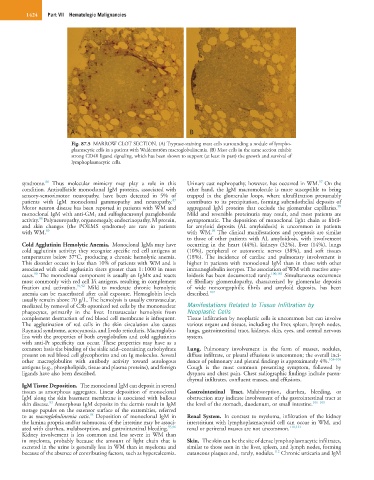
                        Fig. 87.5  MARROW CLOT SECTION. (A) Tryptase-staining mast cells surrounding a nodule of lympho-
                        plasmacytic cells in a patient with Waldenström macroglobulinemia. (B) Mast cells in the same section exhibit
                        strong CD40 ligand signaling, which has been shown to support (at least in part) the growth and survival of
                        lymphoplasmacytic cells.


                                                                                                         97
                86
        syndrome.   Thus  molecular  mimicry  may  play  a  role  in  this   Urinary cast nephropathy, however, has occurred in WM.  On the
        condition. Antisulfatide monoclonal IgM proteins, associated with   other  hand,  the  IgM  macromolecule  is  more  susceptible  to  being
        sensory-sensorimotor  neuropathy,  have  been  detected  in  5%  of   trapped  in  the  glomerular  loops,  where  ultrafiltration  presumably
                                                         87
        patients  with  IgM  monoclonal  gammopathy  and  neuropathy.    contributes to its precipitation, forming subendothelial deposits of
                                                                                                               98
        Motor neuron disease has been reported in patients with WM and   aggregated  IgM  proteins  that  occlude  the  glomerular  capillaries.
        monoclonal IgM with anti-GM 1  and sulfoglucuronyl paragloboside   Mild  and  reversible  proteinuria  may  result,  and  most  patients  are
              88
        activity.  Polyneuropathy, organomegaly, endocrinopathy, M protein,   asymptomatic. The deposition of monoclonal light chain as fibril-
        and  skin  changes  (the  POEMS  syndrome)  are  rare  in  patients    lar  amyloid  deposits  (AL  amyloidosis)  is  uncommon  in  patients
                                                                      99
        with WM. 89                                           with  WM.  The  clinical  manifestations  and  prognosis  are  similar
                                                              to  those  of  other  patients  with  AL  amyloidosis,  with  involvement
        Cold Agglutinin Hemolytic Anemia.  Monoclonal IgMs may have   occurring  in  the  heart  (44%),  kidneys  (32%),  liver  (14%),  lungs
        cold agglutinin activity; they recognize specific red cell antigens at   (10%),  peripheral  or  autonomic  nerves  (38%),  and  soft  tissues
        temperatures  below  37°C,  producing  a  chronic  hemolytic  anemia.   (18%).  The  incidence  of  cardiac  and  pulmonary  involvement  is
        This disorder occurs in less than 10% of patients with WM and is   higher in patients with monoclonal IgM than in those with other
        associated with cold agglutinin titers greater than 1 : 1000 in most   immunoglobulin isotypes. The association of WM with reactive amy-
            90
        cases.  The monoclonal component is usually an IgMκ and reacts   loidosis has been documented rarely. 100,101  Simultaneous occurrence
        most commonly with red cell I/i antigens, resulting in complement   of  fibrillary  glomerulopathy,  characterized  by  glomerular  deposits
        fixation  and  activation. 91,92   Mild  to  moderate  chronic  hemolytic   of  wide  noncongophilic  fibrils  and  amyloid  deposits,  has  been
        anemia can be exacerbated after cold exposure. Hemoglobin levels   described. 102
        usually remain above 70 g/L. The hemolysis is usually extravascular,
        mediated by removal of C3b opsonized red cells by the mononuclear   Manifestations Related to Tissue Infiltration by
        phagocytes,  primarily  in  the  liver.  Intravascular  hemolysis  from   Neoplastic Cells
        complement destruction of red blood cell membrane is infrequent.   Tissue infiltration by neoplastic cells is uncommon but can involve
        The  agglutination  of  red  cells  in  the  skin  circulation  also  causes   various organs and tissues, including the liver, spleen, lymph nodes,
        Raynaud syndrome, acrocyanosis, and livedo reticularis. Macroglobu-  lungs, gastrointestinal tract, kidneys, skin, eyes, and central nervous
        lins with the properties of both cryoglobulins and cold agglutinins   system.
        with  anti-Pr  specificity  can  occur. These  properties  may  have  as  a
        common basis the binding of the sialic acid–containing carbohydrate   Lung.  Pulmonary  involvement  in  the  form  of  masses,  nodules,
        present on red blood cell glycophorins and on Ig molecules. Several   diffuse infiltrate, or pleural effusions is uncommon; the overall inci-
        other  macroglobulins  with  antibody  activity  toward  autologous   dence of pulmonary and pleural findings is approximately 4%. 103–105
        antigens (e.g., phospholipids, tissue and plasma proteins), and foreign   Cough  is  the  most  common  presenting  symptom,  followed  by
        ligands have also been described.                     dyspnea and chest pain. Chest radiographic findings include paren-
                                                              chymal infiltrates, confluent masses, and effusions.
        IgM Tissue Deposition.  The monoclonal IgM can deposit in several
        tissues  as  amorphous  aggregates.  Linear  deposition  of  monoclonal   Gastrointestinal  Tract.  Malabsorption,  diarrhea,  bleeding,  or
        IgM along the skin basement membrane is associated with bullous   obstruction may indicate involvement of the gastrointestinal tract at
                 93
        skin disease.  Amorphous IgM deposits in the dermis result in IgM   the level of the stomach, duodenum, or small intestine. 106–109
        storage papules on the extensor surface of the extremities, referred
                              94
        to  as  macroglobulinemia  cutis.   Deposition  of  monoclonal  IgM  in   Renal  System.  In  contrast  to  myeloma,  infiltration  of  the  kidney
        the lamina propria and/or submucosa of the intestine may be associ-  interstitium with lymphoplasmacytoid cell can occur in WM, and
        ated with diarrhea, malabsorption, and gastrointestinal bleeding. 95,96    renal or perirenal masses are not uncommon. 110,111
        Kidney  involvement  is  less  common  and  less  severe  in  WM  than
        in  myeloma,  probably  because  the  amount  of  light  chain  that  is   Skin.  The skin can be the site of dense lymphoplasmacytic infiltrates,
        excreted in the urine is generally less in WM than in myeloma and   similar to those seen in the liver, spleen, and lymph nodes, forming
                                                                                           112
        because of the absence of contributing factors, such as hypercalcemia.   cutaneous plaques and, rarely, nodules.  Chronic urticaria and IgM

