


Page 1650 - Hematology_ Basic Principles and Practice ( PDFDrive )
P. 1650
Chapter 90  Psychosocial Aspects of Hematologic Disorders  1471


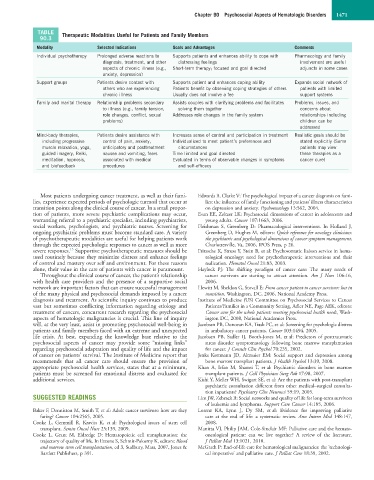
             TABLE   Therapeutic Modalities Useful for Patients and Family Members
              90.3
             Modality            Selected Indications     Goals and Advantages                   Comments
             Individual psychotherapy  Prolonged adverse reactions to   Supports patients and enhances ability to cope with   Pharmacology and family
                                   diagnosis, treatment, and other   distressing feelings          involvement are useful
                                   aspects of chronic illness (e.g.,   Short-term therapy; focused and goal directed  adjuncts in some cases
                                   anxiety, depression)
             Support groups      Patients desire contact with   Supports patient and enhances coping ability  Expands social network of
                                   others who are experiencing   Patients benefit by observing coping strategies of others  patients with limited
                                   chronic illness        Usually does not involve a fee           support systems
             Family and marital therapy  Relationship problems secondary   Assists couples with clarifying problems and facilitates   Problems, issues, and
                                   to illness (e.g., family tension,   solving them together       concerns about
                                   role changes, conflict, sexual   Addresses role changes in the family system  relationships including
                                   problems)                                                       children can be
                                                                                                   addressed
             Mind-body therapies,   Patients desire assistance with   Increases sense of control and participation in treatment  Realistic goals should be
               including progressive   control of pain, anxiety,   Individualized to meet patient’s preferences and   stated explicitly (Some
               muscle relaxation, yoga,   anticipatory and posttreatment   circumstances           patients may view
               guided imagery, Reiki,   nausea and vomiting, fears   Time limited and goal directed  these therapies as a
               meditation, hypnosis,   associated with medical   Evaluated in terms of observable changes in symptoms   cancer cure)
               and biofeedback     procedures              and self-efficacy


              Most patients undergoing cancer treatment, as well as their fami-  Edwards B, Clarke V: The psychological impact of a cancer diagnosis on fami-
            lies, experience expected periods of psychologic turmoil that occur at   lies: the influence of family functioning and patients’ illness characteristics
            transition points along the clinical course of cancer. In a small propor-  on depression and anxiety. Psychooncology 13:562, 2004.
            tion of patients, more severe psychiatric complications may occur,   Evan EE, Zeltzer LK: Psychosocial dimensions of cancer in adolescents and
            warranting referral to a psychiatric specialist, including psychiatrists,   young adults. Cancer 107:1663, 2006.
            social workers, psychologists, and psychiatric nurses. Screening for   Fleishman  S,  Greenberg  D:  Pharmacological  interventions.  In  Holland  J,
            ongoing psychiatric problems must become standard care. A variety   Greenberg D, Hughes M, editors: Quick reference for oncology clinicians:
            of psychotherapeutic modalities are useful for helping patients work   the psychiatric and psychological dimensions of cancer symptom management,
            through the expected psychologic responses to cancer as well as more   Charlottesville, Va, 2006, IPOS Press, p 26.
                        15
            severe responses.  Supportive psychotherapeutic measures should be   Fritzsche K, Struss Y, Stein B, et al: Psychosomatic liaison service in hema-
            used routinely because they minimize distress and enhance feelings   tological  oncology:  need  for  psychotherapeutic  interventions  and  their
            of control and mastery over self and environment. For these reasons   realization. Hematol Oncol 21:83, 2003.
            alone, their value in the care of patients with cancer is paramount.  Haylock  PJ:  The  shifting  paradigm  of  cancer  care:  The  many  needs  of
              Throughout the clinical course of cancer, the patient’s relationship   cancer  survivors  are  starting  to  attract  attention.  Am  J  Nurs  106:16,
            with  health  care  providers  and  the  presence  of  a  supportive  social   2006.
            network are important factors that can ensure successful management   Hewitt M, Sheldon G, Stovall E: From cancer patient to cancer survivor: lost in
            of the many physical and psychosocial demands imposed by a cancer   transition, Washington, DC, 2006, National Academy Press.
            diagnosis and treatment. As scientific inquiry continues to produce   Institute of Medicine (US) Committee on Psychosocial Services to Cancer
            vast but sometimes conflicting information regarding etiology and   Patients/Families in a Community Setting, Adler NE, Page AEK, editors:
            treatment of cancers, concurrent research regarding the psychosocial   Cancer care for the whole patient: meeting psychosocial health needs, Wash-
            aspects of hematologic malignancies is crucial. This line of inquiry   ington DC, 2008, National Academies Press.
            will, at the very least, assist in promoting psychosocial well-being in   Jacobsen PB, Donovan KA, Trask PC, et al: Screening for psychologic distress
            patients and family members faced with an extreme and unexpected   in ambulatory cancer patients. Cancer 103:1494, 2005.
            life  crisis.  At  best,  expanding  the  knowledge  base  relative  to  the   Jacobsen  PB,  Sadler  IJ,  Booth-Jones  M,  et al:  Predictors  of  posttraumatic
            psychosocial  aspects  of  cancer  may  provide  some  “missing  links”   stress disorder symptomatology following bone marrow transplantation
            regarding psychosocial adaptation and quality of life and the impact   for cancer. J Consult Clin Psychol 70:235, 2002.
            of cancer on patients’ survival. The Institute of Medicine report that   Jenks  Kettmann  JD,  Altmaier  EM:  Social  support  and  depression  among
            recommends  that  all  cancer  care  should  ensure  the  provision  of   bone marrow transplant patients. J Health Psychol 13:39, 2008.
            appropriate psychosocial health services, states that at a minimum,   Khan  A,  Irfan  M,  Shamsi  T,  et al:  Psychiatric  disorders  in  bone  marrow
            patients must be screened for emotional distress and evaluated for   transplant patients. J Coll Physicians Surg Pak 17:98, 2007.
            additional services.                                  Kishi Y, Meller WH, Swigart SE, et al: Are the patients with post-transplant
                                                                    psychiatric consultation different from other medical–surgical consulta-
                                                                    tion inpatients? Psychiatry Clin Neurosci 59:19, 2005.
            SUGGESTED READINGS                                    Lim JW, Zebrack B: Social networks and quality of life for long-term survivors
                                                                    of leukemia and lymphoma. Support Care Cancer 14:185, 2006.
            Baker F, Denniston M, Smith T, et al: Adult cancer survivors: how are they   Lorenz  KA,  Lynn  J,  Dy  SM,  et al:  Evidence  for  improving  palliative
              faring? Cancer 104:2565, 2005.                        care  at  the  end  of  life:  a  systematic  review.  Ann  Intern  Med  148:147,
            Cooke  L,  Gemmill  R,  Kravits  K,  et al:  Psychological  issues  of  stem  cell   2008.
              transplant. Semin Oncol Nurs 25:139, 2009.          Manitta VJ, Philip JAM, Cole-Sinclair MF: Palliative care and the hemato-
            Cooke  L,  Grant  M,  Eldredge  D:  Hematopoietic  cell  transplantation:  the   oncological  patient:  can  we  live  together?  A  review  of  the  literature.
              trajectory of quality of life. In Ezzone S, Schmit-Pokorny K, editors: Blood   J Palliat Med 13:1021, 2010.
              and marrow stem cell transplantation, ed 3, Sudbury, Mass, 2007, Jones &   McGrath P: End-of-life care for hematological malignancies: the ‘technologi-
              Bartlett Publishers, p 391.                           cal imperative’ and palliative care. J Palliat Care 18:39, 2002.

