


Page 1647 - Hematology_ Basic Principles and Practice ( PDFDrive )
P. 1647
1468   Part VIII  Comprehensive Care of Patients with Hematologic Malignancies


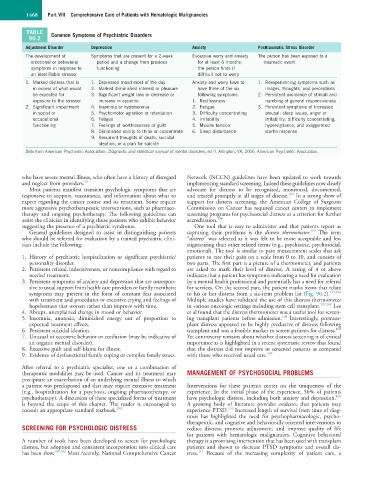
          TABLE   Common Symptoms of Psychiatric Disorders
          90.2
         Adjustment Disorder   Depression                       Anxiety              Posttraumatic Stress Disorder
         The development of    Symptoms that are present for a 2-week   Excessive worry and anxiety   The person has been exposed to a
           emotional or behavioral   period and a change from previous   for at least 6 months;   traumatic event
           symptoms in response to   functioning                  the person finds it
           an identifiable stressor                               difficult not to worry
         1.  Marked distress that is   1.  Depressed mood most of the day  Anxiety and worry have to   1.  Reexperiencing symptoms such as
            in excess of what would   2.  Marked diminished interest or pleasure  have three of the six   images, thoughts, and perceptions
            be expected for    3.  Significant weight loss or decrease or   following symptoms:  2.  Persistent avoidance of stimuli and
            exposure to the stressor  increase in appetite      1.  Restlessness        numbing of general responsiveness
         2.  Significant impairment   4.  Insomnia or hypersomnia  2.  Fatigue       3.  Persistent symptoms of increased
            in social or       5.  Psychomotor agitation or retardation  3.  Difficulty concentrating  arousal: sleep issues, anger or
            occupational       6.  Fatigue                      4.  Irritability        irritability, difficulty concentrating,
            functioning        7.  Feelings of worthlessness or guilt  5.  Muscle tension  hypervigilance, and exaggerated
                               8.  Diminished ability to think or concentrate  6.  Sleep disturbance  startle response
                               9.  Recurrent thoughts of death, suicidal
                                 ideation, or a plan for suicide
         Data from American Psychiatric Association: Diagnostic and statistical manual of mental disorders, ed 4, Arlington, VA, 2000, American Psychiatric Association.


        who have severe mental illness, who often have a history of disregard   Network  (NCCN)  guidelines  have  been  updated  to  work  towards
        and neglect from providers. 99                        implementing standard screening. Indeed these guidelines now clearly
           Most patients manifest transient psychologic symptoms that are   advocate  for  distress  to  be  recognized,  monitored,  documented,
                                                                                               103
        responsive to support, reassurance, and information about what to   and treated promptly at all stages of disease.  In a strong show of
        expect regarding the cancer course and its treatment. Some require   support  for  distress  screening,  the  American  College  of  Surgeons
        more aggressive psychotherapeutic interventions, such as pharmaco-  Commission  on  Cancer  has  required  cancer  centers  to  implement
        therapy  and  ongoing  psychotherapy. The  following  guidelines  can   screening programs for psychosocial distress as a criterion for further
        assist the clinician in identifying those patients who exhibit behavior   accreditation. 104
        suggesting the presence of a psychiatric syndrome.       One tool that is easy to administer and that patients report as
                                                                                                       105
           General  guidelines  designed  to  assist  in  distinguishing  patients   capturing  their  problems  is  the  distress  thermometer.   The  term
        who should be referred for evaluation by a trained psychiatric clini-  “distress” was selected as it was felt to be more acceptable and less
        cian include the following:                           stigmatizing than other related terms (e.g., psychiatric, psychosocial,
                                                              emotional). The tool is similar to pain measurement scales that ask
        1.  History  of  psychiatric  hospitalization  or  significant  psychiatric/  patients to rate their pain on a scale from 0 to 10, and consists of
           personality disorder.                              two parts. The first part is a picture of a thermometer, and patients
        2.  Persistent refusal, indecisiveness, or noncompliance with regard to   are  asked  to  mark  their  level  of  distress.  A  rating  of  4  or  above
           needed treatment.                                  indicates that a patient has symptoms indicating a need for evaluation
        3.  Persistent symptoms of anxiety and depression that are unrespon-  by a mental health professional and potentially has a need for referral
           sive to usual support from health care providers or family members;   for services. On the second part, the patient marks items that relate
           symptoms  may  present  in  the  form  of  constant  fear  associated   to his or her distress from a six-item problem list (Fig. 90.2). 105,106
           with treatment and procedures or excessive crying and feelings of   Multiple studies have validated the use of this distress thermometer
           hopelessness that worsen rather than improve with time.  in various oncologic settings including stem cell transplant. 107,108  Lee
        4.  Abrupt, unexplained change in mood or behavior.   et al found that the distress thermometer was a useful tool for screen-
                                                                                             108
        5.  Insomnia,  anorexia,  diminished  energy  out  of  proportion  to   ing  transplant  patients  before  admission.   Interestingly,  pretrans-
           expected treatment effects.                        plant distress appeared to be highly predictive of distress following
                                                                                                               108
        6.  Persistent suicidal ideation.                     transplant and was a feasible marker to screen patients for distress.
        7.  Unusual or eccentric behavior or confusion (may be indicative of   Yet controversy remains about whether distress screening is of critical
           an organic mental disorder).                       importance as is highlighted in a recent systematic review that found
        8.  Excessive guilt and self-blame for illness.       that the distress did not improve in screened patients as compared
        9.  Evidence of dysfunctional family coping or complex family issues.  with those who received usual care. 109
        After  referral  to  a  psychiatric  specialist,  one  or  a  combination  of
        therapeutic modalities may be used. Cancer and its treatment may   MANAGEMENT OF PSYCHOSOCIAL PROBLEMS
        precipitate an exacerbation of an underlying mental illness to which
        a patient was predisposed and that may require extensive treatment   Interventions  for  these  patients  center  on  the  uniqueness  of  the
        (e.g., hospitalization for a psychosis, ongoing pharmacotherapy, or   experience. In the initial phase of the experience, 50% of patients
                                                                                                               106
        psychotherapy). A discussion of these specialized forms of treatment   have psychologic distress, including both anxiety and depression.
        is  beyond  the  scope  of  this  chapter. The  reader  is  encouraged  to   A  growing  body  of  literature  provides  evidence  that  patients  may
                                                                            110
        consult an appropriate standard textbook. 100         experience PTSD.  Increased length of survival from time of diag-
                                                              nosis  has  highlighted  the  need  for  psychopharmacologic,  psycho-
                                                              therapeutic, and cognitive and behaviorally oriented interventions to
        SCREENING FOR PSYCHOLOGIC DISTRESS                    reduce  distress,  promote  adjustment,  and  improve  quality  of  life
                                                              for  patients  with  hematologic  malignancies.  Cognitive  behavioral
        A  number  of  tools  have  been  developed  to  screen  for  psychologic   therapy is a promising intervention that has been used with transplant
        distress, but adoption and consistent incorporation into clinical care   patients  and  shown  to  decrease  PTSD  symptoms  and  overall  dis-
                                                                  111
        has been slow. 101,102  Most recently, National Comprehensive Cancer   tress.   Because  of  the  increasing  complexity  of  patient  care,  a

