


Page 1645 - Hematology_ Basic Principles and Practice ( PDFDrive )
P. 1645
1466   Part VIII  Comprehensive Care of Patients with Hematologic Malignancies


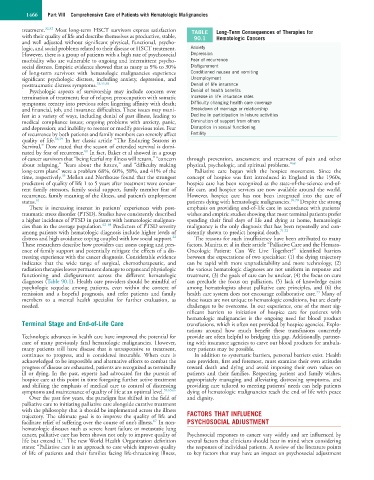
        treatment. 32,52  Most long-term HSCT survivors express satisfaction   TABLE   Long-Term Consequences of Therapies for
        with their quality of life and describe themselves as productive, stable,   90.1  Hematologic Cancers
        and well adjusted  without significant  physical,  functional, psycho-
        logic, and social problems related to their disease or HSCT treatment.   Anxiety
        However, there is a group of patients with a high rate of psychosocial   Depression
        morbidity who are vulnerable to ongoing and intermittent psycho-  Fear of recurrence
        social distress. Empiric evidence showed that as many as 9% to 30%   Disfigurement
        of  long-term  survivors  with  hematologic  malignancies  experience   Conditioned nausea and vomiting
        significant  psychologic  distress,  including  anxiety,  depression,  and   Unemployment
        posttraumatic distress symptoms. 53,55,58              Denial of life insurance
           Psychologic  aspects  of  survivorship  may  include  concern  over   Denial of health benefits
        termination of treatment; fear of relapse; preoccupation with somatic   Increase in life insurance rates
        symptoms; reentry into previous roles; lingering affinity with death;   Difficulty changing health care coverage
        and financial, job, and insurance difficulties. These issues may mani-  Breakdown of marriage or relationship
        fest in a variety of ways, including denial of past illness, leading to   Decline in participation in leisure activities
        medical  compliance  issues;  ongoing  problems  with  anxiety,  panic,   Diminution of support from others
        and depression; and inability to reenter or modify previous roles. Fear   Disruption in sexual functioning
        of recurrence by both patients and family members can severely affect   Fertility
        quality  of  life. 48,59   In  her  classic  article  “The  Enduring  Seasons  in
        Survival,” Dow stated that the season of extended survival is domi-
                             60
        nated by fear of recurrence.  In fact, Baker et al showed in a group
        of cancer survivors that “being fearful my illness will return,” “concern   through  prevention,  assessment  and  treatment  of  pain  and  other
        about  relapsing,”  “fears  about  the  future,”  and  “difficulty  making   physical, psychologic, and spiritual problems.” 68
        long-term plans” were a problem 68%, 60%, 58%, and 41% of the   Palliative  care  began  with  the  hospice  movement.  Since  the
                     33
        time, respectively.  Mellon and Northouse found that the strongest   concept  of  hospice  was  first  introduced  in  England  in  the  1960s,
        predictors of quality of life 1 to 5 years after treatment were concur-  hospice care has been recognized as the state-of-the-science end-of-
        rent family stressors, family social support, family member fear of   life care, and hospice services are now available around the world.
        recurrence, family meaning of the illness, and patient’s employment   However,  hospice  care  has  not  been  integrated  into  the  care  of
        status. 61                                            patients dying with hematologic malignancies. 69,70  Despite the strong
           There  is  increasing  interest  in  patients’  experiences  with  post-  emphasis on providing end-of-life care in accordance with patients’
        traumatic stress disorder (PTSD). Studies have consistently described   wishes and empiric studies showing that most terminal patients prefer
        a higher incidence of PTSD in patients with hematologic malignan-  spending  their  final  days  of  life  and  dying  at  home,  hematologic
        cies than in the average population. 62–64  Predictors of PTSD severity   malignancy is the only diagnosis that has been repeatedly and con-
        among patients with hematologic diagnosis include higher levels of   sistently shown to predict hospital death. 71,72
                                                         22
        distress and high avoidance coping coupled with low social support.    The reasons for such insufficiency have been attributed to many
        These researchers describe how providers can assess coping and pres-  factors. Manitta et al in their article “Palliative Care and the Hemato-
        ence of family support and potentially mitigate the effects of a dis-  Oncologic  Patient:  Can  We  Live  Together?”  identified  barriers
        tressing experience with the cancer diagnosis. Considerable evidence   between the expectations of two specialties: (1) the dying trajectory
        indicates  that  the  wide  range  of  surgical,  chemotherapeutic,  and   can be rapid with more unpredictability and more technology, (2)
        radiation therapies leaves permanent damage to organs and physiologic   the various hematologic diagnoses are not uniform in response and
        functioning  and  disfigurement  across  the  different  hematologic   treatment, (3) the goals of care can be unclear, (4) the focus on cure
        diagnoses (Table 90.1). Health care providers should be mindful of   can  preclude  the  focus  on  palliation,  (5)  lack  of  knowledge  exists
        psychologic  sequelae  among  patients,  even  within  the  context  of   among  hematologists  about  palliative  care  principles,  and  (6)  the
                                                                                                        73
        remission  and  a  hopeful  prognosis,  and  refer  patients  and  family   health care system does not encourage collaborative care.  Many of
        members  to  a  mental  health  specialist  for  further  evaluation,  as   these issues are not unique to hematologic conditions, but are clearly
        needed.                                               challenges to be overcome. In our experience, one of the most sig-
                                                              nificant  barriers  to  initiation  of  hospice  care  for  patients  with
                                                              hematologic  malignancies  is  the  ongoing  need  for  blood  product
        Terminal Stage and End-of-Life Care                   transfusions, which is often not provided by hospice agencies. Explo-
                                                              rations  around  how  much  benefit  these  transfusions  concretely
        Technologic advances in health care have improved the potential for   provide are often helpful to bridging this gap. Additionally, partner-
        cure of many previously fatal hematologic malignancies. However,   ing with insurance agencies to carve out blood products for ambula-
        many  patients  still  have  disease  that  is  unresponsive  to  treatment,   tory patients may be possible.
        continues  to  progress,  and  is  considered  incurable.  When  cure  is   In addition to systematic barriers, personal barriers exist. Health
        acknowledged to be impossible and alternative efforts to combat the   care providers, first and foremost, must examine their own attitudes
        progress of disease are exhausted, patients are recognized as terminally   toward  death  and  dying  and  avoid  imposing  their  own  values  on
        ill  or  dying.  In  the  past,  experts  had  advocated  for  the  pursuit  of   patients  and  their  families.  Respecting  patient  and  family  wishes,
        hospice care at this point in time foregoing further active treatment   appropriately  managing  and  alleviating  distressing  symptoms,  and
        and shifting the emphasis of medical care to control of distressing   providing care tailored to meeting patients’ needs can help patients
        symptoms and maintenance of quality of life at an optimal level. 59,65,66  dying of hematologic malignancies reach the end of life with peace
           Over the past few years, the paradigm has shifted in the field of   and dignity.
        palliative care to initiating palliative care alongside curative treatment
        with the philosophy that it should be implemented across the illness
        trajectory. The  ultimate  goal  is  to  improve  the  quality  of  life  and   FACTORS THAT INFLUENCE
                                                   67
        facilitate relief of suffering over the course of one’s illness.  In non-  PSYCHOSOCIAL ADJUSTMENT
        hematologic diseases such as severe heart failure or metastatic lung
        cancer, palliative care has been shown not only to improve quality of   Psychosocial responses to cancer vary widely and are influenced by
                     11
        life but extend it.  The new World Health Organization definition   several factors that clinicians should bear in mind when considering
        states: “Palliative care is an approach to care which improves quality   the responses of individual patients. A review of the literature points
        of  life  of  patients  and  their  families  facing  life-threatening  illness,   to key factors that may have an impact on psychosocial adjustment

