


Page 1671 - Hematology_ Basic Principles and Practice ( PDFDrive )
P. 1671
Chapter 92  Palliative Care  1489


                     Summary of the Institute of Medicine Report: When   TABLE
             TABLE   Children Die: Improving Palliative and End-of-Life   92.2  Breaking Bad News
              92.1   Care for Children and Their Families
                                                                    1.  Make yourself, the patient, and the family comfortable
             Improve Organization and Delivery of Care              2.  Find out what they know
             Emphasis is placed on the development of care guidelines and   3.  Indicate that you are planning to tell them something that is
               protocols in all pediatric settings, the development of regional   unpleasant and may be disturbing
               information programs and resources in rural areas, and policies and   4.  Find out whether they want to be told, or whether they want
               procedures for involving children in decision making   someone else to be told
             Reform Financing of Palliative Services and Hospice Care  5.  Find out how much they want to know (i.e., the big picture versus
                                                                      all the details)
             Vast changes in public and private health coverage: add hospice,   6.  Tell them in words they can understand, allowing time for
               change eligibility rules, provide outlier payments, extend coverage for   questions along the way
               counseling family members and for bereavement follow-up  7.  Respond to their feelings
             Better Prepare Health Professionals                    8.  Let them know that this is only the first of many discussions with
             Create educational experiences and curricula that will provide basic and   you
               advanced competence in palliative, end-of-life, and bereavement   9.  Ask them to summarize what they heard you say; ask if they have
               care                                                   further questions
             Strengthen Research Base for Effective Care           10.  Arrange your next meeting with them
             Emphases include appropriate quality-of-life measures, effective   From Abrahm JL: Update in palliative medicine and end-of-life care, Annu Rev
               symptom management, impact of perinatal death on parents and   Med 54:53, 2003; and Back A, Arnold R, Tulsky J: Mastering communication
               siblings, impact of sudden death on family and professional   with seriously ill patients: Balancing honesty with empathy and hope, New York,
               caregivers, efficacy of bereavement interventions, models for   2009, Cambridge University Press.
               provision of care, financing alternatives, effective strategies for
               educating professionals
             From Institute of Medicine: When children die: Improving palliative and   Breaking Bad News
             end-of-life care for children and their families, Washington, DC, 2003, National
             Academy Press.                                        I just wanted to be told the truth and not too bluntly, but the truth
                                                                   nonetheless. So that I could make a decision myself, be able to accept
                                                                   it, decide what I was going to do about it.
            Children with serious hematologic disorders have usually lived with   — Adult cancer patient seeking a second-opinion
            the illness over a prolonged period of months or years. Their knowl-          hematology-oncology consultation 11
            edge, understanding, and awareness of their precarious life situation
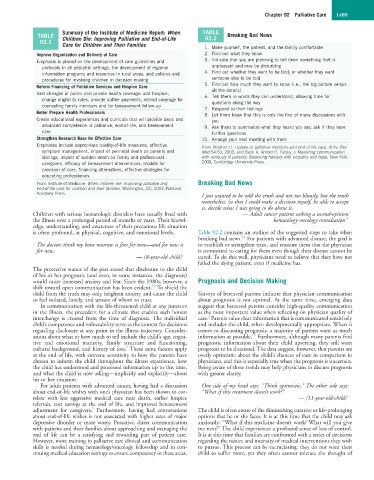
            is often profound, at physical, cognitive, and emotional levels.  Table 92.2 contains an outline of the suggested steps to take when
                                                                                12
                                                                  breaking bad news.  For patients with advanced disease, the goal is
             The doctors think my bone marrow is fine for now—and for now is   to establish or strengthen trust, and reassure them that the physician
             for now.                                             is committed to caring for them even though their disease cannot be
                                              — (8-year-old child) 7  cured. To do this well, physicians need to believe that they have not
                                                                  failed the dying patient, even if medicine has.
            The protective stance of the past stated that disclosure to the child
            of his or her prognosis (and even, in some instances, the diagnosis)
            would cause increased anxiety and fear. Since the 1980s, however, a   Prognosis and Decision Making
                                                   10
            shift toward open communication has been evident.  To shield the
            child from the truth may only heighten anxiety and cause the child   Surveys of bereaved parents indicate that physician communication
            to feel isolated, lonely, and unsure of whom to trust.  about  prognosis  is  not  optimal.  At  the  same  time,  emerging  data
              In communication with the life-threatened child at any juncture   suggest that bereaved parents consider high-quality communication
            in the illness, the precedent for a climate that enables such honest   as the most important value when reflecting on physician quality of
                                                                     2
            interchange  is  created  from  the  time  of  diagnosis. The  individual   care.  Parents value clear information that is communicated sensitively
            child’s competence and vulnerability serve as the context for decisions   and includes the child, when developmentally appropriate. When it
            regarding disclosure at any point in the illness trajectory. Consider-  comes to discussing prognosis, a majority of parents want as much
                                                                                   13
            ations about what or how much to tell include the child’s age, cogni-  information as possible.  Furthermore, although many parents find
            tive  and  emotional  maturity,  family  structure  and  functioning,   prognostic information about their child upsetting, they still want
                                          7
            cultural background, and history of loss.  These same factors apply   prognosis to be discussed. The data suggest, however, that parents are
            at the end of life, with extreme sensitivity to how the parents have   overly optimistic about the child’s chances of cure in comparison to
            chosen to inform the child throughout the illness experience, how   physicians, and this is especially true when the prognosis is uncertain.
            the child has understood and processed information up to this time,   Being aware of these trends may help physicians to discuss prognosis
            and what the child is now asking—implicitly and explicitly—about   with greater clarity.
            his or her situation.
              For adult patients with advanced cancer, having had a discussion   One side of my head says: “Think optimistic.” The other side says:
            about end-of-life wishes with one’s physician has been shown to cor-  “What if this treatment doesn’t work?”
            relate  with  less  aggressive  medical  care  near  death,  earlier  hospice          — (11-year-old-child) 7
            referrals,  cost  savings  at  the  end  of  life,  and  improved  bereavement
                               2
            adjustment  for  caregivers.   Furthermore,  having  had  conversations   The child is often aware of the diminishing curative or life-prolonging
            about end-of-life wishes is not associated with higher rates of major   options that he or she faces. It is at this time that the child may ask
            depressive disorder or more worry. Proactive, direct communication   anxiously: “What if this medicine doesn’t work? What will you give
            with patients and their families about approaching and managing the   me next?” The child experiences a profound sense of loss of control.
            end  of  life  can  be  a  satisfying  and  rewarding  part  of  patient  care.   It is at this time that families are confronted with a series of decisions
            However, more training in palliative care clinical and communication   regarding the nature and intensity of medical interventions they wish
            skills is needed during hematology/oncology fellowship and in con-  to pursue. This process can be excruciating: they do not want their
            tinuing medical education settings to ensure competency in these areas.  child to suffer more, yet they often cannot tolerate the thought of

