


Page 1674 - Hematology_ Basic Principles and Practice ( PDFDrive )
P. 1674
1492   Part VIII  Comprehensive Care of Patients with Hematologic Malignancies


        patients  can  be  agitated,  hypoactive,  or  vacillate  between  the  two.   families, there is the possibility of planning ahead and choosing a
        Symptoms of delirium include insomnia and daytime somnolence,   setting for their child’s death—home, hospice, or hospital. The child
        nightmares,  restlessness  or  agitation,  irritability,  distractibility,   may express a preference about where he or she feels safe or prefers
        hypersensitivity  to  light  and  sound,  anxiety,  difficulty  in  concen-  to  be.  Clear  information  about  how  the  child  is  likely  to  die  and
        trating  or  marshaling  thoughts,  fleeting  illusions,  hallucinations   professional support to validate the family’s choice are crucial. Even
        and  delusions,  emotional  lability,  attention  deficits,  and  memory    more important is the explicitly stated “permission” from all members
        disturbances.                                         of the professional team that the family may change their choice freely
           Validated delirium screening and severity tools are available, but   at any time—that all options remain open and that no decision is
        a comprehensive psychiatric evaluation is recommended to exclude   irrevocable. In the past, siblings were rarely included in these discus-
        other disorders, such as anxiety, minor depression, anger, dementia,   sions and were often inadequately prepared for the eventuality of a
        or psychosis. The cause of delirium is often never determined and is   child dying at home. It is only recently that their voices are beginning
        frequently multifactorial. Medications, especially opioids, nonsteroi-  to be heard.
        dal antiinflammatory drugs, and high-dose corticosteroids, commonly
        contribute.  Opioid-induced  central  nervous  system  toxicities  are
        more common in patients with renal dysfunction, on high doses of   The Dying Child
        opioids  for  long  periods  of  time,  with  impaired  cognition  before
        starting the opioids, with dehydration, or taking other psychoactive   Therapist: Are you in any pain? Does anything hurt?
        drugs. Other causes include metabolic abnormalities (hypercalcemia,   Child: My heart.
        hyperglycemia,  or  uremia),  malnutrition,  hypoxia,  fever,  infection,   Therapist: Your heart?
        uncontrolled pain, hepatic failure, primary brain tumor, and brain   Child: My heart is broken. I miss everybody. 7
        metastases.
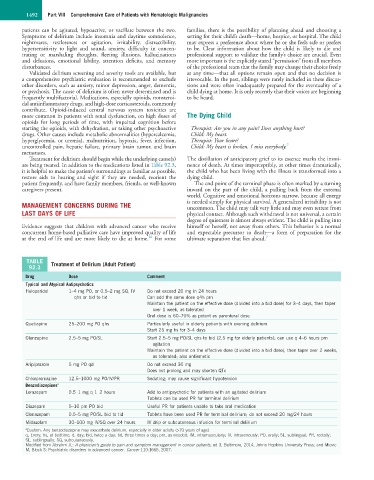
           Treatment for delirium should begin while the underlying cause(s)   The distillation of anticipatory grief to its essence marks the immi-
        are being treated. In addition to the medications listed in Table 92.3,   nence of death. At times imperceptibly, at other times dramatically,
        it is helpful to make the patient’s surroundings as familiar as possible,   the child who has been living with the illness is transformed into a
        restore  aids  to  hearing  and  sight  if  they  are  needed,  reorient  the   dying child.
        patient frequently, and have family members, friends, or well-known   The end point of the terminal phase is often marked by a turning
        caregivers present.                                   inward  on  the  part  of  the  child,  a  pulling  back  from  the  external
                                                              world. Cognitive and emotional horizons narrow, because all energy
        MANAGEMENT CONCERNS DURING THE                        is needed simply for physical survival. A generalized irritability is not
                                                              uncommon. The child may talk very little and may even retreat from
        LAST DAYS OF LIFE                                     physical contact. Although such withdrawal is not universal, a certain
                                                              degree of quietness is almost always evident. The child is pulling into
        Evidence  suggests  that  children  with  advanced  cancer  who  receive   himself or herself, not away from others. This behavior is a normal
        concurrent home-based palliative care have improved quality of life   and  expectable  precursor  to  death—a  form  of  preparation  for  the
                                                  26
        at the end of life and are more likely to die at home.  For some   ultimate separation that lies ahead. 7


          TABLE   Treatment of Delirium (Adult Patient)
          92.3
         Drug          Dose                      Comment
         Typical and Atypical Antipsychotics
         Haloperidol   1–4 mg PO, or 0.5–2 mg SQ, IV   Do not exceed 20 mg in 24 hours
                         qhs or bid to tid       Can add the same dose q4h prn
                                                 Maintain the patient on the effective dose (divided into a bid dose) for 3–4 days, then taper
                                                   over 1 week, as tolerated
                                                 Oral dose is 60–70% as potent as parenteral dose
         Quetiapine    25–200 mg PO qhs          Particularly useful in elderly patients with evening delirium
                                                 Start 25 mg hs for 3–4 days
         Olanzapine    2.5–5 mg PO/SL            Start 2.5–5 mg PO/SL qhs to bid (2.5 mg for elderly patients); can use q 4–6 hours prn
                                                   agitation
                                                 Maintain the patient on the effective dose (divided into a bid dose), then taper over 2 weeks,
                                                   as tolerated; also antiemetic
         Aripiprazole  5 mg PO qd                Do not exceed 30 mg
                                                 Does not prolong and may shorten QTc
         Chlorpromazine  12.5–1000 mg PO/IV/PR   Sedating; may cause significant hypotension
         Benzodiazepines a
         Lorazepam     0.5–1 mg q 1–2 hours      Add to antipsychotic for patients with an agitated delirium
                                                 Tablets can be used PR for terminal delirium
         Diazepam       5–10 pm PO bid           Useful PR for patients unable to take oral medication
         Clonazepam    0.5–5 mg PO/SL bid to tid  Tablets have been used PR for terminal delirium; do not exceed 20 mg/24 hours
         Midazolam     30–100 mg IV/SQ over 24 hours  IV drip or subcutaneous infusion for terminal delirium
         a Caution: Any benzodiazepine may exacerbate delirium, especially in older adults (>70 years of age).
         q, Every; hs, at bedtime; d, day; bid, twice a day; tid, three times a day; prn, as needed; IM, intramuscularly; IV, intravenously; PO, orally; SL, sublingual; PR, rectally;
         SL, sublingually; SQ, subcutaneously.
         Modified from Abrahm JL: A physician’s guide to pain and symptom management in cancer patients, ed 3, Baltimore, 2014, Johns Hopkins University Press; and Miovic
         M, Block S: Psychiatric disorders in advanced cancer. Cancer 110:1665, 2007.

