


Page 1676 - Hematology_ Basic Principles and Practice ( PDFDrive )
P. 1676
1494   Part VIII  Comprehensive Care of Patients with Hematologic Malignancies


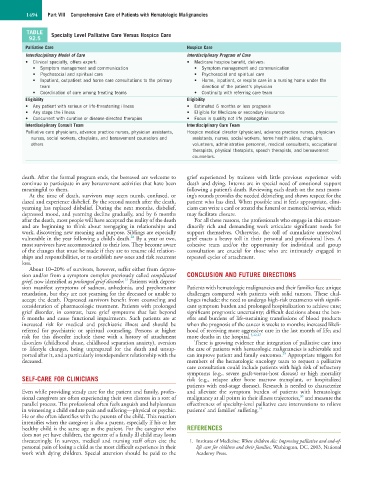
          TABLE   Specialty Level Palliative Care Versus Hospice Care
          92.5
         Palliative Care                                      Hospice Care
         Interdisciplinary Model of Care                      Interdisciplinary Program of Care
         •  Clinical specialty, offers expert:                •  Medicare hospice benefit, delivers:
            •  Symptom management and communication              •  Symptom management and communication
            •  Psychosocial and spiritual care                   •  Psychosocial and spiritual care
            •  Inpatient, outpatient and home care consultations to the primary   •  Home, inpatient, or respite care in a nursing home under the
              team                                                 direction of the patient’s physician
            •  Coordination of care among treating teams         •  Continuity with referring care team
         Eligibility                                          Eligibility
         •  Any patient with serious or life-threatening illness  •  Estimated 6 months or less prognosis
         •  Any stage the illness                             •  Eligible for Medicare or secondary insurance
         •  Concurrent with curative or disease-directed therapies  •  Focus is quality not life prolongation
         Interdisciplinary Consult Team                       Interdisciplinary Care Team
         Palliative care physicians, advance practice nurses, physician assistants,   Hospice medical director (physician), advance practice nurses, physician
           nurses, social workers, chaplains, and bereavement counselors and   assistants, nurses, social workers, home health aides, chaplains,
           others                                               volunteers, administrative personnel, medical consultants, occupational
                                                                therapists, physical therapists, speech therapists, and bereavement
                                                                counselors.


        death. After the formal program ends, the bereaved are welcome to   grief  experienced  by  trainees  with  little  previous  experience  with
        continue to participate in any bereavement activities that have been   death and dying. Interns are in special need of emotional support
        meaningful to them.                                   following a patient’s death. Reviewing each death on the next morn-
           At  the  time  of  death,  survivors  may  seem  numb,  confused,  or   ing’s rounds provides the needed debriefing and shows respect for the
        dazed and experience disbelief. By the second month after the death,   patient who has died. When possible and it feels appropriate, clini-
        yearning has replaced disbelief. During the next months, disbelief,   cians can write a card or attend the funeral or memorial service, which
        depressed mood, and yearning decline gradually, and by 6 months   may facilitate closure.
        after the death, most people will have accepted the reality of the death   For all these reasons, the professionals who engage in this extraor-
        and  are  beginning  to  think  about  reengaging  in  relationships  and   dinarily  rich  and  demanding  work  articulate  significant  needs  for
        work, discovering new meaning and purpose. Siblings are especially   support  themselves.  Otherwise,  the  toll  of  cumulative  unresolved
                                            28
        vulnerable in the year following a child’s death.  By a year or two,   grief exacts a heavy toll in their personal and professional lives. A
        most survivors have accommodated to their loss. They become aware   cohesive  team  and/or  the  opportunity  for  individual  and  group
        of the changes that must be made if they are to resume old relation-  consultation  are  crucial  for  those  who  are  intimately  engaged  in
        ships and responsibilities, or to establish new ones and risk recurrent   repeated cycles of attachment.
        loss.
           About 10–20% of survivors, however, suffer either from depres-
        sion and/or from a symptom complex previously called complicated   CONCLUSION AND FUTURE DIRECTIONS
                                          12
        grief, now identified as prolonged grief disorder.  Patients with depres-
        sion  manifest  symptoms  of  sadness,  anhedonia,  and  psychomotor   Patients with hematologic malignancies and their families face unique
        retardation, but they are not yearning for the deceased or unable to   challenges  compared  with  patients  with  solid  tumors. These  chal-
        accept the death. Depressed survivors benefit from counseling and   lenges include: the need to undergo high-risk treatments with signifi-
        consideration of pharmacologic treatment. Patients with prolonged   cant symptom burden and prolonged hospitalization to achieve cure;
        grief  disorder,  in  contrast,  have  grief  symptoms  that  last  beyond   significant prognostic uncertainty; difficult decisions about the ben-
        6  months  and  cause  functional  impairments.  Such  patients  are  at   efits  and  burdens  of  life-sustaining  transfusions  of  blood  products
        increased  risk  for  medical  and  psychiatric  illness  and  should  be   when the prognosis of the cancer is weeks to months; increased likeli-
        referred  for  psychiatric  or  spiritual  counseling.  Persons  at  higher   hood of receiving more aggressive care in the last month of life; and
        risk  for  this  disorder  include  those  with  a  history  of  attachment   more deaths in the hospital. 5,22,27
        disorders (childhood abuse, childhood separation anxiety), aversion   There is growing evidence that integration of palliative care into
        to  lifestyle  changes,  being  unprepared  for  the  death  and  unsup-  the care of patients with hematologic malignancies is achievable and
                                                                                             29
        ported after it, and a particularly interdependent relationship with the     can improve patient and family outcomes.  Appropriate triggers for
        deceased.                                             members of the hematologic oncology team to request a palliative
                                                              care consultation could include patients with high risk of refractory
                                                              symptoms  (e.g.,  severe  graft-versus-host  disease)  or  high  mortality
        SELF-CARE FOR CLINICIANS                              risk  (e.g.,  relapse  after  bone  marrow  transplant,  or  hospitalized
                                                              patients with end-stage disease). Research is needed to characterize
        Even while providing steady care for the patient and family, profes-  and  alleviate  the  symptom  burden  of  patients  with  hematologic
                                                                                                   30
        sional caregivers are often experiencing their own distress in a sort of   malignancy at all points in their illness trajectories,  and measure the
        parallel process. The professional often feels anguish and helplessness   effectiveness of specialty-level palliative care interventions to relieve
        in witnessing a child endure pain and suffering—physical or psychic.   patients’ and families’ suffering. 14
        He or she often identifies with the parents of the child. This reaction
        intensifies when the caregiver is also a parent, especially if his or her
        healthy child is the same age as the patient. For the caregiver who   REFERENCES
        does not yet have children, the specter of a fatally ill child may loom
        threateningly.  In  surveys,  medical  and  nursing  staff  often  cite  the   1.  Institute of Medicine: When children die: Improving palliative and end-of-
        personal pain of losing a child as the most difficult experience in their   life care for children and their families, Washington, DC, 2003, National
        work with dying children. Special attention should be paid to the   Academy Press.

