


Page 1675 - Hematology_ Basic Principles and Practice ( PDFDrive )
P. 1675
Chapter 92  Palliative Care  1493


             TABLE   Treatment of Common Problems in the Final Days (Adult Patient)
              92.4
             Problem           Agent(s)                             Routes, Doses
             Baseline pain     Concentrated oxycodone or morphine solution  PO/SL q4h around the clock; individualized
                               Morphine or hydromorphone tablets    PR q4h; individualized
                               Fentanyl a                           Transdermal; individualized
                               Methadone liquid                     PO; individualized
                               Acetaminophen, naproxen              PR tid to qid
                               Dexamethasone (requires compounding)  PR daily to bid
             Breakthrough pain  Concentrated oxycodone or morphine solution  PO or per gastric tube q4h around the clock; individualized
                               Fentanyl a                           Transmucosal (buccal, sublingual); individualized
             “Death rattle”    Scopolamine                          Transderm Scop patch 1–3q3 days; gel
                               Hyoscyamine                          0.125–0.25 SL tid to qid
                               Glycopyrrolate                       0.2–0.4 mg IV tid to qid or 1–2 mg po bid to tid
                               Atropine                             0.4 mg SL q4–6h
             Dyspnea (anxiety)  Lorazepam                           1 mg PO, SL, q2–4h
                               Chlorpromazine                       25 mg PO, PR q4–12h; or 12.5 mg IV q4–8h
             Dyspnea (other)   Morphine/oxycodone                   5–10 mg SL oral concentrate q2h
                               Morphine                             2–4 mg IV q1h
             Nausea            Combinations of lorazepam, metoclopramide,   PR q6h; compounded suppositories with desired agents (depending on
                                 dexamethasone, and/or haloperidol    presumed cause of nausea)
             Anxiety           Lorazepam                            1 mg PO, SL, q2–4h
                               Diazepam suppository                 5–10 mg PR daily
             All liquid PO medications can be given per gastric tube.
             a Fentanyl only for opioid tolerant patients.
             h, Hour; IV, intravenously; PO, orally; PR, rectally; q, every; qid, four times a day; SL, sublingually; tid, three times a day.
             Modified from Abrahm JL: A physician’s guide to pain and symptom management in cancer patients, ed 3, Baltimore, 2014, Johns Hopkins University Press.


            Adults                                                reimburses hospice programs about $186 per day per patient (as of
                                                                  fiscal year 2013) to provide the routine care described in Table 92.5.
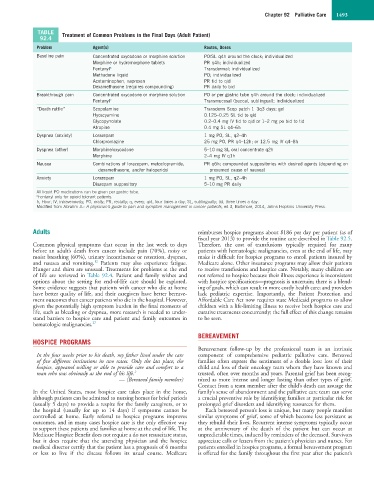
            Common  physical  symptoms  that  occur  in  the  last  week  to  days   Therefore,  the  cost  of  transfusions  typically  required  for  many
            before  an  adult’s  death  from  cancer  include  pain  (70%),  noisy  or   patients with hematologic malignancies, even at the end of life, may
            moist breathing (60%), urinary incontinence or retention, dyspnea,   make it difficult for hospice programs to enroll patients insured by
                                12
            and  nausea  and  vomiting.   Patients  may  also  experience  fatigue.   Medicare alone. Other insurance programs may allow their patients
            Hunger and thirst are unusual. Treatments for problems at the end   to receive transfusions and hospice care. Notably, many children are
            of  life  are  reviewed  in Table  92.4.  Patient  and  family  wishes  and   not referred to hospice because their illness experience is inconsistent
            options  about  the  setting  for  end-of-life  care  should  be  explored.   with hospice specifications—prognosis is uncertain; there is a blend-
            Some evidence suggests that patients with cancer who die at home   ing of goals, which can result in more costly health care; and providers
            have better quality of life, and their caregivers have better bereave-  lack  pediatric  expertise.  Importantly,  the  Patient  Protection  and
            ment outcomes than cancer patients who die in the hospital. However,   Affordable Care Act now requires state Medicaid programs to allow
            given the potentially high symptom burden in the final moments of   children with a life-limiting illness to receive both hospice care and
            life, such as bleeding or dyspnea, more research is needed to under-  curative treatments concurrently; the full effect of this change remains
            stand barriers to hospice care and patient and family outcomes in   to be seen.
            hematologic malignancies. 27
                                                                  BEREAVEMENT
            HOSPICE PROGRAMS
                                                                  Bereavement  follow-up  by  the  professional  team  is  an  intrinsic
             In the four weeks prior to his death, my father lived under the care   component  of  comprehensive  pediatric  palliative  care.  Bereaved
             of  five  different  institutions  in  two  states.  Only  the  last  place,  the   families  often  express the  sentiment  of  a  double  loss:  loss of  their
             hospice, appeared willing or able to provide care and comfort to a   child and loss of their oncology team whom they have known and
             man who was obviously at the end of his life. 2      trusted, often over months and years. Parental grief has been recog-
                                        — (Bereaved family member)  nized as more intense and longer lasting than other types of grief.
                                                                  Contact from a team member after the child’s death can assuage the
            In  the  United  States,  most  hospice  care  takes  place  in  the  home,   family’s sense of abandonment and the palliative care team can serve
            although patients can be admitted to nursing homes for brief periods   a crucial preventive role by identifying families at particular risk for
            (usually 5 days) to provide a respite for the family caregivers, or to   prolonged grief disorders and identifying resources for them.
            the  hospital  (usually  for  up  to  14  days)  if  symptoms  cannot  be   Each bereaved person’s loss is unique, but many people manifest
            controlled  at  home.  Early  referral  to  hospice  programs  improves   similar symptoms of grief, some of which become less persistent as
            outcomes, and in many cases hospice care is the only effective way   they rebuild their lives. Recurrent intense symptoms typically occur
            to support these patients and families at home at the end of life. The   at  the  anniversary  of  the  death  of  the  patient  but  can  occur  at
            Medicare Hospice Benefit does not require a do not resuscitate status,   unpredictable times, induced by reminders of the deceased. Survivors
            but  it  does  require  that  the  attending  physician  and  the  hospice   appreciate calls or letters from the patient’s physician and nurses. For
            medical director certify that the patient has a prognosis of 6 months   patients enrolled in hospice programs, a formal bereavement program
            or  less  to  live  if  the  disease  follows  its  usual  course.  Medicare   is offered for the family throughout the first year after the patient’s

