


Page 1726 - Hematology_ Basic Principles and Practice ( PDFDrive )
P. 1726
1532   Part IX  Cell-Based Therapies


                                         Manufacturing
                                         • Scale up
                                         • Validation
                                         • Release criteria
                                         • CMC
                         Discovery; proof of           Dose escalation;  Dose ranging;  Efficacy and safety
                         concept; cell product Animal studies  safety and toxicity safety and  studies; full product
                         potential; therapeutic • GLP/GMP cell  studies; small trial efficacy studies;  characterization;
                         mechanism and     product     size          increase trial  potency; scale up;
                         pathway; cell and  • Efficacy               size         full GMP
                         disease interaction  • Toxicity
                                                    IND Filing

                            Basic research  Pre-clinical   Phase        Phase II     Phase III
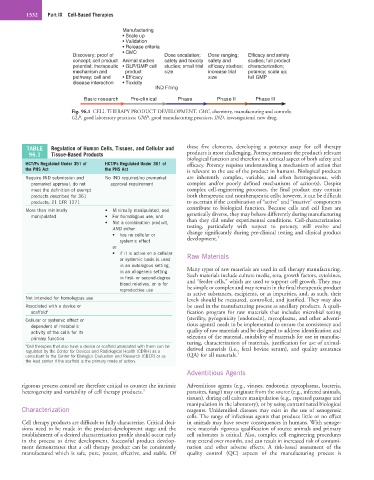
                        Fig. 96.1  CELL THERAPY PRODUCT DEVELOPMENT. CMC, chemistry, manufacturing and controls;
                        GLP, good laboratory practices; GMP, good manufacturing practices; IND, investigational new drug.


          TABLE   Regulation of Human Cells, Tissues, and Cellular and   these  five  elements,  developing  a  potency  assay  for  cell  therapy
          96.1    Tissue-Based Products                       products is most challenging. Potency measures the product’s relevant
                                                              biological function and therefore is a critical aspect of both safety and
         HCT/Ps Regulated Under 351 of   HCT/Ps Regulated Under 361 of   efficacy. Potency requires understanding a mechanism of action that
         the PHS Act               the PHS Act                is relevant to the use of the product in humans. Biological products
         Require IND submission and   No IND required/no premarket   are  inherently  complex,  variable,  and  often  heterogeneous,  with
           premarket approval; do not   approval requirement  complex  and/or  poorly  defined  mechanisms  of  action(s).  Despite
           meet the definition of exempt                      complex  cell-engineering  processes,  the  final  product  may  contain
           products described for 361                         both therapeutic and nontherapeutic cells; however, it can be difficult
           products; 21 CFR 1271                              to ascertain if the combination of “active” and “inactive” components
         More than minimally       •  Minimally manipulated, and  contribute  to  biological  function.  Because  cells  and  cell  lines  are
           manipulated             •  For homologous use, and  genetically diverse, they may behave differently during manufacturing
                                   •  Not a combination product,   than they did under experimental conditions. Cell-characterization
                                      AND either              testing,  particularly  with  respect  to  potency,  will  evolve  and
                                      •  has no cellular or   change significantly during pre-clinical testing and clinical product
                                                                        4
                                        systemic effect       development.
                                      or
                                      •  if it is active on a cellular   Raw Materials
                                        or systemic basis is used
                                        in an autologous setting,
                                        in an allogeneic setting   Many types of raw materials are used in cell therapy manufacturing.
                                        in first- or second-degree   Such materials include culture media, sera, growth factors, cytokines,
                                        blood relatives, or is for   and “feeder cells,” which are used to support cell growth. They may
                                        reproductive use      be simple or complex and may remain in the final therapeutic product
                                                              as active substances, excipients, or as impurities, and, as such, their
         Not intended for homologous use                      levels should be measured, controlled, and justified. They may also
         Associated with a device or                          be used in the manufacturing process as ancillary products. A quali-
           scaffold a                                         fication  program  for  raw  materials  that  includes  microbial  testing
         Cellular or systemic effect or                       (sterility, pyrogenicity [endotoxin], mycoplasma, and other adventi-
           dependent of metabolic                             tious agents) needs to be implemented to ensure the consistency and
           activity of the cells for its                      quality of raw materials and be designed to address identification and
           primary function                                   selection of the material, suitability of materials for use in manufac-
                                                              turing, characterization of materials, justification for use of animal-
         a Cell therapies that also have a device or scaffold associated with them can be
         regulated by the Center for Devices and Radiological Health (CDRH) as a   derived  materials  (i.e.,  fetal  bovine  serum),  and  quality  assurance
                                                                               5
         consultant to the Center for Biologics Evaluation and Research (CBER) or as   (QA) for all materials.
         the lead center if the scaffold is the primary mode of action.
                                                              Adventitious Agents

        rigorous process control are therefore critical to counter the intrinsic   Adventitious agents (e.g., viruses, endotoxin mycoplasma, bacteria,
        heterogeneity and variability of cell therapy products. 3  parasites, fungi) may originate from the source (e.g., infected animals,
                                                              tissues), during cell culture manipulation (e.g., repeated passages and
                                                              manipulation in the laboratory), or by using contaminated biological
        Characterization                                      reagents.  Unidentified  diseases  may  exist  in  the  use  of  xenogeneic
                                                              cells. The range of infectious agents that produce little or no effect
        Cell therapy products are difficult to fully characterize. Critical deci-  in animals may have severe consequences in humans. With xenoge-
        sions  need  to  be  made  in  the  product-development  stage  and  the   neic materials rigorous qualification of source animals and primary
        establishment of a desired characterization profile should occur early   cell substrates is critical. Also, complex cell engineering procedures
        in  the  process  to  drive  development.  Successful  product  develop-  may extend over months, and can result in increased risk of contami-
        ment demonstrates that a cell therapy product can be consistently   nation  and  other  adverse  effects.  A  risk-based  assessment  of  the
        manufactured which is safe, pure, potent, effective, and stable. Of   quality  control  (QC)  aspects  of  the  manufacturing  process  is

