


Page 1766 - Hematology_ Basic Principles and Practice ( PDFDrive )
P. 1766
1570   Part IX  Cell-Based Therapies


                                                               Chimeric antigen receptor
                                                   αβTCR
                                                                       Redirecting T cell
                                                                         specificity

                                                                   Costimulation
                           Autocrine production of  IL-2
                           production of cytokines  IL-15
                                                                            T-GFβ
                                                            Tumor cells
                                                                         FasL
                                           IL-7
                                                                          Fas
                                                                          Reduced sensitivity to FasL
                                             IL−7Rα                          mediated apoptosis
                                    Restore the response                    BCL-2
                                   homeostatic cytokines  Chemokine

                                                                             Overexpression of
                                                         Expression of the  antiapoptotic molecules
                                                         specific chemokine
                                                            receptor

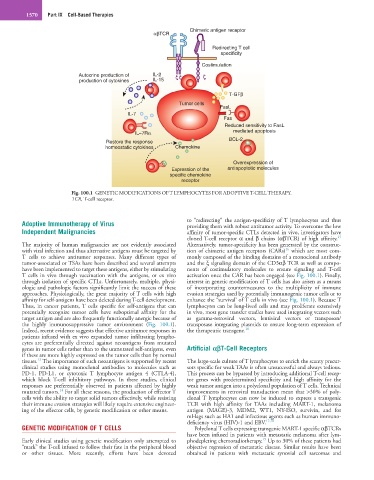
                        Fig. 100.1  GENETIC MODIFICATIONS OF T LYMPHOCYTES FOR ADOPTIVE T-CELL THERAPY.
                        TCR, T-cell receptor.


        Adoptive Immunotherapy of Virus                       to  “redirecting”  the  antigen-specificity  of T  lymphocytes  and  thus
                                                              providing them with robust antitumor activity. To overcome the low
        Independent Malignancies                              affinity of tumor-specific CTLs detected in vivo, investigators have
                                                                                                               15
                                                              cloned T-cell receptor α and β chains (αβTCR) of high affinity.
        The  majority  of  human  malignancies  are  not  evidently  associated   Alternatively, tumor-specificity has been generated by the construc-
                                                                                              16
        with viral infection and thus alternative antigens must be targeted by   tion  of  chimeric  antigen  receptors  (CARs)   which  are  most  com-
        T  cells  to  achieve  antitumor  responses.  Many  different  types  of   monly composed of the binding domains of a monoclonal antibody
        tumor-associated or TSAs have been described and several attempts   and the ξ signaling domain of the CD3αβ TCR as well as compo-
        have been implemented to target these antigens, either by stimulating   nents  of  costimulatory  molecules  to  ensure  signaling  and  T-cell
        T  cells  in  vivo  through  vaccination  with  the  antigens,  or  ex  vivo   activation once the CAR has been engaged (see Fig. 100.1). Finally,
        through isolation of specific CTLs. Unfortunately, multiple, physi-  interest in genetic modification of T cells has also arisen as a means
        ologic and pathologic factors significantly limit the success of these   of  incorporating  countermeasures  to  the  multiplicity  of  immune
        approaches. Physiologically, the great majority of T cells with high   evasion strategies used by potentially immunogenic tumor cells or to
        affinity for self-antigens have been deleted during T-cell development.   enhance the “survival’ of T cells in vivo (see Fig. 100.1). Because T
        Thus, in cancer patients, T cells specific for self-antigens that can   lymphocytes can be long-lived cells and may proliferate extensively
        potentially  recognize  tumor  cells  have  suboptimal  affinity  for  the   in vivo, most gene transfer studies have used integrating vectors such
        target antigen and are also frequently functionally anergic because of   as  gamma-retroviral  vectors,  lentiviral  vectors  or  transposon/
        the  highly  immunosuppressive  tumor  environment  (Fig.  100.1).   transposase integrating plasmids to ensure long-term expression of
        Indeed, recent evidence suggests that effective antitumor responses in   the therapeutic transgene. 16
        patients infused with ex vivo expanded tumor infiltrating lympho-
        cytes  are  preferentially  directed  against  neoantigens  from  mutated
        genes in tumor cells rather than to the unmutated self-antigens, even   Artificial αβT-Cell Receptors
        if these are more highly expressed on the tumor cells than by normal
             13
        tissues.  The importance of such neoantigens is supported by recent   The large-scale culture of T lymphocytes to enrich the scanty precur-
        clinical  studies  using  monoclonal  antibodies  to  molecules  such  as   sors specific for weak TAAs is often unsuccessful and always tedious.
        PD-1,  PD-L1,  or  cytotoxic  T  lymphocyte  antigen  4  (CTLA-4),   This process can be bypassed by introducing additional T-cell recep-
        which  block  T-cell  inhibitory  pathways.  In  these  studies,  clinical   tor  genes  with  predetermined  specificity  and  high  affinity  for  the
        responses  are  preferentially  observed  in  patients  affected  by  highly   weak tumor antigen into a polyclonal population of T cells. Technical
                     14
        mutated tumors.  For all these reasons, the production of effector T   improvements in retroviral transduction mean that >30% of poly-
        cells with the ability to target solid tumors effectively, while resisting   clonal T lymphocytes can now be induced to express a transgenic
        their immune evasion strategies will likely require extensive engineer-  TCR  with  high  affinity  for  TAAs  including  MART-1,  melanoma
        ing of the effector cells, by genetic modification or other means.  antigen  (MAGE)-3,  MDM2,  WT1,  NY-ISO,  survivin,  and  for
                                                              mHags such as HA1 and infectious agents such as human immuno-
                                                              deficiency virus (HIV)-1 and EBV. 17,18
        GENETIC MODIFICATION OF T CELLS                          Polyclonal T cells expressing transgenic MART-1 specific αβTCRs
                                                              have been infused in patients with metastatic melanoma after lym-
                                                                                       15
        Early clinical studies using genetic modification only attempted to   phodepleting chemoradiotherapy.  Up to 30% of these patients had
        “mark” the T-cell infused to follow their fate in the peripheral blood   objective regression of metastatic disease. Similar results have been
        or  other  tissues.  More  recently,  efforts  have  been  devoted   obtained  in  patients  with  metastatic  synovial  cell  sarcomas  and

