


Page 1768 - Hematology_ Basic Principles and Practice ( PDFDrive )
P. 1768
1572   Part IX  Cell-Based Therapies


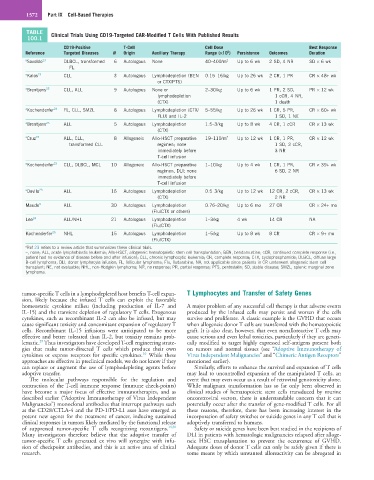
          TABLE   Clinical Trials Using CD19-Targeted CAR-Modified T Cells With Published Results
          100.1
                      CD19-Positive      T-Cell                     Cell Dose                         Best Response
         Reference    Targeted Diseases  N  Origin  Auxiliary Therapy  Range (×10 )  Persistence  Outcomes  Duration
                                                                           6
         a Savoldo 23  DLBCL, transformed   6  Autologous  None     40–400/m 2  Up to 6 wk  2 SD, 4 NR  SD × 6 wk
                        FL
         a Kalos 23   CLL             3  Autologous  Lymphodepletion (BEN   0.15–16/kg  Up to 26 wk  2 CR, 1 PR  CR × 48+ wk
                                                     or CTX/PTS)
         a Brentjens 23  CLL, ALL     9  Autologous  None or        2–30/kg    Up to 6 wk  1 PR, 2 SD,    PR × 12 wk
                                                     lymphodepletion                       1 cCR, 4 NR,
                                                     (CTX)                                 1 death
         a Kochenderfer 23  FL, CLL, SMZL  8  Autologous  Lymphodepletion (CTX/  5–55/kg  Up to 26 wk  1 CR, 5 PR,    CR × 60+ wk
                                                     FLU) and IL-2                         1 SD, 1 NE
         a Brentjens 23  ALL          5  Autologous  Lymphodepletion   1.5–3/kg  Up to 8 wk  4 CR, 1 cCR  CR × 13 wk
                                                     (CTX)
         a Cruz 23    ALL, CLL,       8  Allogeneic  Allo-HSCT preparative   19–110/m 2  Up to 12 wk  1 CR, 1 PR,    CR × 12 wk
                        transformed CLL              regimen; none                         1 SD, 2 cCR,
                                                     immediately before                    3 NR
                                                     T-cell infusion
         a Kochenderfer 23  CLL, DLBCL, MCL  10  Allogeneic  Allo-HSCT preparative   1–10/kg  Up to 4 wk  1 CR, 1 PR,    CR × 39+ wk
                                                     regimen, DLI; none                    6 SD, 2 NR
                                                     immediately before
                                                     T-cell infusion
         a Davila 23  ALL            16  Autologous  Lymphodepletion   0.5–3/kg  Up to 12 wk  12 CR, 2 cCR,    CR × 13 wk
                                                     (CTX)                                 2 NR
         Maude 3      ALL            30  Autologous  Lymphodepletion  0.76–20/kg  Up to 6 mo  27 CR   CR × 24+ mo
                                                   (Flu/CTX or others)
         Lee 24       ALL/NHL        21  Autologous  Lymphodepletion  1–3/kg   4 wk      14 CR        NA
                                                   (Flu/CTX)
         Kochenderfer 25  NHL        15  Autologous  Lymphodepletion  1–5/kg   Up to 8 wk  8 CR       CR × 9+ mo
                                                   (Flu/CTX)
         a Ref 23 refers to a review article that summarizes these clinical trials.
         –, none; ALL, acute lymphoblastic leukemia; Allo-HSCT, allogeneic hematopoietic stem cell transplantation; BEN, bendamustine; cCR, continued complete response (i.e.,
         patient had no evidence of disease before and after infusion); CLL, chronic lymphocytic leukemia; CR, complete response; CTX, cyclophosphamide; DLBCL, diffuse large
         B-cell lymphoma; DLI, donor lymphocyte infusion; FL, follicular lymphoma; Flu, fludarabine; NA, not applicable since patients in CR underwent allogeneic stem cell
         transplant; NE, not evaluable; NHL, non-Hodgkin lymphoma; NR, no response; PR, partial response; PTS, pentostatin; SD, stable disease; SMZL, splenic marginal zone
         lymphoma.


        tumor-specific T cells in a lymphodepleted host benefits T-cell expan-  T Lymphocytes and Transfer of Safety Genes
        sion,  likely  because  the  infused  T  cells  can  exploit  the  favorable
        homeostatic  cytokine  milieu  (including  production  of  IL-7  and   A major problem of any successful cell therapy is that adverse events
        IL-15) and the transient depletion of regulatory T cells. Exogenous   produced  by  the  infused  cells  may  persist  and  worsen  if  the  cells
        cytokines, such as recombinant IL-2 can also be infused, but may   survive and proliferate. A classic example is the GVHD that occurs
        cause significant toxicity and concomitant expansion of regulatory T   when allogeneic donor T cells are transferred with the hematopoietic
        cells.  Recombinant  IL-15  infusions  were  anticipated  to  be  more   graft. It is also clear, however, that even nonalloreactive T cells may
        effective and better tolerated than IL-2, but toxicity remains prob-  cause serious and even lethal toxicities, particularly if they are geneti-
              29
        lematic.  Thus investigators have developed T-cell engineering strate-  cally modified to target highly expressed self-antigens present both
        gies  that  make  tumor-directed  T  cells  which  produce  their  own   on  tumors  and  normal  tissues  (see  “Adoptive  Immunotherapy  of
                                                16
        cytokines  or  express  receptors  for  specific  cytokines.  While  these   Virus Independent Malignancies” and “Chimeric Antigen Receptors”
        approaches are effective in preclinical models, we do not know if they   mentioned earlier).
        can  replace  or  augment  the  use  of  lymphodepleting  agents  before   Similarly, efforts to enhance the survival and expansion of T cells
        adoptive transfer.                                    may lead to uncontrolled expansion of the manipulated T cells, an
           The  molecular  pathways  responsible  for  the  regulation  and   event that may even occur as a result of retroviral genotoxicity alone.
        contraction of the T-cell immune response (immune check-points)   While  malignant  transformation  has  so  far  only  been  observed  in
        have  become  a  major  focus  of  effective  immunotherapies,  and  as   clinical  studies  of  hematopoietic  stem  cells  transduced  by  murine
        described earlier (“Adoptive Immunotherapy of Virus Independent   oncoretroviral  vectors,  there  is  understandable  concern  that  it  can
        Malignancies”) monoclonal antibodies that interrupt pathways such   potentially occur after the transfer of gene-modified T cells. For all
        as the CD28/CTLA-4 and the PD-1/PD-L1 axes have emerged as   these  reasons,  therefore,  there  has  been  increasing  interest  in  the
        potent new agents for the treatment of cancer, inducing sustained   incorporation of safety switches or suicide genes in any T cell that is
        clinical responses in tumors likely mediated by the functional release   adoptively transferred to humans.
        of  suppressed  tumor-specific  T  cells  recognizing  neoantigens. 14,30    Safety or suicide genes have been best studied in the recipients of
        Many  investigators  therefore  believe  that  the  adoptive  transfer  of   DLI in patients with hematologic malignancies relapsed after alloge-
        tumor-specific  T  cells  generated  ex  vivo  will  synergize  with  infu-  neic  HSC  transplantation  to  prevent  the  occurrence  of  GVHD.
        sion of checkpoint antibodies, and this is an active area of clinical     Adequate doses of donor T cells can only be safely given if there is
        research.                                             some means by which unwanted alloreactivity can be abrogated in

