


Page 1818 - Hematology_ Basic Principles and Practice ( PDFDrive )
P. 1818
1620   Part X  Transplantation


        A current consensus, the “missing self” hypothesis, 21,22  is that NK   NK  cells  can  attune  themselves  to  the  new  HLA  environment,
        cells have evolved to detect and rapidly eliminate virally infected or   indicating  that  NK  cell  alloreactivity  is  a  complex  and  dynamic
                                                                        29
        tumor cells that have downregulated cell surface expression of MHC   phenomenon.  Because the genes comprising the LRC and the HLA
                                    +
        class  I  molecules  to  evade  the  CD8   T-cell  arm  of  the  immune   locus  are  on  chromosomes  19  and  6,  respectively,  KIR  and  HLA
        response.                                             molecules are inherited independently, so individuals can inherit an
           The  molecular  basis  of  NK  cell  alloreactivity  is  incompletely   iKIR  but  not  its  ligand,  resulting  in  an  NK  cell  that  cannot  be
        understood,  but  it  involves  a  dynamic  balance  of  signals  through   licensed  during  development.  Unlicensed  NK  cells  would  be  pre-
        activating as well as inhibitory receptors on the NK cell. The killer   dicted to be poorly functional; unexpectedly, however, they dominate
                                                                                                            30
        immunoglobulin-like receptors (KIRs) are encoded by a set of linked   the early response to cytomegalovirus (CMV) infection in mice,  and
        genes called the leukocyte receptor complex (LRC) on human chro-  they also may be potent mediators of antibody-dependent cellular
                      23
                                                                       31
        mosome 19q13.4.  KIRs contain two or three extracellular Ig-like   cytotoxicity.  DNA damage resulting from transplant conditioning
        domains and either a short (S) or a long (L) cytoplasmic tail, which   or inflammatory conditions such as viral infection may be sufficient
                                                                                                      32
        mediates  activating  or  inhibitory  signals,  respectively. The  LRC  is   to induce stress ligands of NK cell activation receptors,  break toler-
        marked by significant interindividual variation in KIR gene content   ance in unlicensed NK cells, and generate autoreactivity, 33–35  includ-
                                                      24
        as well as significant allelic variation in individual KIR genes.  As a   ing tumor regression. In contrast to HLA-matched transplants, where
        consequence, the KIR locus is second only to the HLA locus in the   donors and recipients express the same ligands for iKIRs, in HLA-
        number of polymorphisms, and unrelated individuals are unlikely to   haploidentical SCTs, the recipient may lack the HLA ligand for the
        share KIR genotypes.                                  iKIR on a licensed donor NK cell, releasing the cell from inhibition
           Distinct HLA class I molecules comprise the ligands for specific   and resulting in donor NK cell alloreactivity. Unlicensed donor NK
        inhibitory KIRs (iKIRs). An organizing principle of NK cell biology   cells may also be activated by a dominance of stimulatory NK cell
        is that NK cell self-tolerance is mediated by inhibitory signals deliv-  ligands in the inflammatory milieu of a conditioned recipient, but
        ered by self HLA class I molecules through iKIRs. The ontogeny of   this scenario is not unique to HLA-haploidentical SCT and may also
        receptor expression on individual NK cells is poorly understood, but   occur after HLA-matched SCT as long as the recipient lacks HLA
        it is currently thought that each NK cell expresses at least one inhibi-  ligands  for  iKIR  molecules.  Although  the  mechanisms  of  NK  cell
                                         25
        tory receptor for a self HLA class I molecule.  There are four distinct   alloreactivity remain to be fully elucidated, there is great interest in
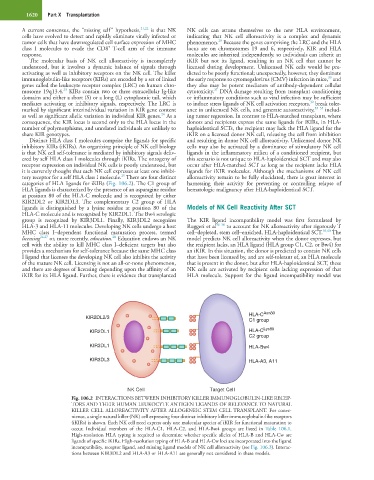
        categories of HLA ligands for iKIRs (Fig. 106.2). The C1 group of   harnessing  their  activity  for  preventing  or  controlling  relapse  of
        HLA ligands is characterized by the presence of an asparagine residue   hematologic malignancy after HLA-haploidentical SCT.
        at position 80 of the HLA-C molecule and is recognized by either
        KIR2DL2  or  KIR2DL3.  The  complementary  C2  group  of  HLA
        ligands  is  distinguished  by  a  lysine  residue  at  position  80  of  the   Models of NK Cell Reactivity After SCT
        HLA-C molecule and is recognized by KIR2DL1. The Bw4 serologic
        group  is  recognized  by  KIR3DL1.  Finally,  KIR3DL2  recognizes   The  KIR  ligand  incompatibility  model  was  first  formulated  by
        HLA-3 and HLA-11 molecules. Developing NK cells undergo a host   Ruggeri et al 36–38  to account for NK alloreactivity after rigorously T
        MHC  class  I–dependent  functional  maturation  process,  termed   cell–depleted, stem cell–enriched, HLA-haploidentical SCT. 39,40  The
                                      28
        licensing 26,27  or, more recently, education.  Education endows an NK   model predicts NK cell alloreactivity when the donor expresses, but
        cell with the ability to kill MHC class I–deficient targets but also   the recipient lacks, an HLA ligand (HLA group C1, C2, or Bw4) for
        provides a mechanism for self-tolerance because the same MHC class   an iKIR. In this situation, the donor is predicted to contain NK cells
        I ligand that licenses the developing NK cell also inhibits the activity   that have been licensed by, and are self-tolerant of, an HLA molecule
        of the mature NK cell. Licensing is not an all-or-none phenomenon,   that is present in the donor, but after HLA-haploidentical SCT, these
        and there are degrees of licensing depending upon the affinity of an   NK cells are activated by recipient cells lacking expression of that
        iKIR for its HLA ligand. Further, there is evidence that transplanted   HLA  molecule.  Support  for  the  ligand  incompatibility  model  was


                                                                                  HLA-C Asn80
                             KIR2DL2/3
                                                                                  C1 group
                              KIR2DL1                                             HLA-C Lys80
                                                                                  C2 group
                              KIR3DL1                                             HLA-Bw4

                              KIR3DL3                                             HLA-A3, A11


                                           NK Cell                    Target Cell
                        Fig. 106.2  INTERACTIONS BETWEEN INHIBITORY KILLER IMMUNOGLOBULIN-LIKE RECEP-
                        TORS AND THEIR HUMAN LEUKOCYTE ANTIGEN LIGANDS OF RELEVANCE TO NATURAL
                        KILLER  CELL  ALLOREACTIVITY  AFTER  ALLOGENEIC  STEM  CELL TRANSPLANT.  For  conve-
                        nience, a single natural killer (NK) cell expressing four distinct inhibitory killer immunoglobulin-like receptors
                        (iKIRs) is shown. Each NK cell need express only one molecular species of iKIR for functional maturation to
                        occur.  Individual  members  of  the  HLA-C1,  HLA-C2,  and  HLA-Bw4  groups  are  listed  in  Table  106.1.
                        High-resolution HLA typing is required to determine whether specific alleles of HLA-B and HLA-Cw are
                        ligands of specific iKIRs. High-resolution typing of HLA-B and HLA-Cw loci are incorporated into the ligand
                        incompatibility, receptor ligand, and missing ligand models of NK cell alloreactivity (see Fig. 106.3). Interac-
                        tions between KIR3DL2 and HLA-A3 or HLA-A11 are generally not considered in these models.

