


Page 1816 - Hematology_ Basic Principles and Practice ( PDFDrive )
P. 1816
1618   Part X  Transplantation


                                                            a    b               c    d
                                                      0201  A    A   3101  0201  A    A  0101
                              Antigen                 1513  B    B   1502  0702  B    B  5701
                               ∗
                                {
                        HLA-A 0201                    0102  Cw   Cw  0305  0701  Cw  Cw  0602
                                   {
                     Locus     Allele                 0701  DRB1 DRB1 0404  0401  DRB1 DRB1 0101
                                                      0303  DQB1 DQB1 0302  0304  DQB1 DQB1 0501
                   A
                                                             Mother               Father

                                               a    c         a    c     a    c     a    c     b   d

                                               A    A         A    A     A    A     A   A      A   A
                                               B    B         B    B     B    B     B   B      B   B
                                              Cw   Cw        Cw   Cw    Cw   Cw    Cw   Cw    Cw   Cw
                                             DRB1 DRB1      DRB1 DRB1  DRB1 DRB1  DRB1 DRB1  DRB1 DRB1
                                             DQB1 DQB1      DQB1 DQB1  DQB1 DQB1  DQB1 DQB1  DQB1 DQB1
                                        B      Patient          1          2  Siblings  3        4


                                A1     A2      B1     B2     Cw1    Cw2   DRB1-1 DRB1-2  DQB1-1  DQB1-2
                       Patient  0201   0201   1513   0702   0102    0701   0701   0401   0303    0304
                       Sibling 2  0201  0101  1513   5701   0102    0602   0701   0101   0303    0601

                       Patient  0201   0201   0702   1513   0701    0102   0401   0701   0304    0303
                   C   Sibling 3  0201  3101  0702   1502   0701    0305   0401   0404   0304    0302

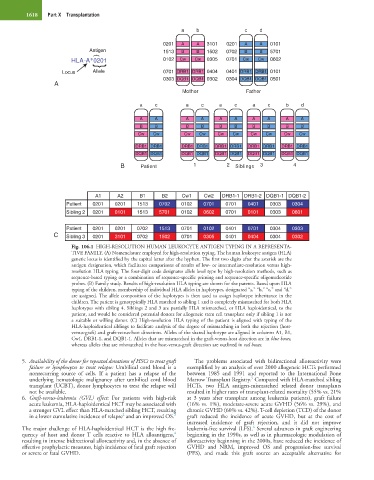
                        Fig. 106.1  HIGH-RESOLUTION HUMAN LEUKOCYTE ANTIGEN TYPING IN A REPRESENTA-
                        TIVE FAMILY. (A) Nomenclature employed for high-resolution typing. The human leukocyte antigen (HLA)
                        genetic locus is identified by the capital letter after the hyphen. The first two digits after the asterisk are the
                        antigen designation, which facilitates comparisons of results of low- or intermediate-resolution versus high-
                        resolution HLA typing. The four-digit code designates allele level type by high-resolution methods, such as
                        sequence-based typing or a combination of sequence-specific priming and sequence-specific oligonucleotide
                        probes. (B) Family study. Results of high-resolution HLA typing are shown for the parents. Based upon HLA
                        typing of the children, membership of individual HLA alleles in haplotypes, designated “a,” “b,” “c,” and “d,”
                        are assigned. The allele composition of the haplotypes is then used to assign haplotype inheritance in the
                        children. The patient is genotypically HLA matched to sibling 1 and is completely mismatched for both HLA
                        haplotypes with sibling 4. Siblings 2 and 3 are partially HLA mismatched, or HLA haploidentical, to the
                        patient, and would be considered potential donors for allogeneic stem cell transplant only if sibling 1 is not
                        a suitable or willing donor. (C) High-resolution HLA typing of the patient is aligned with typing of the
                        HLA-haploidentical siblings to facilitate analysis of the degree of mismatching in both the rejection (host-
                        versus-graft) and graft-versus-host directions. Alleles of the shared haplotype are aligned in columns A1, B1,
                        Cw1, DRB1-1, and DQB1-1. Alleles that are mismatched in the graft-versus-host direction are in blue boxes,
                        whereas alleles that are mismatched in the host-versus-graft direction are outlined in red boxes.

        5.  Availability of the donor for repeated donations of HSCs to treat graft   The  problems  associated  with  bidirectional  alloreactivity  were
           failure  or  lymphocytes  to  treat  relapse:  Umbilical  cord  blood  is  a   exemplified by an analysis of over 2000 allogeneic HCTs performed
           nonrecurring  source  of  cells.  If  a  patient  has  a  relapse  of  the   between  1985  and  1991  and  reported  to  the  International  Bone
                                                                                   5
           underlying  hematologic  malignancy  after  umbilical  cord  blood   Marrow Transplant Registry.  Compared with HLA-matched sibling
           transplant (UCBT), donor lymphocytes to treat the relapse will   HCTs,  two  HLA  antigen-mismatched  related  donor  transplants
           not be available.                                  resulted in higher rates of transplant-related mortality (55% vs. 21%
        6.  Graft-versus-leukemia  (GVL)  effect:  For  patients  with  high-risk   at  3  years  after  transplant  among  leukemia  patients),  graft  failure
           acute leukemia, HLA-haploidentical HCT may be associated with   (16% vs. 1%), moderate-severe acute GVHD (56% vs. 29%), and
           a stronger GVL effect than HLA-matched sibling HCT, resulting   chronic GVHD (60% vs. 42%). T-cell depletion (TCD) of the donor
                                         2
           in a lower cumulative incidence of relapse  and an improved OS. 3  graft  reduced  the  incidence  of  acute  GVHD,  but  at  the  cost  of
                                                              increased  incidence  of  graft  rejection,  and  it  did  not  improve
                                                                                    6
        The major challenge of HLA-haploidentical HCT is the high fre-  leukemia-free survival (LFS).  Several advances in graft engineering
                                                          4
        quency  of  host  and  donor  T  cells  reactive  to  HLA  alloantigens,    beginning in the 1990s, as well as in pharmacologic modulation of
        resulting in intense bidirectional alloreactivity and, in the absence of   alloreactivity beginning in the 2000s, have reduced the incidence of
        effective prophylactic measures, high incidence of fatal graft rejection   GVHD  and  NRM,  improved  OS  and  progression-free  survival
        or severe or fatal GVHD.                              (PFS),  and  made  this  graft  source  an  acceptable  alternative  for

