


Page 1911 - Hematology_ Basic Principles and Practice ( PDFDrive )
P. 1911
Chapter 110  Human Blood Group Antigens and Antibodies  1691


                                  Single-pass proteins
                                   MNSs (GPA/GPB)
                                   Gerbich (GPC/GPD)
                                   Indian (CD44)                                              GPI-linked proteins
                                   Knops (CR1)                                                    Cromer (DAF)
                                   Lutheran (B-CAM)                                               Yt (AChE)
                                   LW (ICAM-4)                                                    Dombrock (ART4)
                                   Xg                                                             JMH
                                   Sc (ERMAP)
                                              Kell               Multipass proteins                         NH 2
                  Carbohydrate
                                  NH 2       COOH                        Rh (12 pass)
                       ABO                                               RhAg (12 pass)
                       Hh                                                Kx (10 pass)
                       Lewis                                             Diego (Band 3, 14 pass)
                       I                                                 Colton (AQP-1, 10 pass)
                 P1                           NH 2     Duffy (7 pass)    Kidd (10 pass)
                 P                                                                                      Outside


                         COOH                 NH 2            COOH         NH 2     COOH

                                                    N-glycan   O-glycan    GPI-linker
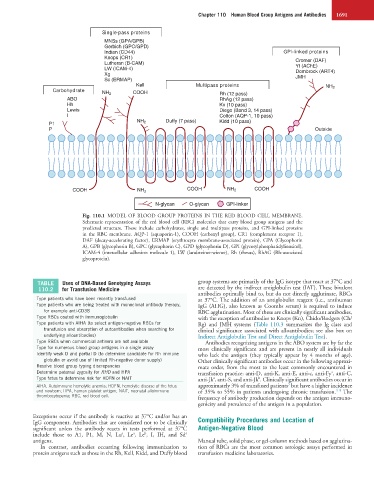
                            Fig. 110.1  MODEL OF BLOOD GROUP PROTEINS IN THE RED BLOOD CELL MEMBRANE.
                            Schematic  representation  of the  red  blood cell (RBC)  molecules  that  carry blood group antigens and  the
                            predicted  structure. These  include  carbohydrates,  single  and  multipass  proteins,  and  GPI-linked  proteins
                            in  the  RBC  membrane.  AQP-1  (aquaporin-1),  COOH  (carboxyl  group),  CR1  (complement  receptor  1),
                            DAF  (decay-accelerating  factor),  ERMAP  (erythrocyte  membrane-associated  protein),  GPA  (Glycophorin
                            A), GPB (glycophorin B), GPC (glycophorin C), GPD (glycophorin D), GPI (glycosylphosphatidylinositol),
                            ICAM-4  (intercellular  adhesion  molecule  1),  LW  (landsteiner-wiener),  Rh  (rhesus),  RhAG  (Rh-associated
                            glycoprotein).


             TABLE   Uses of DNA-Based Genotyping Assays          group systems are primarily of the IgG isotype that react at 37°C and
              110.2  for Transfusion Medicine                     are detected by the indirect antiglobulin test (IAT). These bivalent
                                                                  antibodies optimally bind to, but do not directly agglutinate, RBCs
             Type patients who have been recently transfused      at 37°C. The addition of an antiglobulin reagent (i.e., antihuman
             Type patients who are being treated with monoclonal antibody therapy,   IgG (AHG), also known as Coombs serum) is required to induce
               for example anti-CD38                              RBC agglutination. Most of these are clinically significant antibodies,
             Type RBCs coated with immunoglobulin                 with the exception of antibodies to Knops (Kn), Chido/Rodgers (Ch/
             Type patients with AIHA (to select antigen-negative RBCs for   Rg)  and  JMH  systems  (Table  110.3  summarizes  the  Ig  class  and
               transfusion and absorption of autoantibodies when searching for   clinical significance associated with alloantibodies; see also box on
               underlying alloantibodies)                         Indirect Antiglobulin Test and Direct Antiglobulin Test).
             Type RBCs when commercial antisera are not available   Antibodies recognizing antigens in the ABO system are by far the
             Type for numerous blood group antigens in a single assay  most  clinically  significant  and  are  present  in  nearly  all  individuals
             Identify weak D and partial D (to determine candidate for Rh immune   who  lack  the  antigen  (they  typically  appear  by  4  months  of  age).
               globulin or avoid use of limited Rh-negative donor supply)  Other clinically significant antibodies occur in the following approxi-
             Resolve blood group typing discrepancies             mate order, from the most to the least commonly encountered in
             Determine paternal zygosity for RHD and HPA          transfusion practice: anti-D, anti-K, anti-E, anti-c, anti-Fy , anti-C,
                                                                                                             a
             Type fetus to determine risk for HDFN or NAIT        anti-Jk , anti-S, and anti-Jk . Clinically significant antibodies occur in
                                                                                      b
                                                                       a
                                                                                               3
             AIHA, Autoimmune hemolytic anemia; HDFN, hemolytic disease of the fetus   approximately 3% of transfused patients  but have a higher incidence
             and newborn; HPA, human platelet antigen; NAIT, neonatal alloimmune   of 35% to 55% in patients undergoing chronic transfusion.  The
                                                                                                               4–8
             thrombocytopenia; RBC, red blood cell.               frequency of antibody production depends on the antigen immuno-
                                                                  genicity and prevalence of the antigen in a population.
            Exceptions occur if the antibody is reactive at 37°C and/or has an
            IgG component. Antibodies that are considered not to be clinically   Compatibility Procedures and Location of
            significant  unless  the  antibody  reacts  in  tests  performed  at  37°C   Antigen-Negative Blood
                                         a
                                                b
                                             a
            include  those  to  A1,  P1,  M,  N,  Lu ,  Le ,  Le ,  I,  IH,  and  Sd   a
            antigens.                                             Manual tube, solid phase, or gel-column methods based on agglutina-
              In  contrast,  antibodies  occurring  following  immunization  to   tion of RBCs are the most common serologic assays performed in
            protein antigens such as those in the Rh, Kell, Kidd, and Duffy blood   transfusion medicine laboratories.

