


Page 1914 - Hematology_ Basic Principles and Practice ( PDFDrive )
P. 1914
1694   Part XI  Transfusion Medicine

        Blood Group Systems                                   add specific monosaccharides in specific linkages to a growing oligo-
                                                                                                              15
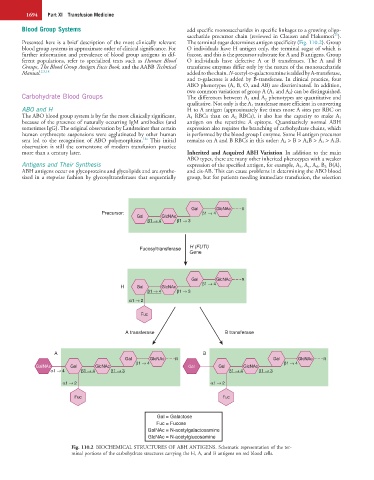
                                                              saccharide precursor chain (reviewed in Clausen and Hakomori ).
        Presented here is a brief description of the most clinically relevant   The terminal sugar determines antigen specificity (Fig. 110.2). Group
        blood group systems in approximate order of clinical significance. For   O individuals have H antigen only, the terminal sugar of which is
        further information and prevalence of blood group antigens in dif-  fucose, and this is the precursor substrate for A and B antigens. Group
        ferent  populations,  refer  to  specialized  texts  such  as  Human  Blood   O  individuals  have  defective  A  or  B  transferases.  The  A  and  B
        Groups, The Blood Group Antigen Facts Book, and the AABB Technical   transferase enzymes differ only by the nature of the monosaccharide
        Manual. 2,3,14                                        added to the chain. N-acetyl-D-galactosamine is added by A-transferase,
                                                              and  D-galactose is added by B-transferase. In clinical practice, four
                                                              ABO phenotypes (A, B, O, and AB) are discriminated. In addition,
                                                              two common variations of group A (A 1 and A 2) can be distinguished.
        Carbohydrate Blood Groups                             The differences between A 1 and A 2 phenotypes are quantitative and
                                                              qualitative. Not only is the A 1 transferase more efficient in converting
        ABO and H                                             H to A antigen (approximately five times more A sites per RBC on
        The ABO blood group system is by far the most clinically significant,   A 1  RBCs  than  on  A 2  RBCs),  it  also  has  the  capacity  to  make  A 1
        because of the presence of naturally occurring IgM antibodies (and   antigen  on  the  repetitive  A  epitope.  Quantitatively  normal  ABH
        sometimes IgG). The original observation by Landsteiner that certain   expression also requires the branching of carbohydrate chains, which
        human erythrocyte suspensions were agglutinated by other human   is performed by the blood group I enzyme. Some H antigen precursor
                                                14a
        sera  led  to  the  recognition  of  ABO  polymorphism.  This  initial   remains on A and B RBCs in this order: A 2 > B > A 2B > A 1 > A 1 B.
        observation  is  still  the  cornerstone  of  modern  transfusion  practice
        more than a century later.                            Inherited and Acquired ABH Variation  In addition to the main
                                                              ABO types, there are many other inherited phenotypes with a weaker
        Antigens and Their Synthesis                          expression of the specified antigen, for example, A 3 , A x , A el , B 3,  B(A),
        ABH antigens occur on glycoproteins and glycolipids and are synthe-  and cis-AB. This can cause problems in determining the ABO blood
        sized in a stepwise fashion by glycosyltransferases that sequentially   group, but for patients needing immediate transfusion, the selection


                                                                Gal     GlcNAc  R
                                  Precursor:                       β1   4
                                              Gal     GlcNAc
                                                 β1   4    β1   3


                                               Fucosyltransferase  H (FUTI)
                                                               Gene


                                                                Gal     GlcNAc  R
                                                                   β1   4
                                         H    Gal     GlcNAc
                                                 β1   4    β1   3
                                           α1   2

                                               Fuc

                                          A transferase                    B transferase


                   A                                               B
                                          Gal     GlcNAc  R                               Gal      GlcNAc  R
                                             β1   4                                           β1   4
             GalNAc     Gal     GlcNAc                         Gal       Gal     GlcNAc
                  α1   4    β1   4   β1   3                                 β1   4    β1   3
                      α1   2                                          α1   2
                         Fuc                                              Fuc


                                                    Gal = Galactose
                                                    Fuc = Fucose
                                                 GalNAc = N-acetylgalactosamine
                                                 GlcNAc = N-acetylglucosamine

                        Fig. 110.2  BIOCHEMICAL STRUCTURES OF ABH ANTIGENS. Schematic representation of the ter-
                        minal portions of the carbohydrate structures carrying the H, A, and B antigens on red blood cells.

