


Page 1912 - Hematology_ Basic Principles and Practice ( PDFDrive )
P. 1912
1692   Part XI  Transfusion Medicine


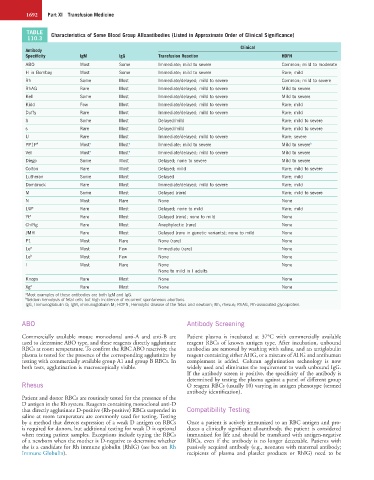
          TABLE   Characteristics of Some Blood Group Alloantibodies (Listed in Approximate Order of Clinical Significance)
          110.3
                                                                                Clinical
         Antibody
         Specificity       IgM          IgG          Transfusion Reaction                    HDFN
         ABO               Most         Some         Immediate; mild to severe               Common; mild to moderate
         H in Bombay       Most         Some         Immediate; mild to severe               Rare; mild
         Rh                Some         Most         Immediate/delayed; mild to severe       Common; mild to severe
         RhAG              Rare         Most         Immediate/delayed; mild to severe       Mild to severe
         Kell              Some         Most         Immediate/delayed; mild to severe       Mild to severe
         Kidd              Few          Most         Immediate/delayed; mild to severe       Rare; mild
         Duffy             Rare         Most         Immediate/delayed; mild to severe       Rare; mild
         S                 Some         Most         Delayed/mild                            Rare; mild to severe
         s                 Rare         Most         Delayed/mild                            Rare; mild to severe
         U                 Rare         Most         Immediate/delayed; mild to severe       Rare; severe
         PP1P k            Most a       Most a       Immediate; mild to severe               Mild to severe b
         Vel               Most a       Most a       Immediate/delayed; mild to severe       Mild to severe
         Diego             Some         Most         Delayed; none to severe                 Mild to severe
         Colton            Rare         Most         Delayed; mild                           Rare; mild to severe
         Lutheran          Some         Most         Delayed                                 Rare; mild
         Dombrock          Rare         Most         Immediate/delayed; mild to severe       Rare; mild
         M                 Some         Most         Delayed (rare)                          Rare; mild to severe
         N                 Most         Rare         None                                    None
         LW a              Rare         Most         Delayed; none to mild                   Rare; mild
         Yt a              Rare         Most         Delayed (rare); none to mild            None
         Ch/Rg             Rare         Most         Anaphylactic (rare)                     None
         JMH               Rare         Most         Delayed (rare in genetic variants); none to mild  None
         P1                Most         Rare         None (rare)                             None
         Le a              Most         Few          Immediate (rare)                        None
         Le b              Most         Few          None                                    None
         I                 Most         Rare         None                                    None
                                                     None to mild in I adults
         Knops             Rare         Most         None                                    None
         Xg a              Rare         Most         None                                    None
         a Most examples of these antibodies are both IgM and IgG.
         b Seldom hemolysis of fetal cells but high incidence of recurrent spontaneous abortions.
         IgG, Immunoglobulin G; IgM, immunoglobulin M; HDFN, Hemolytic disease of the fetus and newborn; Rh, rhesus; RhAG, Rh-associated glycoprotein.

        ABO                                                   Antibody Screening

        Commercially  available  mouse  monoclonal  anti-A  and  anti-B  are   Patient  plasma  is  incubated  at  37°C  with  commercially  available
        used to determine ABO type, and these reagents directly agglutinate   reagent  RBCs  of  known  antigen  type.  After  incubation,  unbound
        RBCs at room temperature. To confirm the RBC ABO reactivity, the   antibodies are removed by washing with saline, and an antiglobulin
        plasma is tested for the presence of the corresponding agglutinins by   reagent containing either AHG, or a mixture of AHG and antihuman
        testing with commercially available group A1 and group B RBCs. In   complement  is  added.  Column  agglutination  technology  is  now
        both tests, agglutination is macroscopically visible.  widely used and eliminates the requirement to wash unbound IgG.
                                                              If the antibody screen is positive, the specificity of the antibody is
                                                              determined by testing the plasma against a panel of different group
        Rhesus                                                O reagent RBCs (usually 10) varying in antigen phenotype (termed
                                                              antibody identification).
        Patient and donor RBCs are routinely tested for the presence of the
        D antigen in the Rh system. Reagents containing monoclonal anti-D
        that directly agglutinate D-positive (Rh-positive) RBCs suspended in   Compatibility Testing
        saline at room temperature are commonly used for testing. Testing
        by a method that detects expression of a weak D antigen on RBCs   Once a patient is actively immunized to an RBC antigen and pro-
        is required for donors, but additional testing for weak D is optional   duces a clinically significant alloantibody, the patient is considered
        when testing patient samples. Exceptions include typing the RBCs   immunized for life and should be transfused with antigen-negative
        of a newborn when the mother is D-negative to determine whether   RBCs,  even  if  the  antibody  is  no  longer  detectable.  Patients  with
        she is a candidate for Rh immune globulin (RhIG) (see box on Rh   passively acquired antibody (e.g., neonates with maternal antibody;
        Immune Globulin).                                     recipients  of  plasma  and  platelet  products  or  RhIG)  need  to  be

