


Page 1931 - Hematology_ Basic Principles and Practice ( PDFDrive )
P. 1931
Chapter 111  Principles of Red Blood Cell Transfusion  1711


            many of these procedures are now performed using laparoscopy or   in fact, manufacturers contraindicate the use of cell salvage in cases
            other  techniques  to  limit  blood  loss,  the  demand  for  predeposit   where there is potential contamination of salvaged blood with enteric
            autologous transfusion support has fallen in recent years.  contents. However, in recent years this viewpoint has been reconsid-
              Autologous blood has been safely collected from women during   ered as studies have found that autotransfusion of microbiologically
            pregnancy  for  use  during  childbirth.  Nevertheless,  the  transfusion   contaminated salvaged blood have demonstrated no adverse outcomes
            rate at delivery is quite low (<2.5% in many institutions) and most   or increase in postoperative infectious complications. Tumor cells have
            autologous  donations  are  unused.  Long-term  (frozen)  storage  of   been  found  in  blood  salvaged  during  cancer  operations,  and  thus
            autologous RBCs in the absence of a planned transfusion episode is   many practitioners consider cancer another contraindication. Others
            largely ineffective and expensive.                    believe that filtration would remove salvaged tumor cells.
                                                                    Approximately one-half the blood lost during surgery can be sal-
                                                                  vaged. The rest is usually irretrievably absorbed in drapes and sponges
            Intraoperative Blood Salvage                          or damaged during collection. The use of salvaged autologous blood
                                                                  has been associated with a 50% reduction in allogeneic blood use in
            Cell salvage occurs in three phases: collection, washing, and reinfu-  orthopedic procedures such as spinal surgery and hip replacement, and
            sion. RBCs are collected from the operative field using a dedicated   is also effective in vascular surgical procedures such as aortic recon-
            double lumen suction device. One lumen suctions blood from the   struction. Autologous salvage has been a useful adjunct in the treatment
            operative field and the other lumen adds heparinized saline to the   of  some  Jehovah’s  Witnesses  whose  literal  acceptance  of  the  Bible
            salvaged blood. The anticoagulated blood then passes through a filter   includes abstention from routine allogeneic blood transfusions.
            and is collected in a reservoir. If less than 1 L of blood is collected,   Both  the  canister  systems  and  RBC  processors  used  to  collect
            further processing is foregone and the collected blood is discarded.  intraoperative autologous blood can also be used to collect postopera-
              In most circumstances the contents in the bag can be washed to   tive blood drainage, such as that from the mediastinum after open
            remove free Hb, surgical irrigation solutions, and other debris. Instru-  heart surgery, from the knee or hip after orthopedic procedures, or
            ments are available that include both a reservoir for collecting salvaged   from the peritoneal cavity after hepatic injury. Because blood salvaged
            blood and a centrifugal washer. Large aliquots (>500 mL) can be fully   from a serosal cavity has little residual fibrinogen and platelets, clot-
            washed in as little as 3 minutes. As a result of this speed, autologous   ting is not a problem, and the addition of anticoagulants is usually
            blood salvage has become practical in situations in which blood loss   unnecessary. Shed mediastinal blood after open-heart surgery contains
            may be extremely rapid, such as trauma or liver transplantation.  high levels of cardiac muscle enzymes, especially creatine kinase, as
              The hematocrit level of unwashed blood is typically low because   well  as  lactate  dehydrogenase  from  hemolyzed  RBCs.  Therefore,
            of dilution from irrigating surgical fluids and some degree of mechani-  reinfusion of shed blood results in elevated levels of both enzymes
            cal hemolysis. Free Hb levels are sometimes greater than 1000 mg in   that can confound the diagnosis of myocardial infarction (MI) in the
            unwashed  blood,  and  hemoglobinemia  and  hemoglobinuria  may   postoperative period. Reinfusion of shed mediastinal blood has been
            occur after the transfusion, although renal sequelae are surprisingly   shown to reduce the need for allogeneic transfusions.
            low.  Despite  this  evidence  of  red  cell  injury,  the  survival  rate  of
            51 Cr-labeled salvaged cells is normal in most patients studied.
              There  are  many  potential  complications  associated  with  cell   Hemodilution
            salvage, such as nonimmune hemolysis, air embolus, febrile nonhe-
            molytic  transfusion  reactions,  mistransfusion,  coagulopathy,  and     The collection of autologous blood during surgery for later reinfusion
            contamination with drugs. Transfusion of salvaged blood has resulted   at the end of the procedure was first suggested in open-heart opera-
            in  coagulation  abnormalities,  including  hypofibrinogenemia,  pro-  tions, in which it was hoped that a supply of platelets undamaged by
            longed prothrombin time and partial thromboplastin time, elevated   exposure to the membrane oxygenator might reduce the incidence of
            fibrin degradation products, and thrombocytopenia. These coagula-  coagulopathies. Hemodilution itself reduces RBC loss: a patient with
            tion abnormalities most likely reflect the characteristics of the salvaged   a hematocrit level of 45% and 2 L blood loss during surgery loses
            blood itself, which, after exposure to serosal surfaces, becomes defi-  roughly 900 mL of RBCs, but one with a hematocrit level of 20%
            cient in coagulation factors and platelets and, in the case of unwashed   from hemodilution loses only 400 mL of RBCs. Hemodilution is less
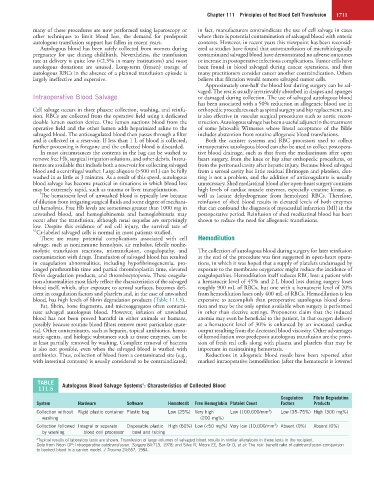
            blood, has high levels of fibrin degradation products (Table 111.5).  expensive to accomplish than preoperative autologous blood dona-
              Fat, fibrin, bone fragments, and microaggregates often contami-  tion and may be the only option available when surgery is performed
            nate  salvaged  autologous  blood.  However,  infusion  of  unwashed   in  other  than  elective  settings.  Proponents  claim  that  the  induced
            blood  has  not  been  proved  harmful  in  either  animals  or  humans,   anemia may even be beneficial to the patient, in that oxygen delivery
            possibly because routine blood filters remove most particulate mate-  at  a  hematocrit  level  of  30%  is  enhanced  by  an  increased  cardiac
            rial. Other contaminants, such as heparin, topical antibiotics, hemo-  output resulting from the decreased blood viscosity. Other advantages
            static agents, and biologic substances such as tissue enzymes, can be   of hemodilution over predeposit autologous transfusion are the provi-
            at least partially removed by washing. Complete removal of bacteria   sion of fresh red cells along with plasma and platelets that may be
            is also not possible, even when the salvaged blood is washed with   important in maintaining hemostasis.
            antibiotics. Thus, collection of blood from a contaminated site (e.g.,   Reductions  in  allogeneic  blood  needs  have  been  reported  after
            with intestinal contents) is usually considered to be contraindicated;   marked intraoperative hemodilution (after the hematocrit is lowered


             TABLE   Autologous Blood Salvage Systems : Characteristics of Collected Blood
                                                a
              111.5
                                                                                             Coagulation   Fibrin Degradation
             System        Hardware       Software      Hematocrit  Free Hemoglobin Platelet Count  Factors  Products
                                                                                         3
             Collection without  Rigid plastic container Plastic bag  Low (25%) Very high   Low (100,000/mm )  Low (35–75%) High (300 mg%)
               washing                                             (200 mg%)
                                                                                           3
             Collection followed  Integral or separate   Disposable plastic  High (60%) Low (<50 mg%) Very low (10,000/mm ) Absent (0%)  Absent (0%)
               by washing   blood cell processor  bowl and tubing
             a Typical results of laboratory tests are shown. Transfusion of large volumes of salvaged blood results in similar alterations in these tests in the recipient.
             Data from Noon GP: Intraoperative autotransfusion. Surgery 84:719, 1978; and Silva R, Moore EE, Bar-Or D, et al: The risk: benefit ratio of autotransfusion-comparison
             to banked blood in a canine model. J Trauma 24:557, 1984.

