


Page 1932 - Hematology_ Basic Principles and Practice ( PDFDrive )
P. 1932
1712   Part XI  Transfusion Medicine


        by  50%).  More  modest  hemodilution  (e.g.,  removal  of  2  units  of   coagulation  factors  and  WBCs. There  are  two  main  categories  of
        blood  at  the  beginning  of  surgery)  is  also  beneficial,  according  to   oxygen carriers that show promise as RBC substitutes: perfluorocar-
        some investigators but the amount of red cells saved is small. Fur-  bons (PFCs) and Hb-based oxygen carriers (HBOC).
        thermore, one group has provided evidence that hemodilution may
        jeopardize  patients  at  risk  of  ischemic  myocardial  injury.  More
        research is needed to establish the safety, efficacy, and ideal protocols   Perfluorocarbons
        for this form of blood conservation. The availability of blood substi-
        tutes may facilitate augmented hemodilution for some patients who   PFCs  are  chemically  and  biologically  inert  artificial  fluorinated
        are expected to have large volumes of blood loss or who refuse blood   organic fluids that are immiscible in water and have a high solubility
        transfusions.                                         for oxygen. The amount of dissolved oxygen in PFC is linearly related
                                                              to  the  ambient  oxygen  tension,  unlike  Hb;  gas  molecules  are  not
                                                              chemically bound to PFCs but are absorbed and released by simple
        BLOOD SUBSTITUTES                                     diffusion. Products require oxygen inhalation by the patient, as the
                                                              oxygen delivery capacity is less than 30% of normal blood. PFC has
        The  search  for  blood  substitutes  began  when  our  early  scientific   been shown to reduce the need for RBC transfusion, but has been
        ancestors tested alternatives to human blood, including animal blood,   associated with an increase in stroke rates. Although some PFCs are
        milk,  and  wine.  Modern  research  into  the  use  of  animal  blood   still  being  investigated,  there  are  no  major  trials  ongoing  and  no
        includes the work by Amberson et al, who reported the successful use   licensed products in the United States.
        of a bovine hemosylate for exchange transfusions in cats and dogs.
        Further work revealed that human and bovine hemosylates caused
        renal dysfunction in human recipients. The suspected cause of this   Hemoglobin-Based Oxygen Carriers
        nephrotoxicity was the stromal lipid component of the RBC mem-
        brane. The logical next step in the search for the ideal substitute was   As RBCs age and degrade, the stroma and unmodified Hb released
        the development of stroma-free Hb (Hb tetramer). Unfortunately, in   can lead to various adverse effects in the transfused recipients. There-
        1978  Savitsky  et al  demonstrated  renal  dysfunction,  hypertension,   fore, the HBOC that were most recently in clinical development were
        and abdominal pain using stroma-free Hb in healthy volunteers. It   stroma-free and engineered to produce desirable oxygen dissociation
        was hypothesized that these adverse events were due to the instability   characteristics as well as an adequate in vivo half-life with minimal
        of the Hb tetramer. Since then, efforts have been made to produce   toxicities. Stroma-free Hb has a very high oxygen affinity compared
        stabilized products with desirable oxygen off-loading characteristics   with native Hb in a RBC because of a lack of 2,3-DPG. Furthermore,
        and extended intravascular retention times.           the  Hb  tetramer  is  such  a  small  molecule  that  the  kidney  rapidly
           Today, the United States blood supply is increasingly safe and has   removes it.
        sufficient  capacity  to  meet  most  patient  needs. There  is  room  for   Four different methods have been suggested to avoid toxicities:
        considerable improvement, however, in supply levels and risk reduc-  stabilization, polymerization, conjugation, and Hb vesicles. HBOC
        tion. The shrinking donor pool (owing to lack of willingness and/or   can  be  prepared  from  different  Hb  sources  (e.g.,  bovine  RBCs  or
        ability)  and  the  increasing  transfusion  requirements  of  an  aging   recombinant Hb harvested from bacteria/yeasts). However, the safety
        population may lead to shortage of blood products. The threat of   concerns of using Hb from nonhuman sources, such as the potential
        new and emerging infections results in the vulnerability of human-  for  transmitting  diseases,  immunogenicity,  and  toxicities  have  not
        derived  oxygen  carriers.  The  continuous  battle  against  emerging   been  fully  addressed.  While  one  of  the  commercially  available
        infectious diseases underscore the risk of a tainted blood supply and   HBOCs (e.g., Bovine-derived Oxyglobin, HBOC-301) is approved
        depletion  of  transfusion  resources. Theoretically,  the  ideal  red  cell   for veterinary use, there is no HBOC product approved for clinical
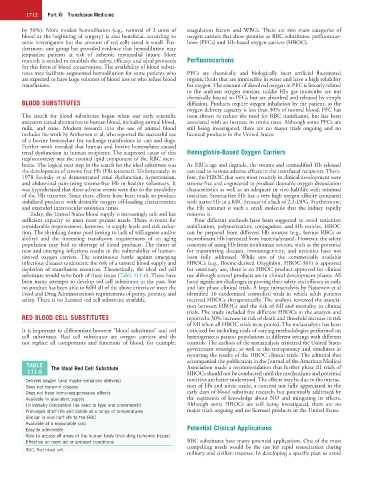
        substitute would solve both of these issues (Table 111.6). There have   use although several products are in clinical development phases. All
        been many attempts to develop red cell substitutes in the past, but   faced significant challenges in proving their safety and efficacy in early
        no product has been able to fulfil all of the above criteria or meet the   and late phase clinical trials. A large metaanalysis by Natanson et al
        Food and Drug Administration’s requirements of purity, potency, and   identified  16  randomized  controlled  trials  in  which  adult  patients
        safety. There is no licensed red cell substitute available.  received HBOCs therapeutically. The analysis reviewed the associa-
                                                              tion between HBOCs and the risk of MI and mortality in clinical
                                                              trials. The study included five different HBOCs in the analysis and
        RED BLOOD CELL SUBSTITUTES                            reported a 30% increase in risk of death and threefold increase in risk
                                                              of MI when all HBOC trials were pooled. The metaanalysis has been
        It is important to differentiate between “blood substitutes” and red   criticized for including trials of varying methodologies performed on
        cell  substitutes.  Red  cell  substitutes  are  oxygen  carriers  and  do     heterogeneous patient populations in different settings with different
        not  replace  all  components  and  functions  of  blood,  for  example,   controls. The authors of the metaanalysis criticized the United States
                                                              government oversight, as well as the transparency and timeliness in
                                                              reporting the results of the HBOC clinical trials. The editorial that
                                                              accompanied the publication in the Journal of the American Medical
          TABLE   The Ideal Red Cell Substitute               Association made a recommendation that further phase III trials of
          111.6                                               HBOCs should not be conducted until the mechanisms and potential
         Delivers oxygen (and maybe enhances delivery)        toxicities are better understood. The effects may be due to the interac-
         Does not transmit disease                            tion of Hb and nitric oxide, a concern not fully appreciated in the
         Does not have immunosuppressive effects              early days of blood substitute research, but potentially addressed by
         Available in abundant supply                         the  expansion  of  knowledge  about  NO  and  mitigating  its  effects.
         Universally compatible (no need to type and crossmatch)  Although  some  HBOCs  are  still  being  investigated,  there  are  no
         Prolonged shelf-life and stable at a range of temperatures  major trials ongoing and no licensed products in the United States.
         Similar in vivo half-life to the RBC
         Available at a reasonable cost
         Easy to administer                                   Potential Clinical Applications
         Able to access all areas of the human body (including ischemic tissue)
         Effective on room air or ambient conditions          RBC substitutes have many potential applications. One of the most
                                                              compelling  needs  would  be  the  use  for  rapid  resuscitation  during
         RBC, Red blood cell.
                                                              military and civilian traumas. In developing a specific plan to avoid

