


Page 1936 - Hematology_ Basic Principles and Practice ( PDFDrive )
P. 1936
1716   Part XI  Transfusion Medicine


                        40
                     Days with Bleeding of Grade  2 or Higher % 30
                        35

                        25
                        20
                        15
                        10


                         0 5
                           1−5  6−10  11−15  16−20  21−25  26−30  31−35  36−40  41−45  46−50  51−55  56−60  61−65  66−70  71−75  76−80  81−85  86−90  91−95 96−100  >100

                                               Morning Platelet-Count Category (x10 -3 /mm 3 )
                    No.of   652 3240 3843 3194 2449 1976 1501 1182 1009 774 677 513 409 358 298 232 192 162 140 139 1369
                    Days
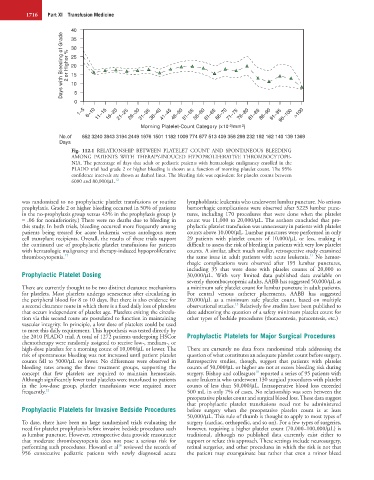
                        Fig.  112.1  RELATIONSHIP  BETWEEN  PLATELET  COUNT  AND  SPONTANEOUS  BLEEDING
                        AMONG  PATIENTS  WITH  THERAPY-INDUCED  HYPOPROLIFERATIVE  THROMBOCYTOPE-
                        NIA. The percentage of days that adult or pediatric patients with hematologic malignancy enrolled in the
                        PLADO trial had grade 2 or higher bleeding is shown as a function of morning platelet count. The 95%
                        confidence intervals are shown as dashed lines. The bleeding risk was equivalent for platelet counts between
                        6000 and 80,000/µL.
                                       12

        was randomized to no prophylactic platelet transfusions or routine   lymphoblastic leukemia who underwent lumbar puncture. No serious
        prophylaxis. Grade 2 or higher bleeding occurred in 50% of patients   hemorrhagic complications were observed after 5223 lumbar punc-
        in the no-prophylaxis group versus 43% in the prophylaxis group (p   tures,  including  170  procedures  that  were  done  when  the  platelet
        = .06 for noninferiority.) There were no deaths due to bleeding in   count was 11,000 to 20,000/µL. The authors concluded that pro-
        this study. In both trials, bleeding occurred more frequently among   phylactic platelet transfusion was unnecessary in patients with platelet
        patients  being  treated  for  acute  leukemia  versus  autologous  stem   counts above 10,000/µL. Lumbar punctures were performed in only
        cell transplant recipients. Overall, the results of these trials support   29  patients  with  platelet  counts  of  10,000/µL  or  less,  making  it
        the continued use of prophylactic platelet transfusions for patients   difficult to assess the risk of bleeding in patients with very low platelet
        with hematologic malignancy and therapy-induced hypoproliferative   counts. A similar, albeit much smaller, retrospective study examined
                                                                                                      17
        thrombocytopenia. 15                                  the same issue in adult patients with acute leukemia.  No hemor-
                                                              rhagic  complications  were  observed  after  195  lumbar  punctures,
                                                              including  35  that  were  done  with  platelet  counts  of  20,000  to
        Prophylactic Platelet Dosing                          30,000/µL.  With  very  limited  data  published  data  available  on
                                                              severely thrombocytopenic adults, AABB has suggested 50,000/µL as
        There are currently thought to be two distinct clearance mechanisms   a minimum safe platelet count for lumbar puncture in adult patients.
        for platelets. Most platelets undergo senescence after circulating in   For  central  venous  catheter  placements,  AABB  has  suggested
        the peripheral blood for 8 to 10 days. But there is also evidence for   20,000/µL  as  a  minimum  safe  platelet  count,  based  on  multiple
                                                                              15
        a second clearance route in which there is a fixed daily loss of platelets   observational studies.  Relatively few studies have been published to
        that occurs independent of platelet age. Platelets exiting the circula-  date addressing the question of a safety minimum platelet count for
        tion via this second route are postulated to function in maintaining   other types of bedside procedures (thoracentesis, paracentesis, etc.)
        vascular integrity. In principle, a low dose of platelets could be used
        to meet this daily requirement. This hypothesis was tested directly by
        the 2010 PLADO trial. A total of 1272 patients undergoing HSCor   Prophylactic Platelets for Major Surgical Procedures
        chemotherapy were randomly assigned to receive low-, medium-, or
        high-dose platelets for a morning count of 10,000/µL or lower. The   There are currently no data from randomized trials addressing the
        risk of spontaneous bleeding was not increased until patient platelet   question of what constitutes an adequate platelet count before surgery.
        counts  fell  to  5000/µL  or  lower.  No  differences  were  observed  in   Retrospective  studies,  though,  suggest  that  patients  with  platelet
        bleeding  rates  among  the  three  treatment  groups,  supporting  the   counts of 50,000/µL or higher are not at excess bleeding risk during
                                                                                     18
        concept  that  few  platelets  are  required  to  maintain  hemostasis.   surgery. Bishop and colleagues  reported a series of 95 patients with
        Although significantly fewer total platelets were transfused to patients   acute leukemia who underwent 130 surgical procedures with platelet
        in  the  low-dose  group,  platelet  transfusions  were  required  more   counts  of  less  than  50,000/µL.  Intraoperative  blood  loss  exceeded
        frequently. 12                                        500 mL in only 7% of cases. No relationship was seen between the
                                                              preoperative platelet count and surgical blood loss. These data suggest
                                                              that  prophylactic  platelet  transfusions  need  not  be  administered
        Prophylactic Platelets for Invasive Bedside Procedures  before  surgery  when  the  preoperative  platelet  count  is  at  least
                                                              50,000/µL. This rule of thumb is thought to apply to most types of
        To date, there have been no large randomized trials evaluating the   surgery (cardiac, orthopedic, and so on). For a few types of surgeries,
        need for platelet prophylaxis before invasive bedside procedures such   however, requiring a higher platelet count (70,000–100,000/µL) is
        as lumbar puncture. However, retrospective data provide reassurance   traditional,  although  no  published  data  currently  exist  either  to
        that  moderate  thrombocytopenia  does  not  pose  a  serious  risk  for   support or refute this approach. These settings include neurosurgery,
                                        16
        performing such procedures. Howard et al  reviewed the records of   retinal surgeries, and other procedures in which the risk is not that
        956  consecutive  pediatric  patients  with  newly  diagnosed  acute   the  patient  may  exsanguinate  but  rather  that  even  a  minor  bleed

