


Page 1980 - Hematology_ Basic Principles and Practice ( PDFDrive )
P. 1980
1754   Part XI  Transfusion Medicine


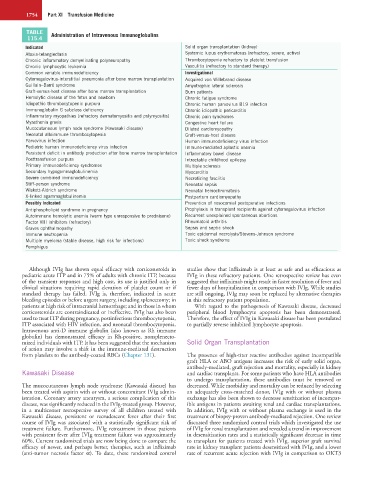
          TABLE   Administration of Intravenous Immunoglobulins
          115.4
         Indicated                                            Solid organ transplantation (kidney)
         Ataxia-telangiectasia                                Systemic lupus erythematosus (refractory, severe, active)
         Chronic inflammatory demyelinating polyneuropathy    Thrombocytopenia refractory to platelet transfusion
         Chronic lymphocytic leukemia                         Vasculitis (refractory to standard therapy)
         Common variable immunodeficiency                     Investigational
         Cytomegalovirus-interstitial pneumonia after bone marrow transplantation  Acquired von Willebrand disease
         Guillain–Barré syndrome                              Amyotrophic lateral sclerosis
         Graft-versus-host disease after bone marrow transplantation  Burn patients
         Hemolytic disease of the fetus and newborn           Chronic fatigue syndrome
         Idiopathic thrombocytopenic purpura                  Chronic human parvovirus B19 infection
         Immunoglobulin G subclass deficiency                 Chronic idiopathic pericarditis
         Inflammatory myopathies (refractory dermatomyositis and polymyositis)  Chronic pain syndromes
         Myasthenia gravis                                    Congestive heart failure
         Mucocutaneous lymph node syndrome (Kawasaki disease)  Dilated cardiomyopathy
         Neonatal alloimmune thrombocytopenia                 Graft-versus-host disease
         Parvovirus infection                                 Human immunodeficiency virus infection
         Pediatric human immunodeficiency virus infection     Immune-mediated aplastic anemia
         Persistent deficit in antibody production after bone marrow transplantation  Inflammatory bowel disease
         Posttransfusion purpura                              Intractable childhood epilepsy
         Primary immunodeficiency syndromes                   Multiple sclerosis
         Secondary hypogammaglobulinemia                      Myocarditis
         Severe combined immunodeficiency                     Necrotizing fasciitis
         Stiff-person syndrome                                Neonatal sepsis
         Wiskott-Aldrich syndrome                             Neonatal hemochromatosis
         X-linked agammaglobulinemia                          Postpartum cardiomyopathy
         Possibly Indicated                                   Prevention of nosocomial postoperative infections
         Antiphospholipid syndrome in pregnancy               Prophylaxis in transplant recipients against cytomegalovirus infection
         Autoimmune hemolytic anemia (warm type unresponsive to prednisone)  Recurrent unexplained spontaneous abortions
         Factor VIII inhibitors (refractory)                  Rheumatoid arthritis
         Graves ophthalmopathy                                Sepsis and septic shock
         Immune neutropenia                                   Toxic epidermal necrolysis/Stevens-Johnson syndrome
         Multiple myeloma (stable disease, high risk for infections)  Toxic shock syndrome
         Pemphigus


           Although IVIg has shown equal efficacy with corticosteroids in   studies show that infliximab is at least as safe and as efficacious as
        pediatric acute ITP and in 75% of adults with chronic ITP, because   IVIg in these refractory patients. One retrospective review has even
        of the transient responses and high cost, its use is justified only in   suggested that infliximab might result in faster resolution of fever and
        clinical  situations  requiring  rapid  elevation  of  platelet  count  or  if   fewer days of hospitalization in comparison with IVIg. While studies
        standard  therapy  has  failed.  IVIg  is,  therefore,  indicated  in  acute   are still ongoing, IVIg may soon be replaced by alternative therapies
        bleeding episodes or before urgent surgery, including splenectomy; in   in this refractory patient population.
        patients at high risk of intracranial hemorrhage; and in those in whom   With regard to the pathogenesis of Kawasaki disease, decreased
        corticosteroids are contraindicated or ineffective. IVIg has also been   peripheral  blood  lymphocyte  apoptosis  has  been  demonstrated.
        used to treat ITP during pregnancy, postinfectious thrombocytopenia,   Therefore, the effect of IVIg in Kawasaki disease has been postulated
        ITP associated with HIV infection, and neonatal thrombocytopenia.   to partially reverse inhibited lymphocyte apoptosis.
        Intravenous  anti-D  immune  globulin  (also  known  as  Rh  immune
        globulin)  has  demonstrated  efficacy  in  Rh-positive,  nonsplenecto-
        mized individuals with ITP. It has been suggested that the mechanism   Solid Organ Transplantation
        of action may involve a shift in the immune-mediated destruction
        from platelets to the antibody-coated RBCs (Chapter 131).  The presence of high-titer reactive antibodies against incompatible
                                                              graft HLA or ABO antigens increases the risk of early solid organ,
                                                              antibody-mediated, graft rejection and mortality, especially in kidney
        Kawasaki Disease                                      and cardiac transplants. For some patients who have HLA antibodies
                                                              to  undergo  transplantation,  these  antibodies  must  be  removed  or
        The mucocutaneous lymph node syndrome (Kawasaki disease) has   decreased. While morbidity and mortality can be reduced by selecting
        been treated with aspirin with or without concomitant IVIg admin-  an  adequately  cross-matched  donor,  IVIg  with  or  without  plasma
        istration. Coronary artery aneurysm, a serious complication of this   exchange has also been shown to decrease sensitization of incompat-
        disease, was significantly reduced in the IVIg-treated group. However,   ible antigens in patients awaiting renal and cardiac transplantations.
        in  a  multicenter  retrospective  survey  of  all  children  treated  with   In addition, IVIg with or without plasma exchange is used in the
        Kawasaki  disease,  persistent  or  recrudescent  fever  after  their  first   treatment of biopsy-proven antibody-mediated rejection. One review
        course of IVIg was associated with a statistically significant risk of   discussed three randomized control trials which investigated the use
        treatment  failure.  Furthermore,  IVIg  retreatment  in  those  patients   of IVIg for renal transplantation and revealed a trend in improvement
        with persistent fever after IVIg treatment failure was approximately   in desensitization rates and a statistically significant decrease in time
        60%. Current randomized trials are now being done to compare the   to transplant for patients treated with IVIg, superior graft survival
        efficacy of newer, and perhaps better, therapies, such as infliximab   rate in kidney transplant patients desensitized with IVIg, and a lower
        (anti-tumor  necrosis  factor  α). To  date,  these  randomized  control   rate of recurrent acute rejection with IVIg in comparison to OKT3

