


Page 1975 - Hematology_ Basic Principles and Practice ( PDFDrive )
P. 1975
Chapter 115  Transfusion of Plasma and Plasma Derivatives  1749


            complement  cascade,  cytokine  release,  and  pulmonary  edema.   TACO is also likely underdiagnosed and underreported. Studies show
            Approximately 5% of TRALI is caused by the opposite mechanisms,   that the mean age of patients who develop TACO range from about
            which  are  recipient  white  cell  antibodies  against  transfused  donor   70  to  85  years.  Additional  known  risk  factors  for TACO  include
            white cells. Nonimmune mechanisms are also postulated to mediate   larger volumes of transfusion, greater plasma transfusion volume, and
            TRALI, including bioactive lipids and CD40 ligand.    a faster transfusion rate. The incidence of TACO is unknown, but it
              TRALI  is  the  most  common  cause  of  transfusion-associated   is increasingly recognized clinically. Studies have reported the inci-
            mortality in the United States and is usually associated with transfu-  dence to range from 1 in 356 to 1 in 10,000 blood products transfused
            sion of blood products containing large volumes of plasma containing   or 1% to 8% of transfusion recipients, depending on the study popu-
            white blood cell antibodies. Patients at higher risk include those with   lation and data collection methodology, and are currently associated
            shock,  chronic  alcohol  abuse,  positive  fluid  balance,  higher  peak   with a mortality rate of 5% to 15% in the United States.
            airway  pressure,  and  current  smoker.  Signs  and  symptoms  appear   Symptoms  include  dyspnea,  orthopnea,  cough,  chest  tightness,
            within 2 to 6 hours of transfusion and include respiratory distress   cyanosis, hypertension, and headache. Symptoms usually present at
            with dyspnea, tachypnea, hypoxia, fever, tachycardia, and hypoten-  the end of transfusion but may occur up to 6 hours posttransfusion.
            sion. Bilateral pulmonary infiltrates on chest x-ray may be seen with   Diagnosis is based on the presence of cardiogenic pulmonary edema.
            no evidence of left atrial hypertension. In cases of suspected TRALI,   Management  includes  discontinuing  transfusion,  diuretic  therapy,
            the  transfusion  should  be  discontinued.  Medical  management  is   oxygen supplementation, and sitting the patient upright. Avoiding
            primarily  supportive,  commonly  with  supplemental  oxygen  and   rapid  transfusion  can  prevent  TACO,  unless  clinically  indicated.
            endotracheal intubation, if needed. Diuresis is not indicated, and the   Transfusions  should  be  administered  slowly,  usually  1 mL/kg/h,
            role of steroids is unclear. The majority of patients improve within 2   particularly in patients at risk for TACO.
            days, although TRALI has a 5% to 25% mortality rate.
              Multiple strategies have been implemented to reduce the risk of
            TRALI and have resulted in a substantial decline in its incidence.   CRYOPRECIPITATE
            First, donors implicated in prior TRALI reactions are deferred from
            further blood donation. Second, multiparous female donors can be   Cryoprecipitate is prepared from 1 unit of FFP thawed at 4°C. The
            tested for HLA and HNA antibodies, and blood products with high   precipitate is then refrozen and stored at −18°C or colder for 1 year.
            volume  plasma  (i.e.,  plasma  and  apheresis  platelets)  are  not  made   Cryoprecipitate, volume of 10 to 15 mL, contains 80 to 100 units
            from  those  with  high-titer  antibodies.  Third,  plasma  supplied  to   of factor VIII, 100 to 250 mg of fibrinogen, and 50 to 60 mg of
            hospitals  for  transfusion  can  be  only  from  male  donors  while  the   fibronectin as well as vWF and factor XIII.
            female plasma is diverted for fractionation. Currently, these strategies   Cryoprecipitate takes 10 to 15 minutes to thaw at 30°C to 37°C,
            have reduced the risk of TRALI from 1 : 4000 to 1 : 12,000 without   and then requires pooling before infusion. Prepooled (pooled before
            significantly reducing blood product availability.    storage) cryoprecipitate products are now available, easing the burden
                                                                  of preparation on the transfusion services. Once pooled and thawed,
                                                                  cryoprecipitate  is  maintained  at  20°C  to  24°C  and  outdates  in  4
            Allergic Reactions                                    hours (6 hours if unpooled or pooled in a closed system).
            Allergic transfusion reactions occur when preformed recipient anti-
            bodies  bind  to  transfused  allergens.  Allergic  transfusion  reactions   Indications
            occur in approximately 1% to 3% of plasma transfusions. Anaphy-
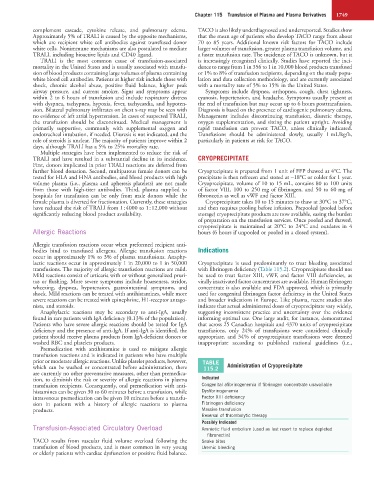
            lactic reactions occur in approximately 1 in 20,000 to 1 in 50,000   Cryoprecipitate  is  used  predominantly  to  treat  bleeding  associated
            transfusions. The majority of allergic transfusion reactions are mild.   with fibrinogen deficiency (Table 115.2). Cryoprecipitate should not
            Mild reactions consist of urticaria with or without generalized pruri-  be  used  to  treat  factor  XIII,  vWF,  and  factor VIII  deficiencies,  as
            tus or flushing. More severe symptoms include hoarseness, stridor,   virally inactivated factor concentrates are available. Human fibrinogen
            wheezing,  dyspnea,  hypotension,  gastrointestinal  symptoms,  and   concentrate is also available and FDA approved, which is primarily
            shock. Mild reactions can be treated with antihistamines, while more   used for congenital fibrinogen factor deficiency in the United States
            severe reactions can be treated with epinephrine, H1-receptor antago-  and broader indications in Europe. Like plasma, recent studies also
            nists, and steroids.                                  indicate that actual administered doses of cryoprecipitate vary widely,
              Anaphylactic  reactions  may  be  secondary  to  anti-IgA,  usually   suggesting  inconsistent  practice  and  uncertainty  over  the  evidence
            found in rare patients with IgA deficiency (0.13% of the population).   informing optimal use. One large audit, for instance, demonstrated
            Patients who have severe allergic reactions should be tested for IgA   that across 25 Canadian hospitals and 4370 units of cryoprecipitate
            deficiency and the presence of anti-IgA. If anti-IgA is identified, the   transfusions,  only  24%  of  transfusions  were  considered  clinically
            patient should receive plasma products from IgA-deficient donors or   appropriate, and 34% of cryoprecipitate transfusions were deemed
            washed RBC and platelets products.                    inappropriate  according  to  published  national  guidelines  (i.e.,
              Premedication  with  antihistamine  is  used  to  mitigate  allergic
            transfusion reactions and is indicated in patients who have multiple
            prior or moderate allergic reactions. Unlike platelet products, however,   TABLE
            which can be washed or concentrated before administration, there   115.2  Administration of Cryoprecipitate
            are currently no other preventative measures, other than premedica-
            tion, to diminish the risk or severity of allergic reactions in plasma   Indicated
            transfusion recipients. Consequently, oral premedication with anti-  Congenital afibrinogenemia if fibrinogen concentrate unavailable
            histamines can be given 30 to 60 minutes before a transfusion, while   Dysfibrinogenemia
            intravenous premedication can be given 10 minutes before a transfu-  Factor XIII deficiency
            sion  in  patients  with  a  history  of  allergic  reactions  to  plasma   Fibrinogen deficiency
            products.                                              Massive transfusion
                                                                   Reversal of thrombolytic therapy
                                                                   Possibly Indicated
            Transfusion-Associated Circulatory Overload            Amniotic fluid embolism (used as last resort to replace depleted
                                                                     fibronectin)
            TACO  results  from  vascular  fluid  volume  overload  following  the   Snake bites
            transfusion of blood products, and is most common in very young   Uremic bleeding
            or elderly patients with cardiac dysfunction or positive fluid balance.

