


Page 1983 - Hematology_ Basic Principles and Practice ( PDFDrive )
P. 1983
Chapter 115  Transfusion of Plasma and Plasma Derivatives  1757

            Antithymocyte Globulin                                  Rh  Ig  doses  are  substantially  higher  for  the  treatment  of  ITP:
                                                                  50 µg/kg  for  hemoglobin  ≥10 L/dL  and  25  to  40 µg/kg  when
            Antithymocyte  globulin  is  a  purified  concentrated  globulin  made   hemoglobin  is  8  to  10 g/dL.  Rh  Ig  use  in  ITP  is  indicated  in
            from  hyperimmune  serum  of  horses  immunized  with  human  T   D-positive patients with intact spleen. Adverse events at high doses
            lymphocytes.  Antithymocyte  globulin  is  used  in  renal  transplant   of Rh Ig include hemolysis, DIC, and rarely death (Chapter 131).
            patients as an adjunct therapy in the treatment of graft rejection. It
            is also used in patients with aplastic anemia who are not candidates
            for bone marrow transplantation.                      SUGGESTED READINGS

                                                                  AABB:  Information  piece:  alternatives  to  transfusable  single-donor  plasma
            Hyperimmune Immunoglobulin                              components.   <http://www.aabb.org/programs/clinical/Documents/
                                                                    Alternatives-to-Transfusable-Single-Donor-Plasma-Components.pdf>,
            Hyperimmune globulin is used to prevent the development of specific   2014.
            clinical disease or alter its symptomatology. Hepatitis B Ig is used to   AABB:  Standards  for  blood  banks  and  transfusion  services,  ed  29,  Bethesda
            provide passive immunity to hepatitis B virus associated with needle   (MD), 2014, AABB.
            stick  exposure  or  sexual  contact  with  hepatitis  B  surface  antigen-  Bellver  J,  Muñoz  EA,  Ballesteros  A,  et al:  Intravenous  albumin  does  not
            positive  individuals,  postliver  transplantation  for  prevention  of   prevent moderate-severe ovarian hyperstimulation syndrome in high-risk
            recurrence, and prevention of hepatitis B vertical transmission. Other   IVF patients: a randomized controlled study. Hum Reprod 18:2283–2288,
            hyperimmunoglobulins include botulism, CMV, hepatitis A, rabies,   2003.
            respiratory  syncytial  virus,  tetanus,  vaccinia,  and  varicella-zoster    Callum JL, Karkouti K, Lin Y: Cryoprecipitate: The current state of knowl-
            virus Igs.                                              edge. Transfus Med Rev 23:177–188, 2009.
                                                                  Cardigan R, Lawrie AS, Mackie IJ, et al: The quality of fresh-frozen plasma
                                                                    produced from whole blood stored at 4°C overnight. Transfusion 45:1342,
            Rh Immunoglobulin                                       2005.
                                                                  Eder AF, Sebok MA: Plasma components: FFP, FP24, and thawed plasma.
            Rh Ig has two primary indications: prevention of D antigen alloim-  Immunohematology 23:150–157, 2007.
            munization  and  treatment  of  ITP.  Rh  Ig  is  given  to  D-negative   Shaz BH, Hillyer CD, Roshal M, et al: Transfusion Medicine and Hemostasis:
            mothers after potential exposure to fetal D-positive RBCs, such as   Clinical and Laboratory Aspects, ed 2, 2013, Elsevier.
            after abortion or amniocentesis, as well as at 28-weeks gestational age,   Holcomb JB, del Junco DJ, Fox EE, et al; PROMMTT Study Group: The
            and postpartum if the child proves to be D positive. The therapeutic   Prospective,  Observational,  Multicenter,  Major  Trauma  Transfusion
            effect  is  thought  to  be  caused  by  antibody  feedback  with  T-cell   (PROMMTT) study: comparative effectiveness of a time-varying treat-
            suppression  of  the  B-cell  clone  responsible  for  the  formation  of   ment with competing risks. JAMA Surg 148(2):127–136, 2013.
            anti-D antibody. Rh Ig can also be given to prevent immunization   Holcomb JB, Tilley BC, Baraniuk S, et al; PROPPR Study Group: Transfu-
            in D-negative individuals given D-positive blood products, such as   sion of plasma, platelets, and red blood cells in a 1 : 1 : 1 vs a 1 : 1 : 2 ratio
            platelets.                                              and mortality in patients with severe trauma: the PROPPR randomized
              Rh  Ig  is  dosed  to  adequately  prevent  D  immunization.  In  the   clinical trial. JAMA 313(5):471–482, 2015.
            United  States,  300 µg  are  administered  after  event  resulting  in   Holland LL, Brooks JP: Toward rational fresh frozen plasma transfusion: The
            maternal-fetal  hemorrhage,  28  weeks  and  postpartum.  Doses  are   effect of plasma transfusion on coagulation test results. Am J Clin Pathol
            increased for evidence of large maternal-fetal hemorrhage (300 µg for   126:133–139, 2006.
            every 15 mL of RBC exposure). This dosing is also used in the pre-  Ketchem L, Hess JR, Hiippala S: Indications for early fresh frozen plasma,
            vention  of  D  alloimmunization  after  receipt  of  RBC  containing   cryoprecipitate,  and  platelet  transfusion  in  trauma.  J  Trauma  60:S51,
            blood product. Rh Ig should be given within 72 hours after RBC   2006.
            exposure. Adverse events to low doses, such as those used to prevent   Kor  DJ,  Stubbs  JR,  Gajic  O:  Perioperative  coagulation  management-fresh
            D immunization include fever, chills, and pain at the injection site.   frozen plasma. Best Prac Res Clinical Anaesthesiol 24:51–64, 2010.
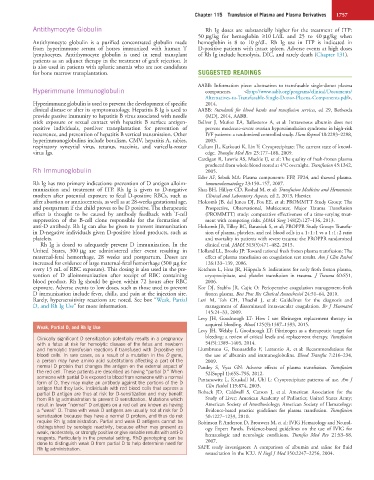
            Rarely, hypersensitivity reactions are noted. See box “Weak, Partial   Levi  M,  Toh  CH,  Thachil  J,  et al:  Guidelines  for  the  diagnosis  and
            D, and Rh Ig Use” for more information.                 management  of  disseminated  intravascular  coagulation.  Br  J  Haematol
                                                                    145:24–33, 2009.
                                                                  Levy  JH,  Goodnough  LT:  How  I  use  fibrinogen  replacement  therapy  in
                                                                    acquired bleeding. Blood 125(9):1387–1393, 2015.
             Weak, Partial D, and Rh Ig Use
                                                                  Levy JH, Welsby I, Goodnough LT: Fibrinogen as a therapeutic target for
             Clinically significant D sensitization potentially results in a pregnancy   bleeding: a review of critical levels and replacement therapy. Transfusion
             with  a  fetus  at  risk  for  hemolytic  disease  of  the  fetus  and  newborn   54(5):1389–1405, 2014.
             and hemolytic transfusion reactions if transfused with D-positive red   Liumbruno  G,  Bennardello  F,  Lattanzio  A,  et al:  Recommendations  for
             blood  cells.  In  rare  cases,  as  a  result  of  a  mutation  in  the  D  gene,   the  use  of  albumin  and  immunoglobulins.  Blood Transfus  7:216–234,
             a  person  may  have  amino  acid  substitutions  affecting  a  part  of  the   2009.
             normal D protein that changes the antigen on the external aspect of   Pandey  S,  Vyas  GN:  Adverse  effects  of  plasma  transfusion.  Transfusion
             the red cell. These patients are described as having “partial D.” When   52(Suppl 1):65S–79S, 2012.
             someone with partial D is exposed to blood from someone with a normal
             form of D, they may make an antibody against the portions of the D   Pantanowitz L, Kruskall M, Uhl L: Cryoprecipitate patterns of use.  Am J
             antigen that they lack. Individuals with red blood cells that express a   Clin Pathol 119:874, 2003.
             partial D antigen are thus at risk for D-sensitization and may benefit   Roback  JD,  Caldwell  S,  Carson  J,  et al.  American  Association  for  the
             from Rh Ig administration to prevent D sensitization. Mutations which   Study  of  Liver;  American  Academy  of  Pediatrics;  United  States  Army;
             result in fewer “normal” D antigens on a red cell are known as having   American Society of Anesthesiology; American Society of Hematology:
             a “weak” D. Those with weak D antigens are usually not at risk for D   Evidence-based  practice  guidelines  for  plasma  transfusion.  Transfusion
             sensitization because they have a normal D protein, and thus do not   50:1227–1239, 2010.
             require Rh Ig administration. Partial and weak D antigens cannot be   Robinson P, Anderson D, Brouwers M, et al: IVIG Hematology and Neurol-
             distinguished  by  serologic  reactivity,  because  either  may  present  as   ogy  Expert  Panels.  Evidence-based  guidelines  on  the  use  of  IVIG  for
             weak, moderately, or strongly positive or give variable results with anti-D
             reagents. Particularly in the prenatal setting, RhD genotyping can be   hematologic  and  neurologic  conditions.  Transfus  Med  Rev  21:S3–S8,
             done to distinguish weak D from partial D to help determine need for   2007.
             Rh Ig administration.                                SAFE  study  investigators:  A  comparison  of  albumin  and  saline  for  fluid
                                                                    resuscitation in the ICU. N Engl J Med 350:2247–2256, 2004.

