


Page 1977 - Hematology_ Basic Principles and Practice ( PDFDrive )
P. 1977
Chapter 115  Transfusion of Plasma and Plasma Derivatives  1751


             Severe Maternal Hemorrhage                            TABLE   Administration of Albumin
                                                                    115.3
             Major obstetric hemorrhage is a leading cause of maternal morbidity
             and mortality, and is preventable and/or treatable. Significant obstetric   Indicated
             hemorrhage  is  defined  as  active  bleeding  >1000 mL  within  the  24   After large-volume paracentesis
             hours following birth that continues despite the use of initial measures   Nephrotic syndrome resistant to potent diuretics
             including first-line uterotonic agents and uterine massage. Early assess-  Ovarian hyperstimulation syndrome
             ment and aggressive treatment of postpartum hemorrhage (PPH) are   Volume/fluid replacement in plasmapheresis
             important for reducing morbidity and mortality rates. A critical first step   Possibly Indicated
             in managing PPH is rapid recognition that clinically significant bleeding
             has  occurred,  with  effective  communication  of  the  situation  to  the   Adult respiratory distress syndrome
             appropriate team members, both clinical and laboratory staff. Subse-  Cardiopulmonary bypass pump priming
             quent measures include immediate resuscitation with definitive action   Fluid resuscitation in shock/sepsis/burns
             to  arrest  the  bleeding  (obstetric,  surgical,  and/or  hematologic)  and   Neonatal kernicterus/hyperbilirubinemia
             ongoing assessment and monitoring of the response to treatment. In   To reduce enteral feeding intolerance
             these cases, blood ordering protocols specific to obstetric patients may   Not Indicated
             be helpful. A massive transfusion protocol, similar to that seen in acute   Correction of measured hypoalbuminemia or hypoproteinemia
             trauma patients ensures sustained availability of blood products while
             the bleeding remains uncontrolled. Unique to maternal hemorrhage,   Nutritional deficiency, total parenteral nutrition
             hypofibrinogenemia is an important predictor for the later development   Preeclampsia
             of severe bleeding. Consequently, point-of-care technologies, such as   Red blood cell suspension
             thromboelastography and rotational thromboelastometry, in addition to   Simple volume expansion (surgery, burns)
             fibrinogen levels can identify decreased fibrin clot quality during PPH,   Wound healing
             which correlate with low fibrinogen levels and can assist in transfusion   Investigational
             management. Early administration of 1 to 2 g tranexamic acid is also
             recommended,  followed  by  an  additional  dose  in  cases  of  ongoing   Cadaveric renal transplantation
             bleeding. Early fibrinogen replacement using an appropriate dose of   Cerebral ischemia
             cryoprecipitate may also be beneficial in these cases.  Stroke
                                                                   Common Usages
                                                                   Cardiopulmonary bypass, pump priming
            have revised target levels to at least 150 to 200 mg/dL, or a TEG   Extensive burns
            Maximum clot firmness (MCF) reading of 6 to 8 mm. It is estimated   Hypotension
            that  a  dose  of  8  to  10  units  of  cryoprecipitate  will  increase  the   Intraoperative fluid requirement exceeding 5–6 L in adults
            fibrinogen in a 70 kg adult by 50 to 70 mg/dL, but how this dose   Labile pulmonary, cardiovascular status
            affects  a TEG  is  unclear.  Dosing  frequency  should  be  determined   Liver disease, hypoalbuminemia, diuresis
            based on clinical and laboratory responses, as factor XIII and fibrino-  Nephrotic syndrome, proteinuria, and hypoalbuminemia
            gen are very stable proteins. Specifically, the half-life of fibrinogen is   Plasma exchange
            4 days, and factor XIII has a half-life of 9 days.     Premature infant undergoing major surgery
                                                                   Protein-losing enteropathy, hypoalbuminemia
                                                                   Resuscitation
            Compatibility                                          Serum albumin <20 g/dL

            Cryoprecipitate can contain minimal anti-A and/or anti-B antibodies
            and, as such, ABO and D compatibility is not necessary for most
            adult and pediatric patients.                         Indications
                                                                  A decrease in measured plasma albumin is found in many situations,
            Adverse Events                                        including chronic liver disease, chronic renal failure, sepsis, malig-
                                                                  nancy, burns, critical illness, severe head trauma, and hemorrhage,
            Cryoprecipitate has similar adverse event risk as other blood products,   and is often, in itself, not a clinically significant concern. Mild edema
            including transfusion-transmitted diseases, hemolytic reactions and   arising  from  hypoalbuminemia  does  not  require  albumin  therapy.
            allergic  reactions.  Since  it  contains  less  plasma  and  no  leukocytes,   However,  inadequate  synthesis,  as  seen  in  severe  liver  disease  and
            febrile and allergic reactions are less likely to occur.  severe malnutrition, or excessive loss, as seen in nephrotic syndrome
                                                                  and protein-losing enteropathy, can lead to significant hypoalbumin-
                                                                  emia  with  intravascular  volume  depletion,  anasarca,  ascites,  and
            ALBUMIN                                               pleural effusions. Hypoalbuminemia is associated with poor clinical
                                                                  outcome in some studies, yet correction of low serum albumin levels
            Albumin, an important plasma protein, contributes primarily to the   in critically ill patients does not improve outcome measures such as
            maintenance of plasma colloid oncotic pressure; it is also involved in   mortality, duration of intensive care unit (ICU) and hospital stay, or
            the transport of numerous substances, such as unconjugated bilirubin,   mechanic ventilation. Historically, albumin had a broader use (i.e.,
            various hormones, and drugs. Albumin also has an established role   nutritional support, correction of hypoalbuminemia, volume replace-
            in acid-base function, free radical scavenging, is antiapoptotic, anti-  ment),  but  recent  studies  support  its  benefit  in  fewer  situations,
            thrombotic, and has positive and negative effects on vascular integrity.   including  nephrotic  syndrome  resistant  to  potent  diuretic  therapy,
            The human body content of albumin is 4 to 5 g/kg, and is responsible   after  large-volume  paracentesis,  and  in  ovarian  hyperstimulation
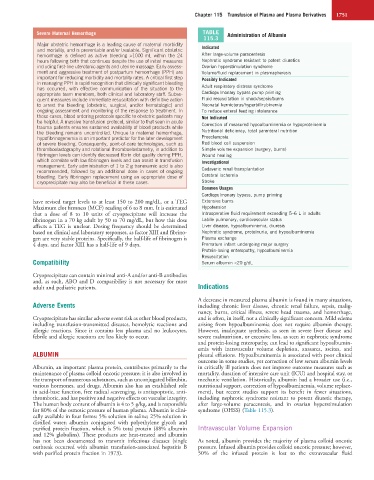
            for 80% of the osmotic pressure of human plasma. Albumin is clini-  syndrome (OHSS) (Table 115.3).
            cally available in four forms: 5% solution in saline; 25% solution in
            distilled  water;  albumin  conjugated  with  polyethylene  glycol;  and
            purified protein fraction, which is 5% total protein (88% albumin   Intravascular Volume Expansion
            and 12% globulins). These products are heat-treated and albumin
            has  not  been  documented  to  transmit  infectious  diseases  (single   As noted, albumin provides the majority of plasma colloid oncotic
            outbreak  occurred  with  albumin  transfusion-associated  hepatitis  B   pressure. Infused albumin provides colloid oncotic pressure; however,
            with purified protein fraction in 1973).              50%  of  the  infused  protein  is  lost  to  the  extravascular  fluid

