


Page 1986 - Hematology_ Basic Principles and Practice ( PDFDrive )
P. 1986
1760   Part XI  Transfusion Medicine


                                                   Frozen human plasma
                                                       Thaw at 4°C
                            Cryoprecipitate                                   Cryosupernatant
                                       FVIII/vWF                   FIX complex       Optional
                                       Fibrinogen                                    adsorption
                                       Factor XIII                Antithrombin       steps


                                                    8% Ethanol, pH 7.2
                               Fraction I                                        Fraction I
                              precipitate                                       supernatant
                                                                  Antithrombin
                                       Fibrinogen

                                                    25% Ethanol, pH 6.8
                             Fraction II + III                                 Fraction II + III
                              precipitate                                       supernatant
                                       Immune
                                       globulins
                                                    18% Ethanol, pH 5.2

                             Fraction IV-1                                      Fraction IV-1
                              precipitate                                       supernatant
                                       FIX complex
                                       API, AT

                                                    40% Ethanol, pH 5.8
                             Fraction IV-4                                      Fraction IV-4
                              precipitate                                       supernatant
                                       PPF with
                                       Fraction V

                                                    40% Ethanol, pH 4.8
                              Fraction V                                         Fraction V
                              precipitate                                       supernatant
                                       Albumin
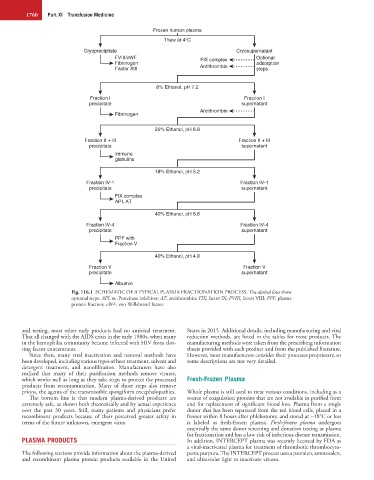
                        Fig. 116.1  SCHEMATIC OF A TYPICAL PLASMA FRACTIONATION PROCESS. The dashed lines show
                        optional steps. API, α 1-Proteinase inhibitor; AT, antithrombin; FIX, factor IX; FVIII, factor VIII; PPF, plasma
                        protein fraction; vWF, von Willebrand factor.


        and testing, most other early products had no antiviral treatment.   States in 2015. Additional details, including manufacturing and viral
        That all changed with the AIDS crisis in the early 1980s, when many   reduction methods, are listed in the tables for most products. The
        in the hemophilia community became infected with HIV from clot-  manufacturing methods were taken from the prescribing information
        ting factor concentrates.                             sheets provided with each product and from the published literature.
           Since  then,  many  viral  inactivation  and  removal  methods  have   However, most manufacturers consider their processes proprietary, so
        been developed, including various types of heat treatment, solvent and   some descriptions are not very detailed.
        detergent  treatment,  and  nanofiltration.  Manufacturers  have  also
        realized  that  many  of  their  purification  methods  remove  viruses,
        which works well as long as they take steps to protect the processed   Fresh-Frozen Plasma
        products  from  recontamination.  Many  of  those  steps  also  remove
        prions, the agents of the transmissible spongiform encephalopathies.  Whole plasma is still used to treat various conditions, including as a
           The  bottom  line  is  that  modern  plasma-derived  products  are   source of coagulation proteins that are not available in purified form
        extremely safe, as shown both theoretically and by actual experience   and for replacement of significant blood loss. Plasma from a single
        over  the  past  30  years.  Still,  many  patients  and  physicians  prefer   donor that has been separated from the red blood cells, placed in a
        recombinant  products  because  of  their  perceived  greater  safety  in   freezer within 8 hours after phlebotomy, and stored at −18°C or less
        terms of the future unknown, emergent virus.          is  labeled  as  fresh-frozen  plasma.  Fresh-frozen  plasma  undergoes
                                                              essentially the same donor screening and donation testing as plasma
                                                              for fractionation and has a low risk of infectious disease transmission.
        PLASMA PRODUCTS                                       In addition, INTERCEPT plasma was recently licensed by FDA as
                                                              a viral-inactivated plasma for treatment of thrombotic thrombocyto-
        The following sections provide information about the plasma-derived   penic purpura. The INTERCEPT process uses a psoralen, amotosalen,
        and  recombinant  plasma  protein  products  available  in  the  United   and ultraviolet light to inactivate viruses.

