


Page 1997 - Hematology_ Basic Principles and Practice ( PDFDrive )
P. 1997
Chapter 117  Transfusion Therapy for Coagulation Factor Deficiencies  1771


             TABLE   Viruses Implicated in Transfusion of Plasma-Derived Products
              117.2
                           Nucleic Acid                          Known Transmission   Lipid
             Virus         Human Disease  Human Disease          by Blood        Enveloped  Size (nm)  Reduction/Inactivation
             HIV           RNA         Yes (AIDS)                Yes             Yes      100–120   S/D
             HBV           DNA         Yes (acute and chronic hepatitis)  Yes    Yes      40–45     S/D
             HCV           RNA         Yes (acute and chronic hepatitis)  Yes    Yes      40–60     S/D
             Parvovirus B19  DNA       Yes (fifth disease, transient   Yes       No       18–20     Incompletely by heat;
                                         erythroblastopenia of                                        nanofiltration
                                         childhood, chronic anemia in
                                         immunocompromised
                                         patients)
             HAV           RNA         Yes                       Yes             No       25–30     Incompletely by heat
             Hepatitis G   RNA         No                        Yes             Yes                ?S/D
             TTV           DNA         No                        Yes             No                 ?S/D
             HHV-8         DNA         Kaposi sarcoma            Unknown
             SEN V         DNA                                                   No
             TSE (prion)   Peptide     Yes (CJD)                 Unknown         N/A      250 kDa   Unknown
             CJD, Creutzfeldt-Jakob disease; HAV, hepatitis A virus; HHV-8, human herpesvirus 8; N/A, not applicable; S/D, solvent/detergent; SEN V, SEN virus; TSE, transmissible
             spongiform encephalopathy; TTV, torque teneo virus.
             Data from Teitel J: Transmissible agents and the safety of coagulation factor concentrates. World Federation of Hemophilia. Facts and Figures 7:1,118 1999; and Allain
             JP: Emerging viruses in blood transfusion. Vox Sang 78:243, 2000.


                                                                              55
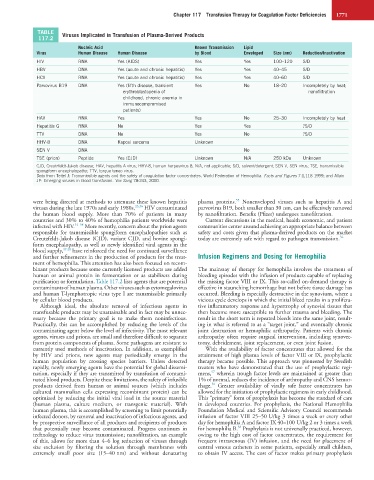
            were being directed at methods to attenuate these known hepatitis   plasma  proteins.   Nonenveloped  viruses  such  as  hepatitis  A  and
            viruses during the late 1970s and early 1980s, 23,36  HIV contaminated   parvovirus B19, both smaller than 30 nm, can be effectively removed
            the  human  blood  supply.  More  than  70%  of  patients  in  many   by nanofiltration. Benefix (Pfizer) undergoes nanofiltration.
            countries and 30% to 40% of hemophilia patients worldwide were   Current discussions in the medical, health economic, and patient
            infected with HIV. 51–54  More recently, concern about the prion agents   communities center around achieving an appropriate balance between
            responsible  for  transmissible  spongiform  encephalopathies  such  as   safety and costs given that plasma-derived products on the market
            Creutzfeldt-Jakob disease (CJD), variant CJD, and bovine spongi-  today are extremely safe with regard to pathogen transmission. 56
            form encephalopathy, as well as newly identified viral agents in the
            blood supply, 47,48  have reinforced the need for continued surveillance
            and further refinements in the production of products for the treat-  Infusion Regimens and Dosing for Hemophilia
            ment of hemophilia. This attention has also been focused on recom-
            binant products because some currently licensed products use added   The mainstay of therapy for hemophilia involves the treatment of
            human  or  animal  protein  in  fermentation  or  as  stabilizers  during   bleeding episodes with the infusion of products capable of replacing
            purification or formulation. Table 117.2 lists agents that are potential   the missing factor VIII or IX. This so-called on-demand therapy is
            contaminants of human plasma. Other viruses such as cytomegalovirus   effective in staunching hemorrhage but not before tissue damage has
            and human T-lymphotropic virus type I are transmissible primarily   occurred. Bleeding is especially destructive in the synovium, where a
            by cellular blood products.                           vicious cycle develops in which the initial bleed results in a prolifera-
              Although  ideal,  the  absolute  removal  of  infectious  agents  in   tive inflammatory response and hypertrophy of synovial tissues that
            transfusable products may be unattainable and in fact may be unnec-  then become more susceptible to further trauma and bleeding. The
            essary  because  the  primary  goal  is  to  make  them  noninfectious.   result in the short term is repeated bleeds into the same joint, result-
            Practically,  this  can  be  accomplished  by reducing the  levels  of  the   ing in what is referred to as a “target joint,” and eventually chronic
            contaminating agent below the level of infectivity. The most relevant   joint destruction or hemophilic arthropathy. Patients with chronic
            agents, viruses and prions, are small and therefore difficult to separate   arthropathy often require surgical intervention, including synovec-
            from protein components of plasma. Some pathogens are resistant to   tomy, debridement, joint replacement, or even joint fusion.
            currently used methods of inactivation. In addition, as exemplified   With the availability of factor concentrates that allowed for the
            by  HIV  and  prions,  new  agents  may  periodically  emerge  in  the   attainment of high plasma levels of factor VIII or IX, prophylactic
            human  population  by  crossing  species  barriers.  Unless  detected   therapy became possible. This approach was pioneered by Swedish
            rapidly, newly emerging agents have the potential for global dissemi-  treaters  who  have  demonstrated  that  the  use  of  prophylactic  regi-
                                                                      57
            nation, especially if they are transmitted by transfusion of contami-  mens,  wherein trough factor levels are maintained at greater than
            nated blood products. Despite these limitations, the safety of infusible   1% of normal, reduces the incidence of arthropathy and CNS hemor-
                                                                      56
            products  derived  from  human  or  animal  sources  (which  includes   rhage.   Greater  availability  of  virally  safe  factor  concentrates  has
            cultured  mammalian  cells  expressing  recombinant  protein)  can  be   allowed for the initiation of prophylactic regimens in early childhood.
            optimized by reducing the initial viral load in the source material   This “primary” form of prophylaxis has become the standard of care
            (human  plasma,  culture  medium,  or  transgenic  material).  With   in  developed  countries.  For  prophylaxis,  the  National  Hemophilia
            human plasma, this is accomplished by screening to limit potentially   Foundation  Medical  and  Scientific  Advisory  Council  recommends
            infected donors, by removal and inactivation of infectious agents, and   infusion of factor VIII 25–50 U/kg 3 times a week or every other
            by prospective surveillance of all products and recipients of products   day for hemophilia A and factor IX 40–100 U/kg 2 or 3 times a week
                                                                               58
            that  potentially  may  become  contaminated.  Progress  continues  in   for hemophilia B.  Prophylaxis is not universally practiced, however,
            technology to reduce virus transmission; nanofiltration, an example   owing to the high cost of factor concentrates, the requirement for
            of this, allows for more than 4–6 log reduction of viruses through   frequent intravenous (IV) infusion, and the need for placement of
            size  exclusion  by  filtering  the  solution  through  membranes  with   central venous catheters in some patients, especially small children,
            extremely  small  poor  size  (15–40 nm)  and  without  denaturing   to obtain IV access. The cost of factor makes primary prophylaxis

