


Page 2029 - Hematology_ Basic Principles and Practice ( PDFDrive )
P. 2029
1800   Part XI  Transfusion Medicine


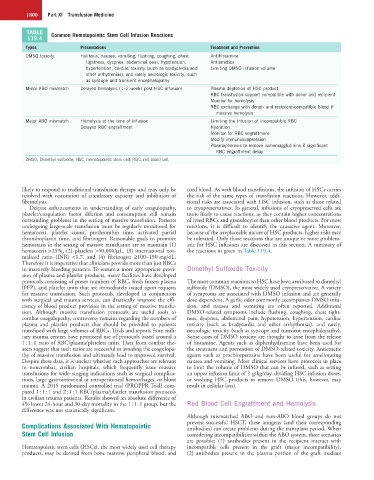
          TABLE   Common Hematopoietic Stem Cell Infusion Reactions
          119.4
         Types             Presentations                              Treatment and Prevention
         DMSO toxicity     Halitosis, nausea, vomiting, flushing, coughing, chest   Antihistamine
                             tightness, dyspnea, abdominal pain, hypotension,   Antiemetics
                             hypertension, cardiac toxicity (such as bradycardia and   Limiting DMSO infusion volume
                             other arrhythmias), and rarely neurologic toxicity, such
                             as syncope and transient encephalopathy
         Minor ABO mismatch  Delayed hemolysis (1–2 weeks post HSC infusion)  Plasma depletion of HSC product
                                                                      RBC transfusion support compatible with donor and recipient
                                                                      Monitor for hemolysis
                                                                      RBC exchange with donor- and recipient-compatible blood if
                                                                        massive hemolysis
         Major ABO mismatch  Hemolysis at the time of infusion        Limiting the infusion of incompatible RBC
                           Delayed RBC engraftment                    Hydration
                                                                      Monitor for RBC engraftment
                                                                      Modify immunosuppression
                                                                      Plasmapheresis to remove isohemagglutinins if significant
                                                                        RBC engraftment delay
         DMSO, Dimethyl sulfoxide; HSC, hematopoietic stem cell; RBC, red blood cell.


        likely to respond to traditional transfusion therapy and may only be   cord blood. As with blood transfusions, the infusion of HSCs carries
        resolved  with  restoration  of  circulatory  capacity  and  inhibition  of   the risk of the same types of transfusion reactions. However, addi-
        fibrinolysis.                                         tional risks are associated with HSC infusion, such as those related
           Despite  enhancements  in  understanding  of  early  coagulopathy,   to cryopreservatives. In general, infusions of cryopreserved cells are
        platelet/coagulation  factor  dilution  and  consumption  still  remain   more likely to cause reactions, as they contain higher concentrations
        outstanding problems in the setting of massive transfusion. Patients   of lysed RBCs and granulocytes than other blood products. For most
        undergoing large-scale transfusion must be regularly monitored for   reactions,  it  is  difficult  to  identify  the  causative  agent.  Moreover,
        hematocrit,  platelet  count,  prothrombin  time,  activated  partial   because of the irreplaceable nature of HSC products, higher risks may
        thromboplastin time, and fibrinogen. Reasonable goals to promote   be tolerated. Only those reactions that are unique or more problem-
        hemostasis in the setting of massive transfusion are to maintain (1)   atic for HSC infusions are discussed in this section. A summary of
        hematocrit >25%, (2) platelets >50,000/µL, (3) international nor-  the reactions in given in Table 119.4.
        malized  ratio  (INR)  <1.7,  and  (4)  fibrinogen  ≥100–150 mg/dL.
        Therefore it is imperative that clinicians provide more than just RBCs
        to massively bleeding patients. To ensure a more appropriate provi-  Dimethyl Sulfoxide Toxicity
        sion of plasma and platelet products, many facilities have developed
        protocols consisting of preset numbers of RBC, fresh frozen plasma   The most common reactions to HSC have been attributed to dimethyl
        (FFP), and platelet units that are immediately issued upon requests   sulfoxide (DMSO), the most widely used cryopreservative. A variety
        for  massive  transfusion.  Such  protocols,  developed  in  conjunction   of symptoms are associated with DMSO infusion and are generally
        with surgical and trauma services, can drastically improve the effi-  dose-dependent. A garlic odor commonly accompanies DMSO infu-
        ciency of blood product provision in the setting of massive transfu-  sion,  and  nausea  and  vomiting  are  often  reported.  Additional
        sion.  Although  massive  transfusion  protocols  are  useful  tools  to   DMSO-related  symptoms  include  flushing,  coughing,  chest  tight-
        combat coagulopathy, controversy remains regarding the numbers of   ness, dyspnea, abdominal pain, hypotension, hypertension, cardiac
        plasma  and  platelet  products  that  should  be  provided  to  patients   toxicity  (such  as  bradycardia  and  other  arrhythmias),  and  rarely,
        transfused with large volumes of RBCs. Trials and reports from mili-  neurologic toxicity (such as syncope and transient encephalopathy).
        tary trauma centers have promoted use of protocols based around a   Some cases of DMSO toxicity are thought to arise from the release
        1 : 1 : 1 ratio of RBC/plasma/platelets units. Data from combat the-  of histamine. Agents such as diphenhydramine have been used for
        aters suggest that such ratios are successful in avoiding the coagulopa-  the treatment and prevention of DMSO-related toxicity. Antiemetic
        thy of massive transfusion and ultimately lead to improved survival.   agents  such  as  prochlorperazine  have  been  useful  for  ameliorating
        Despite these data, it is unclear whether such approaches are relevant   nausea and vomiting. Most clinical services have protocols in place
        to  noncombat,  civilian  hospitals,  which  frequently  issue  massive   to limit the volume of DMSO that can be infused, such as setting
        transfusions for wide-ranging indications such as surgical complica-  an upper infusion limit of 1 g/kg/day, dividing HSC infusion doses,
        tions, large gastrointestinal or retroperitoneal hemorrhages, or blunt   or  washing  HSC  products  to  remove  DMSO  (this,  however,  may
        trauma. A 2015 randomized controlled trial (PROPPR Trial) com-  result in cellular loss).
        pared 1 : 1 : 1 and 2 : 1 : 1 RBC/plasma/platelet transfusion protocols
        in civilian trauma patients. Results showed an absolute difference of
        4% lower 24-hour and 30-day mortality in the 1 : 1 : 1 group, but the   Red Blood Cell Engraftment and Hemolysis
        difference was not statistically significant.
                                                              Although  mismatched  ABO  and  non-ABO  blood  groups  do  not
        Complications Associated With Hematopoietic           prevent  successful  HSCT,  these  antigens  (and  their  corresponding
                                                              antibodies) can create problems during the transplant period. When
        Stem Cell Infusion                                    considering incompatibilities within the ABO system, three scenarios
                                                              are  possible:  (1)  antibodies  present  in  the  recipient  interact  with
        Hematopoietic stem cells (HSCs), the most widely used cell therapy   incompatible  cells  present  in  the  graft  (major  incompatibility),
        products, may be derived from bone marrow, peripheral blood, and   (2)  antibodies  present  in  the  plasma  portion  of  the  graft  mediate

