


Page 2053 - Hematology_ Basic Principles and Practice ( PDFDrive )
P. 2053
1822   Part XI  Transfusion Medicine


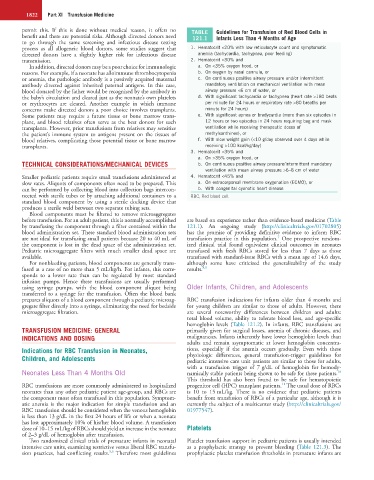
        permit  this.  If  this  is  done  without  medical  reason,  it  offers  no   TABLE   Guidelines for Transfusion of Red Blood Cells in
        benefit and there are potential risks. Although directed donors need   121.1  Infants Less Than 4 Months of Age
        to  go  through  the  same  screening  and  infectious  disease  testing
        process  as  all  allogeneic  blood  donors,  some  studies  suggest  that   1.  Hematocrit <20% with low reticulocyte count and symptomatic
        directed  donors  have  a  slightly  higher  risk  for  infectious  disease    anemia (tachycardia, tachypnea, poor feeding)
        transmission.                                          2.  Hematocrit <30% and
           In addition, directed donors may be a poor choice for immunologic    a.  On <35% oxygen hood, or
        reasons. For example, if a neonate has alloimmune thrombocytopenia    b.  On oxygen by nasal cannula, or
        or anemia, the pathologic antibody is a passively acquired maternal    c.  On continuous positive airway pressure and/or intermittent
        antibody  directed  against  inherited  paternal  antigens.  In  this  case,   mandatory ventilation on mechanical ventilation with mean
        blood donated by the father would be recognized by the antibody in   airway pressure <6 cm of water, or
        the baby’s circulation and cleared just as the neonate’s own platelets    d.  With significant tachycardia or tachypnea (heart rate >180 beats
        or  erythrocytes  are  cleared.  Another  example  in  which  immune   per minute for 24 hours or respiratory rate >80 breaths per
        concerns make directed donors a poor choice involves transplants.   minute for 24 hours)
        Some  patients  may  require  a  future  tissue  or  bone  marrow  trans-   e.  With significant apnea or bradycardia (more than six episodes in
        plant,  and  blood  relatives  often  serve  as  the  best  donors  for  such   12 hours or two episodes in 24 hours requiring bag and mask
        transplants. However, prior transfusions from relatives may sensitize   ventilation while receiving therapeutic doses of
        the  patient’s  immune  system  to  antigens  present  on  the  tissues  of   methylxanthines), or
        blood relatives, complicating those potential tissue or bone marrow     f.  With slow weight gain (<10 g/day observed over 4 days while
        transplants.                                                receiving >100 kcal/kg/day)
                                                               3.  Hematocrit <35% and
                                                                   a.  On >35% oxygen hood, or
        TECHNICAL CONSIDERATIONS/MECHANICAL DEVICES                b.  On continuous positive airway pressure/intermittent mandatory
                                                                    ventilation with mean airway pressure >6–8 cm of water
        Smaller pediatric patients require small transfusions administered at   4.  Hematocrit <45% and
        slow rates. Aliquots of components often need to be prepared. This    a.  On extracorporeal membrane oxygenation (ECMO), or
        can be performed by collecting blood into collection bags intercon-   b.  With congenital cyanotic heart disease
        nected with sterile tubes or by attaching additional containers to a   RBC, Red blood cell.
        standard  blood  component  by  using  a  sterile  docking  device  that
        produces a sterile weld between two separate tubing sets.
           Blood  components  must  be  filtered  to  remove  microaggregates
        before transfusion. For an adult patient, this is normally accomplished   are based on experience rather than evidence-based medicine (Table
        by transfusing the component through a filter contained within the   121.1).  An  ongoing  study  (http://clinicaltrials.gov/01702805)
        blood administration set. These standard blood administration sets   has  the  promise  of  providing  definitive  evidence  to  inform  RBC
                                                                                            7
        are not ideal for transfusing small patients because 20 to 40 mL of   transfusion  practice  in  this  population.   One  prospective  random-
        the component is lost in the dead space of the administration set.   ized  clinical  trial  found  equivalent  clinical  outcomes  in  neonates
        Pediatric  microaggregate  filters  with  much  smaller  dead  space  are   transfused  with  fresh  RBCs  stored  for  less  than  7  days  as  those
        available.                                            transfused with standard-issue RBCs with a mean age of 14.6 days,
           For nonbleeding patients, blood components are generally trans-  although  some  have  criticized  the  generalizability  of  the  study
        fused at a rate of no more than 5 mL/kg/h. For infants, this corre-  results. 8,9
        sponds  to  a  lower  rate  than  can  be  regulated  by  most  standard
        infusion  pumps.  Hence  these  transfusions  are  usually  performed
        using  syringe  pumps,  with  the  blood  component  aliquot  being   Older Infants, Children, and Adolescents
        transferred to a syringe for the transfusion. Often the blood bank
        prepares aliquots of a blood component through a pediatric microag-  RBC  transfusion  indications  for  infants  older  than  4  months  and
        gregate filter directly into a syringe, eliminating the need for bedside   for  young  children  are  similar  to  those  of  adults.  However,  there
        microaggregate filtration.                            are  several  noteworthy  differences  between  children  and  adults:
                                                              total  blood  volume,  ability  to  tolerate  blood  loss,  and  age-specific
                                                              hemoglobin levels (Table 121.2). In infants, RBC transfusions are
        TRANSFUSION MEDICINE: GENERAL                         primarily given for surgical losses, anemia of chronic diseases, and
        INDICATIONS AND DOSING                                malignancies. Infants inherently have lower hemoglobin levels than
                                                              adults  and  remain  asymptomatic  at  lower  hemoglobin  concentra-
        Indications for RBC Transfusion in Neonates,          tions,  especially  if  the  anemia  occurs  gradually.  Even  with  these
        Children, and Adolescents                             physiologic  differences,  general  transfusion-trigger  guidelines  for
                                                              pediatric intensive care unit patients are similar to those for adults,
                                                              with  a  transfusion  trigger  of  7 g/dL  of  hemoglobin  for  hemody-
        Neonates Less Than 4 Months Old                       namically stable patients being shown to be safe for these patients.
                                                                                                               10
                                                              This  threshold  has  also  been  found  to  be  safe  for  hematopoietic
                                                                                             11
        RBC transfusions are more commonly administered to hospitalized   progenitor cell (HPC) transplant patients.  The usual dose of RBCs
        neonates than any other pediatric patient age-group, and RBCs are   is  10  to  15 mL/kg.  There  is  no  evidence  that  pediatric  patients
        the component most often transfused in this population. Symptom-  benefit from transfusion of RBCs of a particular age, although it is
        atic  anemia  is  the  major  indication  for  simple  transfusion  and  an   currently the subject of a multicenter study (http://clinicaltrials.gov/
        RBC transfusion should be considered when the venous hemoglobin   01977547).
        is less than 13 g/dL in the first 24 hours of life or when a neonate
        has lost approximately 10% of his/her blood volume. A transfusion
        dose of 10–15 mL/kg of RBCs should yield an increase in the neonate   Platelets
        of 2–3 g/dL of hemoglobin after transfusion.
           Two randomized clinical trials of premature infants in neonatal   Platelet transfusion support in pediatric patients is usually intended
        intensive care units, examining restrictive versus liberal RBC transfu-  as  a  prophylactic  strategy  to  prevent  bleeding  (Table  121.3). The
                                     5,6
        sion  practices,  had  conflicting  results.  Therefore  most  guidelines   prophylactic platelet transfusion thresholds in premature infants are

