


Page 2054 - Hematology_ Basic Principles and Practice ( PDFDrive )
P. 2054
Chapter 121  Pediatric Transfusion Medicine  1823


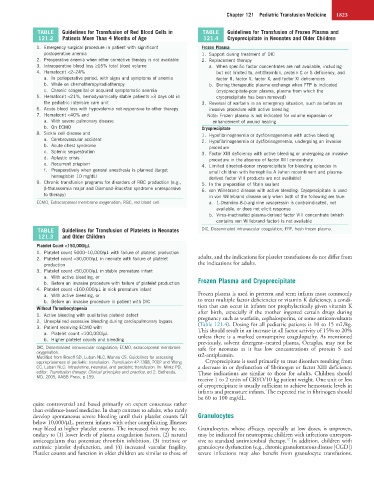
             TABLE   Guidelines for Transfusion of Red Blood Cells in   TABLE   Guidelines for Transfusion of Frozen Plasma and
              121.2  Patients More Than 4 Months of Age             121.4  Cryoprecipitate in Neonates and Older Children
             1.  Emergency surgical procedure in patient with significant   Frozen Plasma
               postoperative anemia                                1.  Support during treatment of DIC
             2.  Preoperative anemia when other corrective therapy is not available  2.  Replacement therapy
             3.  Intraoperative blood loss ≥15% total blood volume    a.  When specific factor concentrates are not available, including
             4.  Hematocrit <2–24%                                      but not limited to, antithrombin, protein C or S deficiency, and
                a.  In perioperative period, with signs and symptoms of anemia  factor II, factor V, factor X, and factor XI deficiencies
                b.  While on chemotherapy/radiotherapy                b.  During therapeutic plasma exchange when FFP is indicated
                c.  Chronic congenital or acquired symptomatic anemia   (cryoprecipitate-poor plasma, plasma from which the
             5.  Hematocrit <21%, hemodynamically stable patients >3 days old in   cryoprecipitate has been removed)
               the pediatric intensive care unit                   3.  Reversal of warfarin in an emergency situation, such as before an
             6.  Acute blood loss with hypovolemia not responsive to other therapy  invasive procedure with active bleeding
             7.  Hematocrit <40% and                                 Note: Frozen plasma is not indicated for volume expansion or
                a.  With severe pulmonary disease                      enhancement of wound healing
                b.  On ECMO                                        Cryoprecipitate
             8.  Sickle cell disease and                           1.  Hypofibrinogenemia or dysfibrinogenemia with active bleeding
                a.  Cerebrovascular accident                       2.  Hypofibrinogenemia or dysfibrinogenemia, undergoing an invasive
                b.  Acute chest syndrome                             procedure
                c.  Splenic sequestration                          3.  Factor XIII deficiency with active bleeding or undergoing an invasive
                d.  Aplastic crisis                                  procedure in the absence of factor XIII concentrate
                e.  Recurrent priapism                             4.  Limited directed-donor cryoprecipitate for bleeding episodes in
                f.  Preoperatively when general anesthesia is planned (target   small children with hemophilia A (when recombinant and plasma-
                  hemoglobin 10 mg/dL)                               derived factor VIII products are not available)
             9.  Chronic transfusion programs for disorders of RBC production (e.g.,   5.  In the preparation of fibrin sealant
               β-thalassemia major and Diamond-Blackfan syndrome unresponsive   6.  von Willebrand disease with active bleeding: Cryoprecipitate is used
               to therapy)                                           in von Willebrand disease only when both of the following are true:
             ECMO, Extracorporeal membrane oxygenation; RBC, red blood cell.   a.  1-Deamino-8-D-arginine vasopressin is contraindicated, not
                                                                        available, or does not elicit response
                                                                      b.  Virus-inactivated plasma-derived factor VIII concentrate (which
                                                                        contains von Willebrand factor) is not available
             TABLE   Guidelines for Transfusion of Platelets in Neonates   DIC, Disseminated intravascular coagulation; FFP, fresh frozen plasma.
              121.3  and Older Children
             Platelet Count <150,000/µL
             1.  Platelet count 5000–10,000/µL with failure of platelet production
             2.  Platelet count <30,000/µL in neonate with failure of platelet   adults, and the indications for platelet transfusions do not differ from
               production                                         the indications for adults.
             3.  Platelet count <50,000/µL in stable premature infant
                a.  With active bleeding, or
                b.  Before an invasive procedure with failure of platelet production  Frozen Plasma and Cryoprecipitate
             4.  Platelet count <100,000/µL in sick premature infant
                a.  With active bleeding, or                      Frozen plasma is used in preterm and term infants most commonly
                b.  Before an invasive procedure in patient with DIC  to treat multiple factor deficiencies or vitamin K deficiency, a condi-
             Without Thrombocytopenia                             tion that can occur in infants not prophylactically given vitamin K
             1.  Active bleeding with qualitative platelet defect  after  birth,  especially  if  the  mother  ingested  certain  drugs  during
                                                                  pregnancy such as warfarin, cephalosporins, or some anticonvulsants
             2.  Unexplained excessive bleeding during cardiopulmonary bypass  (Table 121.4). Dosing for all pediatric patients is 10 to 15 mL/kg.
             3.  Patient receiving ECMO with                      This should result in an increase in all factor activity of 15% to 20%
                a.  Platelet count <100,000/µL                    unless there is a marked consumptive coagulopathy. As mentioned
                b.  Higher platelet counts and bleeding
                                                                  previously, solvent detergent–treated plasma, Octaplas, may not be
             DIC, Disseminated intravascular coagulation; ECMO, extracorporeal membrane   safe  for  neonates  as  it  has  low  concentrations  of  protein  S  and
             oxygenation.                                         α2-antiplasmin.
             Modified from Roseff SD, Luban NLC, Manno CS. Guidelines for assessing
             appropriateness of pediatric transfusion. Transfusion 42:1398, 2002 and Wong   Cryoprecipitate is used primarily to treat disorders resulting from
             CC, Luban NLC: Intrauterine, neonatal, and pediatric transfusion. In: Mintz PD,   a decrease in or dysfunction of fibrinogen or factor XIII deficiency.
             editor: Transfusion therapy: Clinical principles and practice, ed 2. Bethesda,   These  indications  are  similar  to  those  for  adults.  Children  should
             MD, 2005, AABB Press, p 159.
                                                                  receive 1 to 2 units of CRYO/10 kg patient weight. One unit or less
                                                                  of cryoprecipitate is usually sufficient to achieve hemostatic levels in
                                                                  infants and premature infants. The expected rise in fibrinogen should
                                                                  be 60 to 100 mg/dL.
            quite controversial and based primarily on expert consensus rather
            than evidence-based medicine. In sharp contrast to adults, who rarely
            develop spontaneous severe bleeding until their platelet counts fall   Granulocytes
            below 10,000/µL, preterm infants with other complicating illnesses
            may bleed at higher platelet counts. The increased risk may be sec-  Granulocytes,  whose  efficacy,  especially  at  low  doses,  is  unproven,
            ondary to (1) lower levels of plasma coagulation factors, (2) natural   may be indicated for neutropenic children with infections unrespon-
                                                                                               12
            anticoagulants that potentiate thrombin inhibition, (3) intrinsic or   sive to standard antimicrobial therapy.  In addition, children with
            extrinsic  platelet  dysfunction,  and  (4)  increased  vascular  fragility.   granulocyte dysfunction (e.g., chronic granulomatous disease [CGD])
            Platelet counts and function in older children are similar to those of   severe  infections  may  also  benefit  from  granulocyte  transfusions.

