


Page 2055 - Hematology_ Basic Principles and Practice ( PDFDrive )
P. 2055
1824   Part XI  Transfusion Medicine


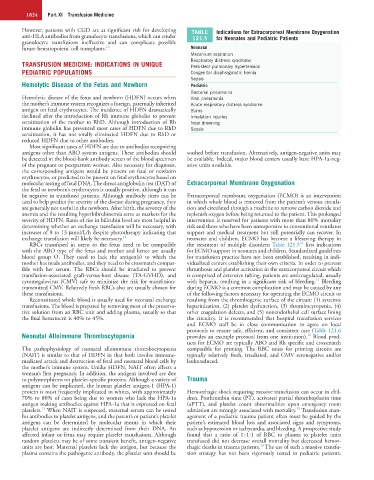
        However, patients with CGD are at significant risk for developing   TABLE   Indications for Extracorporeal Membrane Oxygenation
        anti-HLA antibodies from granulocyte transfusions, which can render   121.5  for Neonates and Pediatric Patients
        granulocyte  transfusions  ineffective  and  can  complicate  possible
        future hematopoietic cell transplants. 13              Neonatal
                                                               Meconium aspiration
                                                               Respiratory distress syndrome
        TRANSFUSION MEDICINE: INDICATIONS IN UNIQUE            Persistent pulmonary hypertension
        PEDIATRIC POPULATIONS                                  Congenital diaphragmatic hernia
                                                               Sepsis
        Hemolytic Disease of the Fetus and Newborn             Pediatric
                                                               Bacterial pneumonia
        Hemolytic disease of the fetus and newborn (HDFN) occurs when   Viral pneumonia
        the mother’s immune system recognizes a foreign, paternally inherited   Acute respiratory distress syndrome
        antigen on fetal erythrocytes. The incidence of HDFN dramatically   Burns
        declined after the introduction of Rh immune globulin to prevent   Inhalation injuries
        sensitization of the mother to RhD. Although introduction of Rh   Near drowning
        immune globulin has prevented most cases of HDFN due to RhD   Sepsis
        sensitization,  it  has  not  totally  eliminated  HDFN  due  to  RhD  or
        reduced HDFN due to other antibodies.
           Most significant cases of HDFN are due to antibodies recognizing
        antigens other than ABO system antigens. These antibodies should   washed before transfusion. Alternatively, antigen-negative units may
        be detected in the blood-bank antibody screen of the blood specimen   be available. Indeed, major blood centers usually have HPA-1a-neg-
        of the pregnant or postpartum woman. Also necessary for diagnosis,   ative units available.
        the  corresponding  antigens  would  be  present  on  fetal  or  newborn
        erythrocytes, or predicted to be present on fetal erythrocytes based on
        molecular testing of fetal DNA. The direct antiglobulin test (DAT) of   Extracorporeal Membrane Oxygenation
        the fetal or newborn’s erythrocytes is usually positive, although it can
        be negative in transfused patients. Although antibody titers can be   Extracorporeal membrane oxygenation (ECMO) is an intervention
        used to help predict the severity of the disease during pregnancy, they   in which whole blood is removed from the patient’s venous circula-
        are generally not useful in the newborn. After birth, the severity of the   tion and circulated through a machine to remove carbon dioxide and
        anemia and the resulting hyperbilirubinemia serve as markers for the   replenish oxygen before being returned to the patient. This prolonged
        severity of HDFN. Rates of rise in bilirubin level are most helpful in   intervention is reserved for patients with more than 80% mortality
        determining whether an exchange transfusion will be necessary, with   risk and those who have been unresponsive to conventional ventilator
        increases of 8 to 13 µmol/L/h despite phototherapy indicating that   support and medical treatment but still potentially can recover. In
        exchange transfusion will likely be necessary. 14     neonates and children, ECMO has become a lifesaving therapy in
                                                                                                   16
           RBCs  transfused  in  utero  to  the  fetus  need  to  be  compatible   the  treatment  of  multiple  disorders; Table  121.5   lists  indications
        with the ABO type of the fetus and mother and hence are usually   for ECMO support in neonates and children. Standardized guidelines
        blood  group  O.  They  need  to  lack  the  antigen(s)  to  which  the   for transfusion practice have not been established, resulting in indi-
        mother has made antibodies, and they need to be crossmatch compat-  vidualized centers establishing their own criteria. In order to prevent
        ible  with  her  serum.  The  RBCs  should  be  irradiated  to  prevent   thrombosis and platelet activation in the extracorporeal circuit which
        transfusion-associated  graft-versus-host  disease  (TA-GVHD),  and   is comprised of extensive tubing, patients are anticoagulated, usually
                                                                                                        17
        cytomegalovirus (CMV) safe to minimize the risk for transfusion-  with heparin, resulting in a significant risk of bleeding.  Bleeding
        transmitted CMV. Relatively fresh RBCs also are usually chosen for   during ECMO is a common complication and may be caused by any
        these transfusions.                                   of the following factors necessary for operating the ECMO circuit or
           Reconstituted whole blood is usually used for neonatal exchange   resulting from the thrombogenic surface of the circuit: (1) systemic
        transfusions. The blood is prepared by removing most of the preserva-  heparinization, (2) platelet dysfunction, (3) thrombocytopenia, (4)
        tive solution from an RBC unit and adding plasma, usually so that   other coagulation defects, and (5) nonendothelial cell surface lining
        the final hematocrit is 40% to 45%.                   the  circuitry.  It  is  recommended  that  hospital  transfusion  services
                                                              and  ECMO  staff  be  in  close  communication  to  agree  on  local
                                                              protocols to ensure safe, efficient, and consistent care (Table 121.6
        Neonatal Alloimmune Thrombocytopenia                  provides an example protocol from one institution).  Blood prod-
                                                                                                      16
                                                              ucts for ECMO are typically ABO and Rh specific and crossmatch
        The  pathophysiology  of  neonatal  alloimmune  thrombocytopenia   compatible  for  priming.  The  RBC  units  for  priming  circuits  are
        (NAIT) is similar to that of HDFN in that both involve immune-  typically relatively fresh, irradiated, and CMV seronegative and/or
        mediated attack and destruction of fetal and neonatal blood cells by   leukoreduced.
        the mother’s immune system. Unlike HDFN, NAIT often affects a
        woman’s first pregnancy. In addition, the antigens involved are due
        to polymorphisms on platelet-specific proteins. Although a variety of   Trauma
        antigens can be implicated, the human platelet antigen-1 (HPA-1)
        protein is most frequently implicated in whites, with approximately   Hemorrhagic shock requiring massive transfusion can occur in chil-
        70% to 80% of cases being due to women who lack the HPA-1a   dren. Prothrombin time (PT), activated partial thromboplastin time
        antigen making antibodies against HPA-1a that is expressed on fetal   (aPTT),  and  platelet  count  abnormalities  upon  emergency  room
                                                                                                  18
               15
        platelets.  When NAIT is suspected, maternal serum can be tested   admission are strongly associated with mortality.  Transfusion man-
        for antibodies to platelet antigens, and the parent’s or patient’s platelet   agement of a pediatric trauma patient often must be guided by the
        antigens  can  be  determined  by  molecular  means  in  which  their   patient’s  estimated  blood  loss  and  associated  signs  and  symptoms,
        platelet  antigens  are  indirectly  determined  from  their  DNA.  An   such as hypotension or tachycardia, and bleeding. A prospective study
        affected infant or fetus may require platelet transfusions. Although   found  that  a  ratio  of  1 : 1:1  of  RBC  to  plasma  to  platelet  units
        random platelets may be of some transient benefit, antigen-negative   transfused did not decrease overall mortality but decreased hemor-
                                                                                      19
        units are best. Maternal platelets lack the antigen, but because the   rhagic deaths in trauma patients.  The use of such a massive transfu-
        plasma contains the pathogenic antibody, the platelet unit should be   sion  strategy  has  not  been  rigorously  tested  in  pediatric  patients.

