


Page 2056 - Hematology_ Basic Principles and Practice ( PDFDrive )
P. 2056
Chapter 121  Pediatric Transfusion Medicine  1825


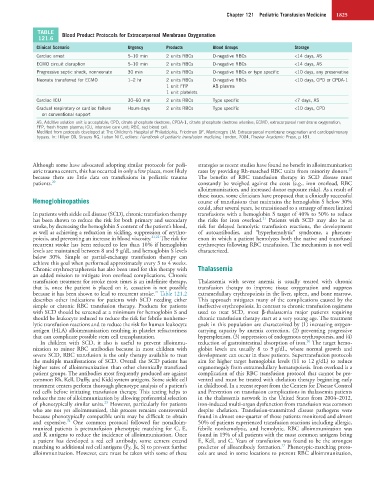
             TABLE   Blood Product Protocols for Extracorporeal Membrane Oxygenation
              121.6
             Clinical Scenario             Urgency     Products        Blood Groups              Storage
             Cardiac arrest                5–10 min    2 units RBCs    O-negative RBCs           <14 days, AS
             ECMO circuit disruption       5–10 min    2 units RBCs    O-negative RBCs           <14 days, AS
             Progressive septic shock, nonneonate  30 min  2 units RBCs  O-negative RBCs or type specific  <10 days, any preservative
             Neonate transferred for ECMO  1–2 hr      2 units RBCs    O-negative RBCs           <10 days, CPD or CPDA-1
                                                       1 unit FFP      AB plasma
                                                       1 unit platelets
             Cardiac ICU                   30–60 min   2 units RBCs    Type specific             <7 days, AS
             Gradual respiratory or cardiac failure   Hours-days  2 units RBCs  Type specific    <10 days, CPD
               on conventional support
             AS, Additive solution unit is acceptable; CPD, citrate phosphate dextrose; CPDA-1, citrate phosphate dextrose adenine; ECMO, extracorporeal membrane oxygenation;
             FFP, fresh frozen plasma; ICU, intensive care unit; RBC, red blood cell.
             Modified from protocols developed at The Children’s Hospital of Philadelphia. Friedman DF, Montenegro LM: Extracorporeal membrane oxygenation and cardiopulmonary
             bypass. In: Hillyer CD, Strauss RG, Luban NLC, editors: Handbook of pediatric transfusion medicine, London, 2004, Elsevier Academic Press, p 181.


            Although some have advocated adopting similar protocols for pedi-  strategies as recent studies have found no benefit in alloimmunization
                                                                                                                   25
            atric trauma centers, this has occurred in only a few places, most likely   rates by providing Rh-matched RBC units from minority donors.
            because  there  are  little  data  on  transfusions  in  pediatric  trauma   The  benefits  of  RBC  transfusion  therapy  in  SCD  disease  must
            patients. 20                                          constantly  be  weighed  against  the  costs  (e.g.,  iron  overload,  RBC
                                                                  alloimmunization, and increased donor exposure risks). As a result of
                                                                  these issues, some clinicians have proposed that a clinically successful
            Hemoglobinopathies                                    course of transfusions that maintains the hemoglobin S below 30%
                                                                  could, after several years, be transitioned to a strategy of more limited
            In patients with sickle cell disease (SCD), chronic transfusion therapy   transfusions with a hemoglobin S target of 40% to 50% to reduce
                                                                                       21
            has been shown to reduce the risk for both primary and secondary   the  risks  for  iron  overload.   Patients  with  SCD  may  also  be  at
            stroke, by decreasing the hemoglobin S content of the patient’s blood,   risk  for  delayed  hemolytic  transfusion  reactions,  the  development
            as well as achieving a reduction in sickling, suppression of erythro-  of  autoantibodies,  and  “hyperhemolytic”  syndrome,  a  phenom-
            poiesis, and preventing an increase in blood viscosity. 21,22  The risk for   enon in which a patient hemolyzes both the native and transfused
            recurrent stroke has been reduced to less than 10% if hemoglobin   erythrocytes following RBC transfusion. The mechanism is not well
            levels are maintained between 8 and 9 g/dL and hemoglobin S levels   characterized.
            below  30%.  Simple  or  partial-exchange  transfusion  therapy  can
            achieve this goal when performed approximately every 3 to 4 weeks.
            Chronic erythrocytapheresis has also been used for this therapy with   Thalassemia
            an added mission to mitigate iron overload complications. Chronic
            transfusion treatment for stroke most times is an indefinite therapy,   Thalassemia  with  severe  anemia  is  usually  treated  with  chronic
            that  is,  once  the  patient  is  placed  on  it,  cessation  is  not  possible   transfusion  therapy  to  improve  tissue  oxygenation  and  suppress
                                                    21
            because it has been shown to lead to recurrent stroke.  Table 121.2   extramedullary erythropoiesis in the liver, spleen, and bone marrow.
            describes  other  indications  for  patients  with  SCD  needing  either   This approach mitigates many of the complications caused by the
            simple  or  chronic  RBC  transfusion  therapy.  Products  for  patients   ineffective erythropoiesis. In contrast to chronic transfusion regimens
            with SCD should be screened at a minimum for hemoglobin S and   used  to  treat  SCD,  most  β-thalassemia  major  patients  requiring
            should be leukocyte reduced to reduce the risk for febrile nonhemo-  chronic transfusion therapy start at a very young age. The treatment
            lytic transfusion reactions and to reduce the risk for human leukocyte   goals in this population are characterized by (1) increasing oxygen-
            antigen (HLA) alloimmunization resulting in platelet refractoriness   carrying  capacity  by  anemia  correction,  (2)  preventing  progressive
            that can complicate possible stem cell transplantation.  hypersplenism, (3) suppression of endogenous erythropoiesis, and (4)
                                                                                                     26
              In  children  with  SCD,  it  also  is  useful  to  prevent  alloimmu-  reduction of gastrointestinal absorption of iron.  The target hemo-
            nization  to  minor  RBC  antibodies  because  in  most  children  with   globin  levels  are  usually  8  to  9 g/dL,  where  normal  growth  and
            severe SCD, RBC transfusion is the only therapy available to treat   development can occur in these patients. Supertransfusion protocols
            the multiple manifestations of SCD. Overall the SCD patient has   aim for higher target hemoglobin levels (11 to 12 g/dL) to reduce
            higher rates of alloimmunization than other chronically transfused   organomegaly from extramedullary hematopoiesis. Iron overload is a
            patient groups. The antibodies most frequently produced are against   complication of this RBC transfusion protocol that cannot be pre-
            common Rh, Kell, Duffy, and Kidd system antigens. Some sickle cell   vented and must be treated with chelation therapy beginning early
            treatment centers perform thorough phenotype analysis of a patient’s   in childhood. In a recent report from the Centers for Disease Control
            red cells before initiating transfusion therapy. This testing helps to   and Prevention on transfusion complications in thalassemia patients
            reduce the rate of alloimmunization by allowing preferential selection   in the thalassemia network in the United States from 2004–2012,
                                   23
            of phenotypically similar units.  However, particularly for patients   iron-induced multi-organ dysfunction from transfusion was common
            who are not yet alloimmunized, this process remains controversial   despite  chelation.  Transfusion-transmitted  disease  pathogens  were
            because phenotypically compatible units may be difficult to obtain   found in almost one-quarter of those patients monitored and almost
                       24
            and  expensive.   One  common  protocol  followed  for  nonalloim-  50% of patients experienced transfusion reactions including allergic,
            munized patients is pretransfusion phenotypic matching for C, E,   febrile  nonhemolytic,  and  hemolytic.  RBC  alloimmunization  was
            and K antigens to reduce the incidence of alloimmunization. Once   found in 19% of all patients with the most common antigens being
            a  patient  has  developed  a  red  cell  antibody,  some  centers  extend   E, Kell, and C. Years of transfusion was found to be the strongest
                                                                                             27
            matching to additional red cell antigens (Fy, Jk, S) to prevent further   predictor of alloantibody formation.  Phenotypic-matching proto-
            alloimmunization. However, care must be taken with some of these   cols are used in some locations to prevent RBC alloimmunization,

