


Page 2116 - Hematology_ Basic Principles and Practice ( PDFDrive )
P. 2116
Chapter 125  Molecular Basis of Platelet Function  1879


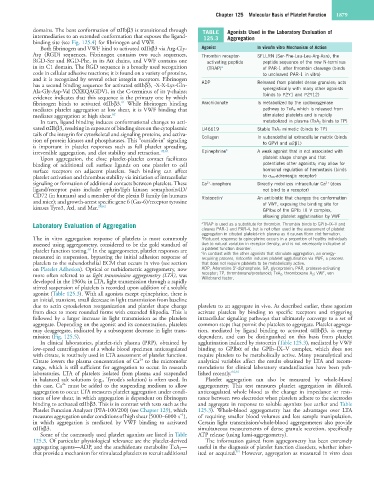
            domains. The bent conformation of αIIbβ3 is transitioned through   TABLE   Agonists Used in the Laboratory Evaluation of
            intermediaries to an extended conformation that exposes the ligand-  125.3  Aggregation
            binding site (see Fig. 125.4) for fibrinogen and VWF.
              Both fibrinogen and VWF bind to activated αIIbβ3 via Arg-Gly-  Agonist  In vivo/In vitro Mechanism of Action
            Asp  (RGD)  sequences.  Fibrinogen  contains  two  such  sequences,   Thrombin receptor-  SFLLRN (Ser-Phe-Leu-Leu-Arg-Asn), the
            RGD-Ser and RGD-Phe, in its Aα chains, and VWF contains one   activating peptide   peptide sequence of the new N-terminus
            in its C1 domain. The RGD sequence is a broadly used recognition   (TRAP) a  of PAR-1 after thrombin cleavage (binds
            code in cellular adhesive reactions; it is found on a variety of proteins,   to uncleaved PAR-1 in vitro)
            and it is recognized by several other integrin receptors. Fibrinogen
            has a second binding sequence for activated αIIbβ3, -X-X-Lys-Gln-  ADP   Released from platelet dense granules; acts
            Ala-Gly-Asp-Val (XXKQAGDV), in the C-terminus of its γ-chains;             synergistically with many other agonists
            evidence indicates that this sequence is the primary one by which          (binds to P2Y1 and P2Y12)
                                         61
            fibrinogen  binds  to  activated  αIIbβ3.   While  fibrinogen  binding   Arachidonate  Is metabolized by the cyclooxygenase
            mediates platelet aggregation at low shear, it is VWF binding that         pathway to TxA 2  which is released from
            mediates aggregation at high shear. 62                                     stimulated platelets and is rapidly
              In turn, ligand binding induces conformational changes to acti-          metabolized in plasma (TxA 2  binds to TP)
            vated αIIbβ3, resulting in exposure of binding sites on the cytoplasmic   U46619  Stable TxA 2  mimetic (binds to TP)
            tails of the integrin for cytoskeletal and signaling proteins, and activa-  Collagen  In subendothelial extracellular matrix (binds
            tion of protein kinases and phosphatases. This “outside-in” signaling      to GPVI and α2β1)
            is  important  in  platelet  responses  such  as  full  platelet  spreading,
            irreversible aggregation, and clot stability and retraction. 28,61  Epinephrine b  A weak agonist that is not associated with
              Upon  aggregation,  the  close  platelet-platelet  contact  facilitates   platelet shape change and that
            binding  of  additional  cell  surface  ligands  on  one  platelet  to  cell   potentiates other agonists; may allow for
            surface  receptors  on  adjacent  platelets.  Such  binding  can  affect   hormonal regulation of hemostasis (binds
            platelet activation and thrombus stability via initiation of intracellular   to α 2A -adrenergic receptor)
            signaling or formation of additional contacts between platelets. These   Ca -ionophore  Directly mobilizes intracellular Ca  (does
                                                                     2+
                                                                                                            2+
            ligand/receptor  pairs  include:  ephrin/Eph  kinase;  semaphorin4D/       not bind to a receptor)
            CD72 (in humans) and a member of the plexin B family (in humans   Ristocetin c  An antibiotic that changes the conformation
            and mice); and growth-arrest specific gene 6 (Gas-6)/receptor tyrosine     of VWF, exposing the binding site for
            kinases Tyro3, Axl, and Mer. 28,62                                         GPIbα of the GPIb–IX–V complex,
                                                                                       allowing platelet agglutination by VWF
            Laboratory Evaluation of Aggregation                   a TRAP is used as a substitute for thrombin. Thrombin binds to GPIb–IX–V and
                                                                   cleaves PAR-1 and PAR-4, but is not often used in the assessment of platelet
                                                                   aggregation in citrated platelet-rich plasma as it causes fibrin clot formation.
            The  in  vitro  aggregation  response  of  platelets  is  most  commonly   b Reduced response to epinephrine occurs in a proportion of healthy individuals
            assessed using aggregometry, considered to be the gold standard of   due to natural variation in receptor density, and is not necessarily indicative of
                              63
            platelet function testing.  In the aggregometer, platelet responses are   a platelet function disorder.
                                                                   In contrast with the other agonists that stimulate aggregation, an energy-
                                                                   c
            measured in suspension, bypassing the initial adhesion response of   requiring process, ristocetin induces platelet agglutination via VWF, a process
            platelets to the subendothelial ECM that occurs in vivo (see section   that does not require platelets to be metabolically active.
            on Platelet Adhesion). Optical or turbidometric aggregometry, now   ADP, Adenosine 5′-diphosphate; GP, glycoprotein; PAR, protease-activating
            more often referred to as light transmission aggregometry (LTA), was   receptor; TP, thromboxane/prostanoid; TxA 2 , thromboxane A 2 ; VWF, von
                                                                   Willebrand factor.
            developed in the 1960s; in LTA, light transmission through a rapidly
            stirred suspension of platelets is recorded upon addition of a soluble
            agonist (Table 125.3). With all agonists except epinephrine, there is
            an initial, transient, small decrease in light transmission from baseline
            due to actin cytoskeleton reorganization and platelet shape change   platelets to an aggregate in vivo. As described earlier, these agonists
            from discs to more rounded forms with extended filipodia. This is   activate  platelets  by  binding  to  specific  receptors  and  triggering
            followed  by  a  larger  increase  in  light  transmission  as  the  platelets   intracellular signaling pathways that ultimately converge to a set of
            aggregate. Depending on the agonist and its concentration, platelets   common steps that permit the platelets to aggregate. Platelet aggrega-
            may deaggregate, indicated by a subsequent decrease in light trans-  tion,  mediated  by  ligand  binding  to  activated  αIIbβ3,  is  energy
            mission (Fig. 125.5).                                 dependent,  and  can  be  distinguished  on  this  basis  from  platelet
              In clinical laboratories, platelet-rich plasma (PRP), obtained by   agglutination induced by ristocetin (Table 125.3), mediated by VWF
            low-speed centrifugation of a whole blood specimen anticoagulated   binding  to  GPIbα  of  the  GPIb–IX–V  complex,  which  does  not
            with citrate, is routinely used in LTA assessment of platelet function.   require platelets to be metabolically active. Many preanalytical and
                                               2+
            Citrate lowers the plasma concentration of Ca  to the micromolar   analytical  variables  affect  the  results  obtained  by  LTA  and  recom-
            range, which is still sufficient for aggregation to occur. In research   mendations  for  clinical  laboratory  standardization  have  been  pub-
            laboratories,  LTA  of  platelets  isolated  from  plasma  and  suspended   lished recently. 64,65
            in balanced salt solutions (e.g., Tyrode’s solution) is often used. In   Platelet  aggregation  can  also  be  measured  by  whole-blood
                     2+
            this case, Ca  must be added to the suspending medium to allow   aggregometry.  This  test  measures  platelet  aggregation  in  diluted,
            aggregation to occur. LTA measures platelet aggregation under condi-  anticoagulated  whole  blood  as  the  change  in  impedance  or  resis-
            tions of low shear, in which aggregation is dependent on fibrinogen   tance between two electrodes when platelets adhere to the electrodes
            binding to activated αIIbβ3. This is in contrast with tests such as the   and aggregate in response to soluble agonists (see earlier and Table
            Platelet Function Analyzer (PFA-100/200) (see Chapter 129), which   125.3).  Whole-blood  aggregometry  has  the  advantages  over  LTA
                                                            −1
            measures aggregation under conditions of high shear (5000–6000 s ),   of  requiring  smaller  blood  volumes  and  less  sample  manipulation.
            in  which  aggregation  is  mediated  by  VWF  binding  to  activated     Certain light transmission/whole-blood aggregometers also provide
            αIIbβ3.                                               simultaneous measurements of dense granule secretion, specifically
              Some of the commonly used platelet agonists are listed in Table   ATP release (using lumi-aggregometry).
            125.3. Of particular physiological relevance are the platelet-derived   The information gained from aggregometry has been extremely
            aggregating agents—ADP, and the arachidonate metabolite TxA 2 —  useful in the diagnosis of platelet function disorders, whether inher-
                                                                              64
            that provide a mechanism for stimulated platelets to recruit additional   ited or acquired.  However, aggregation as measured in vitro does

