


Page 2117 - Hematology_ Basic Principles and Practice ( PDFDrive )
P. 2117
1880   Part XII  Hemostasis and Thrombosis


                                                               Platelet Aggregation Testing for the Diagnosis of Platelet Disorders
                                                                Platelet aggregometry is the mainstay in the work-up of platelet func-
                                                                tion disorders (PFDs). Abnormalities in aggregation tracings can point
                                                                towards specific diagnoses and direct further testing.
           Light Transmission                                   Glanzmann Thrombasthenia
                                                                In this severe PFD in which there are quantitative or qualitative defects
                                                                in  integrin  αIIbβ3  (GPIIb–IIIa),  the  receptor  to  which  fibrinogen/von
                                                                Willebrand factor (VWF) binds on activated platelets, there is absent
                                                                aggregation response to all agonists. However, agglutination in response
                                                                to  a  high  concentration  of  ristocetin  occurs,  as  it  is  independent  of
                                                                αIIbβ3.
                                                                Bernard-Soulier Syndrome
                                                                This disorder with defective surface expression of the adhesive VWF
                                                                receptor GPIb–IX–V is characterized by a lack of agglutination to a high
                                                                concentration of ristocetin. Note that in von Willebrand disease (VWD)
                2.3 µM       4.5 µM        9.1 µM               there is an absent agglutination response to a high concentration of
                                                                ristocetin because of deficient VWF.
                           Time                                 Defects in Agonist/Adhesion Receptors
                                                     1 min
                                                                P2Y12: a defect in this ADP receptor results in decreased and reversible
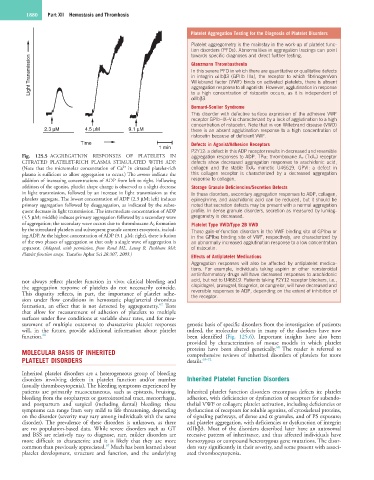
        Fig.  125.5  AGGREGATION  RESPONSES  OF  PLATELETS  IN   aggregation responses to ADP. TPα: thromboxane A 2  (TxA 2 ) receptor
        CITRATED  PLATELET-RICH  PLASMA  STIMULATED  WITH  ADP.   defects  show  decreased  aggregation  responses  to  arachidonic  acid,
                                         2+
        (Note  that  the  micromolar  concentration  of  Ca   in  citrated  platelet-rich   collagen  and  the  stable  TxA 2  mimetic  U46619.  GPVI:  a  defect  in
        plasma is sufficient to allow aggregation to occur.) The arrows indicate the   this  collagen  receptor  is  characterized  by  a  decreased  aggregation
        addition of increasing concentrations of ADP from left to right. Following   response to collagen.
        addition of the agonist, platelet shape change is observed as a slight decrease   Storage Granule Deficiencies/Secretion Defects
        in  light  transmission,  followed  by  an  increase  in  light  transmission  as  the   In these disorders, secondary aggregation responses to ADP, collagen,
        platelets aggregate. The lowest concentration of ADP (2.3 µM; left) induces   epinephrine, and arachidonic acid can be reduced, but it should be
        primary aggregation followed by deaggregation, as indicated by the subse-  noted that secretion defects may be present with a normal aggregation
        quent decrease in light transmission. The intermediate concentration of ADP   profile. In dense granule disorders, secretion as measured by lumiag-
        (4.5 µM; middle) induces primary aggregation followed by a secondary wave   gregometry is decreased.
        of aggregation; the secondary wave occurs due to thromboxane A 2  formation   Platelet Type VWD/Type 2B VWD
        by the stimulated platelets and subsequent granule content exocytosis, includ-  These gain-of-function disorders in the VWF binding site of GPIbα or
        ing ADP. At the highest concentration of ADP (9.1 µM; right), there is fusion   in the GPIbα binding site of VWF, respectively, are characterized by
        of the two phases of aggregation so that only a single wave of aggregation is   an abnormally increased agglutination response to a low concentration
        apparent.  (Adapted,  with  permission,  from  Rand  ML,  Leung  R,  Packham  MA:   of ristocetin.
        Platelet function assays. Transfus Apher Sci 28:307, 2003.)
                                                                Effects of Antiplatelet Medications
                                                                Aggregation  responses  will  also  be  affected  by  antiplatelet  medica-
                                                                tions.  For  example,  individuals  taking  aspirin  or  other  nonsteroidal
                                                                antiinflammatory drugs will have decreased responses to arachidonic
        not  always  reflect  platelet  function  in  vivo;  clinical  bleeding  and   acid, but not to U46619. Patients taking P2Y12 receptor blockers, i.e.,
        the  aggregation  response  of  platelets  do  not  necessarily  coincide.   clopidogrel, prasugrel, ticagrelor, or cangrelor, will have decreased and
        This  disparity  reflects,  in  part,  the  importance  of  platelet  adhe-  reversible responses to ADP, depending on the extent of inhibition of
                                                                the receptor.
        sion  under  flow  conditions  in  hemostatic  plug/arterial  thrombus
                                                     62
        formation,  an  effect  that  is  not  detected  by  aggregometry.  Tests
        that  allow  for  measurement  of  adhesion  of  platelets  to  multiple
        surfaces under flow conditions at variable shear rates, and for mea-
        surement  of  multiple  outcomes  to  characterize  platelet  responses   genetic basis of specific disorders from the investigation of patients;
        will,  in  the  future,  provide  additional  information  about  platelet     indeed,  the  molecular  defects  in  many  of  the  disorders  have  now
        function. 66                                          been  identified  (Fig.  125.6).  Important  insights  have  also  been
                                                              provided  by  characterization  of  mouse  models  in  which  platelet
                                                                                           68
        MOLECULAR BASIS OF INHERITED                          proteins  have  been  altered  genetically.   The  reader  is  referred  to
                                                              comprehensive  reviews  of  inherited  disorders  of  platelets  for  more
        PLATELET DISORDERS                                    details. 69–72

        Inherited  platelet  disorders  are  a  heterogeneous  group  of  bleeding
        disorders  involving  defects  in  platelet  function  and/or  number   Inherited Platelet Function Disorders
        (usually thrombocytopenia). The bleeding symptoms experienced by
        patients  are  primarily  mucocutaneous,  such  as  epistaxis,  bruising,   Inherited platelet function disorders encompass defects in: platelet
        bleeding from the oropharynx or gastrointestinal tract, menorrhagia,   adhesion, with deficiencies or dysfunction of receptors for subendo-
        and  postpartum  and  surgical  (including  dental)  bleeding;  these   thelial VWF or collagen; platelet activation, including deficiencies or
        symptoms can range from very mild to life threatening, depending   dysfunction of receptors for soluble agonists, of cytoskeletal proteins,
        on the disorder (severity may vary among individuals with the same   of signaling pathways, of dense and α granules, and of PS exposure;
        disorder). The  prevalence  of  these  disorders  is  unknown,  as  there   and platelet aggregation, with deficiencies or dysfunction of integrin
        are  no  population-based  data.  While  severe  disorders  such  as  GT   αIIbβ3.  Most  of  the  disorders  described  later  have  an  autosomal
        and  BSS  are  relatively  easy  to  diagnose,  rare,  milder  disorders  are   recessive pattern of inheritance, and thus affected individuals have
        more  difficult  to  characterize  and  it  is  likely  that  they  are  more   homozygous or compound heterozygous gene mutations. The disor-
                                    67
        common than previously appreciated.  Much has been learned about   ders vary significantly in their severity, and some present with associ-
        platelet  development,  structure  and  function,  and  the  underlying   ated thrombocytopenia.

