


Page 2115 - Hematology_ Basic Principles and Practice ( PDFDrive )
P. 2115
1878   Part XII  Hemostasis and Thrombosis


        outer cytoplasmic leaflet, and the minor anionic aminophospholipid                    Ligand
        PS  predominating  in  the  inner.  Platelet  adhesion  to  collagen  and
        stimulation with thrombin synergistically result in a loss of the asym-
        metry, or “scrambling,” of the membrane phospholipids, such that
                                                       53
        PS becomes exposed on the external plasma membrane leaflet.  PS
        translocated to the surface of activated platelets facilitates the assem-
        bly of the intrinsic tenase complex (factors VIIIa, IXa, and X) and
        prothrombinase  complex  (factors  Va  and  Xa,  and  prothrombin),
        contributing to the burst of thrombin generation that occurs in the
        propagation phase of coagulation (see Chapter 126). Specifically, the
        negatively charged γ-carboxyglutamate (Gla) residues of the vitamin
        K-dependent factors, factors VII(a), IX(a), X(a), and prothrombin,
                 2+
        mediate Ca -dependent binding of the factors to negatively-charged   Membrane
        PS.  There  is  recent  evidence  that  plasminogen  also  binds  to    IIb         IIb          3
        PS-exposing platelets, thereby linking coagulation and fibrinolysis. 54     3        Talin-H
           Exposure of PS on the platelet surface requires sustained increases   Cytoplasm
             2+
        in [Ca ] i via influx across the plasma membrane, and activation of                      Kindlin
        phospholipid scramblase (see Chapter 130, Fig. 130.1), which rapidly
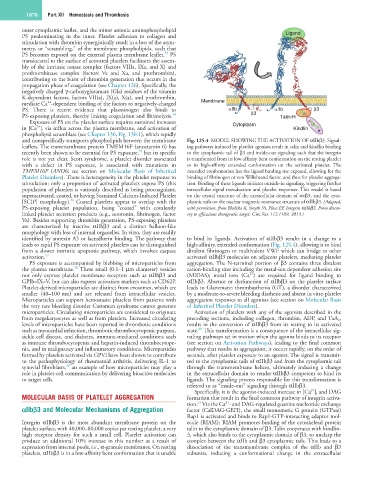
        and nonspecifically transports phospholipids between the membrane   Fig. 125.4  MODEL SHOWING THE ACTIVATION OF αIIbβ3. Signal-
        leaflets. The transmembrane protein TMEM16F (anoctamin 6) has   ing pathways induced by platelet agonists result in talin and kindlin binding
                                              55
        recently been shown to be essential for PS exposure,  but its specific   to the cytoplasmic tail of β3 and inside-out signaling such that the integrin
        role is not yet clear. Scott syndrome, a platelet disorder associated   is transformed from its low-affinity bent conformation on the resting platelet
        with  a  defect  in  PS  exposure,  is  associated  with  mutations  in   to  its  high-affinity  extended  conformation  on  the  activated  platelet.  The
        TMEM16F  (ANO6;  see  section  on  Molecular  Basis  of  Inherited   extended conformation has the ligand binding site exposed, allowing for the
        Platelet Disorders). There is heterogeneity in the platelet response to   binding of fibrinogen or von Willebrand factor, and thus for platelet aggrega-
        stimulation: only a proportion of activated platelets expose PS (this   tion. Binding of these ligands initiates outside-in signaling, triggering further
        population of platelets is variously described as being procoagulant,   intracellular signal transduction and platelet responses. This model is based
        superactivated, coated, or having Sustained Calcium-Induced Platelet   on the crystal structure of the extracellular domain of αvβ3, and the cyto-
                        56
        [SCIP] morphology).  Coated platelets appear to overlap with the   plasmic tails on the nuclear magnetic resonance structure of αIIbβ3. (Adapted,
        PS-exposing  platelet  population,  being  “coated”  with  covalently   with permission, from Bledzka K, Smyth SS, Plow EF. Integrin αIIbβ3. From discov-
        linked platelet secretion products (e.g., serotonin, fibrinogen, factor   ery to efficacious therapeutic target. Circ Res 112:1189, 2013.)
        Va). Besides supporting thrombin generation, PS-exposing platelets
        are  characterized  by  inactive  αIIbβ3  and  a  distinct  balloon-like
        morphology with loss of internal organelles. In vitro, they are readily
        identified by annexin A5 or lactadherin binding. The pathway that   to  bind  its  ligands.  Activation  of  αIIbβ3  results  in  a  change  to  a
        leads to rapid PS exposure on activated platelets can be distinguished   high-affinity, extended conformation (Fig. 125.4), allowing it to bind
        from  a  slower  intrinsic  apoptotic  pathway,  which  involves  caspase   divalent fibrinogen or multivalent VWF which can bridge to other
        activation. 57                                        activated αIIbβ3 molecules on adjacent platelets, mediating platelet
           PS exposure is accompanied by blebbing of microparticles from   aggregation. The N-terminal portion of β3 contains three divalent
                         58
        the plasma membrane.  These small (0.1–1 µm diameter) vesicles   cation-binding sites including the metal-ion dependent adhesion site
                                                                                   2+
        not  only  express  platelet  membrane  receptors  such  as  αIIbβ3  and   (MIDAS);  metal  ions  (Ca )  are  required  for  ligand  binding  to
        GPIb–IX–V, but can also express activation markers such as CD62P.   αIIbβ3. Absence or dysfunction of αIIbβ3 on the platelet surface
        Platelet-derived microparticles are distinct from exosomes, which are   leads to Glanzmann thrombasthenia (GT), a disorder characterized
        smaller  (40–100 nm)  and  are  released  from  intracellular  vesicles.   by a moderate-to-severe bleeding diathesis and absent in vitro platelet
        Microparticles can support hemostasis; platelets from patients with   aggregation responses to all agonists (see section on Molecular Basis
        the very rare bleeding disorder Castaman syndrome cannot generate   of Inherited Platelet Disorders).
        microparticles. Circulating microparticles are considered to originate   Activation of platelets with any of the agonists described in the
        from megakaryocytes as well as from platelets. Increased circulating   preceding sections, including collagen, thrombin, ADP, and TxA 2 ,
        levels of microparticles have been reported in thrombotic conditions   results in the conversion of αIIbβ3 from its resting to its activated
                                                                  60
        such as myocardial infarction, thrombotic thrombocytopenic purpura,   state.  This transformation is a consequence of the intracellular sig-
        sickle cell disease, and diabetes, immune-mediated conditions such   naling pathways set in motion when the agonist binds to its receptor
        as immune thrombocytopenia and heparin-induced thrombocytope-  (see section on Activation Pathways), leading to the final common
        nia, and in malignancy and inflammatory conditions. Microparticles   pathway that results in aggregation; it occurs rapidly, on the order of
        formed by platelets activated via GPVI have been shown to contribute   seconds, after platelet exposure to an agonist. The signal is transmit-
        to  the  pathophysiology  of  rheumatoid  arthritis,  delivering  IL-1  to   ted to the cytoplasmic tails of αIIbβ3 and from the cytoplasmic tail
                       59
        synovial fibroblasts,  an example of how microparticles may play a   through  the  transmembrane  helices,  ultimately  inducing  a  change
        role in platelet-cell communication by delivering bioactive molecules   in the extracellular domain to render αIIbβ3 competent to bind its
        to target cells.                                      ligands. The signaling process responsible for this transformation is
                                                              referred to as “inside-out” signaling through αIIbβ3.
                                                                                                       2+
                                                                 Specifically, it is the agonist-induced increase in [Ca ] i  and DAG
        MOLECULAR BASIS OF PLATELET AGGREGATION               formation that result in the final common pathway of integrin activa-
                                                                           2+
                                                                  61
                                                              tion.  Via the Ca - and DAG-regulated guanine nucleotide exchange
        αIIbβ3 and Molecular Mechanisms of Aggregation        factor (CalDAG-GEFI), the small monomeric G protein (GTPase)
                                                              Rap1 is activated and binds to Rap1-GTP-interacting adaptor mol-
        Integrin  αIIbβ3  is  the  most  abundant  membrane  protein  on  the   ecule (RIAM); RIAM promotes binding of the cytoskeletal protein
        platelet surface, with 40,000–80,000 copies per resting platelet, a very   talin to the cytoplasmic domain of β3. Talin cooperates with kindlin-
        high  receptor  density  for  such  a  small  cell.  Platelet  activation  can   3, which also binds to the cytoplasmic domain of β3, to unclasp the
        produce  an  additional  10%  increase  in  this  number  as  a  result  of   complex between the αIIb and β3 cytoplasmic tails. This leads to a
        expression from internal pools, i.e., α-granule membranes. On resting   dissociation  of  the  transmembrane  complex  of  the  αIIb  and  β3
        platelets, αIIbβ3 is in a low-affinity bent conformation that is unable   subunits,  inducing  a  conformational  change  in  the  extracellular

