


Page 2113 - Hematology_ Basic Principles and Practice ( PDFDrive )
P. 2113
1876   Part XII  Hemostasis and Thrombosis

        Lysosomal Granules                                    that bring the vesicular and target membranes into close proximity
                                                              (Fig.  125.3B).  SNARE  function  is  tightly  regulated  by  chaperone
        Platelets  have  small  numbers  of  primary  and  secondary  lysosomes   proteins.  NSF  regulates  membrane  interaction  by  disassembling
        that contain enzymes involved in degradation of proteins, carbohy-  SNARE  complexes on  the  same  membrane  so  that  they  are avail-
        drates, and lipids. These enzymes include cathepsins, elastase, colla-  able to form complexes with proteins on opposing membranes. The
        genases, galactosidase, glucuronidase, and acid phosphatase.  Sec1/Munc proteins (Munc18a, b, and c, and Munc13-4) and Rab
                                                                                        51
                                                              GTPases  regulate  granule  docking,   a  preliminary  step  to  granule
                                                              membrane fusion (Fig. 125.3B).
        Mechanism of Granule Secretion                           Activation  pathways  involving  intracellular  Ca ,  Rab  GTPase,
                                                                                                    2+
                                                              and PKC isoforms regulate the SNARE complex interactions. PKC
        The secretion of platelet granule contents occurs through mechanisms   isoforms  phosphorylate  several  of  the  SNARE  proteins  and  their
        analogous  to  those  required  for  the  exocytosis  of  granules  from   regulators including Munc18c, syntaxin 4, and SNAP-23. The PKC
        neurons and mast cells. Platelet secretion is triggered by a variety of   substrate pleckstrin is also a critical mediator of granule exocytosis:
        strong  agonists  such  as  thrombin.  Induction  of  secretion  by  weak   pleckstrin-deficient mice show markedly impaired platelet secretion. 52
        agonists  (e.g.,  ADP)  occurs  when  the  cells  are  brought  into  close   The important role of granule releasates in hemostasis is under-
                                   50
        contact, such as during aggregation,  and is dependent on TxA 2 to   lined by the bleeding diathesis in people with granule deficiencies or
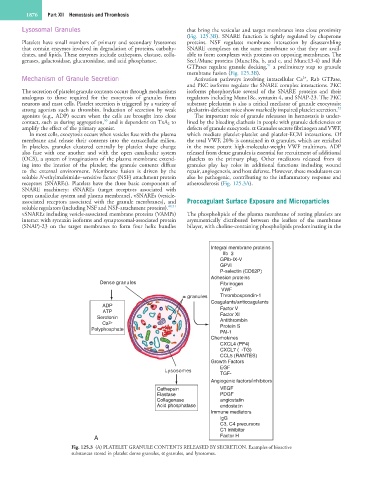
        amplify the effect of the primary agonist.            defects of granule exocytosis. α Granules secrete fibrinogen and VWF,
           In most cells, exocytosis occurs when vesicles fuse with the plasma   which  mediate  platelet-platelet  and  platelet-ECM  interactions.  Of
        membrane  and  release  their  contents  into  the  extracellular  milieu.   the total VWF, 20% is contained in α granules, which are enriched
        In  platelets,  granules  clustered  centrally  by  platelet  shape  change   in  the  most  potent  high-molecular-weight  VWF  multimers.  ADP
        also  fuse  with  one  another  and  with  the  open  canalicular  system   released from dense granules is essential for recruitment of additional
        (OCS), a system of invaginations of the plasma membrane extend-  platelets  to  the  primary  plug.  Other  mediators  released  from  α
        ing  into  the  interior  of  the  platelet;  the  granule  contents  diffuse   granules  play  key  roles  in  additional  functions  including  wound
        to  the  external  environment.  Membrane  fusion  is  driven  by  the   repair, angiogenesis, and host defense. However, these modulators can
        soluble N-ethylmaleimide–sensitive factor (NSF) attachment protein   also be pathogenic, contributing to the inflammatory response and
        receptors  (SNAREs).  Platelets  have  the  three  basic  components  of   atherosclerosis (Fig. 125.3A).
        SNARE  machinery:  tSNAREs  (target  receptors  associated  with
        open canalicular system and plasma membrane), vSNAREs (vesicle-
        associated  receptors  associated  with  the  granule  membranes),  and   Procoagulant Surface Exposure and Microparticles
        soluble regulators (including NSF and NSF-attachment proteins). 48,51
        vSNAREs including vesicle-associated membrane proteins (VAMPs)   The phospholipids of the plasma membrane of resting platelets are
        interact with syntaxin isoforms and synaptosomal-associated protein   asymmetrically  distributed  between  the  leaflets  of  the  membrane
        (SNAP)-23  on  the  target  membranes  to  form  four  helix  bundles   bilayer, with choline-containing phospholipids predominating in the


                                                                      Integral membrane proteins
                                                                         αllbβ3

                                                                         GPlb-IX-V
                                                                         GPVI
                                                                         P-selectin (CD62P)
                                                                      Adhesion proteins
                                  Dense granules                         Fibrinogen
                                                                          VWF
                                                               granules  Thrombospondin-1
                                                                      Coagulants/anticoagulants
                                   ADP                                   Factor V
                                   ATP
                                 Serotonin                               Factor XI
                                                                         Antithrombin
                                  Ca 2+                                  Protein S
                               Polyphosphate
                                                                         PAI-1
                                                                      Chemokines
                                                                         CXCL4 (PF4)
                                                                         CXCL7 (β-TG)
                                                                         CCL5 (RANTES)
                                                                      Growth Factors
                                                                         EGF
                                                       Lysosomes
                                                                         TGF-β
                                                                      Angiogenic factors/inhibitors
                                                    Cathepsin            VEGF
                                                    Elastase             PDGF
                                                    Collagenase          angiostatin
                                                    Acid phosphatase     endostatin
                                                                      Immune mediators
                                                                         lgG
                                                                         C3, C4 precursors
                                                                         C1 inhibitor
                                A                                        Factor H

                        Fig. 125.3  (A) PLATELET GRANULE CONTENTS RELEASED BY SECRETION. Examples of bioactive
                        substances stored in platelet dense granules, α granules, and lysosomes.

