


Page 2160 - Hematology_ Basic Principles and Practice ( PDFDrive )
P. 2160
Chapter 128  Clinical Approach to the Patient With Bleeding or Bruising  1913


                        Assess reason for referral, previous       Case 1: Illustration of a Mild, Inherited Bleeding Problem
                        diagnosis/investigations, and patient’s
                            concerns about bleeding.               A 77-year-old man who is starting treatment for multiple myeloma was
                                                                   discovered to have a prolonged activated partial thromboplastin time.
                                                                   Review of his records indicated that the abnormality was present on
                                                                   a previous admission for spinal cord compression, which was treated
              Evaluate the history for unprovoked, unexpected, significant, and  with  surgery.  He  required  4  units  of  packed  red  blood  cells  several
              recurrent bleeding (current and previous). Assess for symptoms  days  after  this  surgery  because  of  delayed  postoperative  bleeding.
               of bruising, prolonged bleeding with cuts, nosebleeds, gum and  There was no other bleeding history. He was found to have mild factor
               oral bleeding, gastrointestinal bleeding, joint or muscle bleeds,  IX deficiency, unrelated to the myeloma, and his daughter proved to
                urinary tract bleeding, and other bleeding (e.g., intracranial,  be a carrier of this defect.
               umbilical stump). Evaluate the drug history and family history
                 of bleeding problems. Evaluate other medical problems.
                Determine the nature and timing of any abnormal bleeding
                with challenges (right away, within hours or days after) and
                the severity (e.g., required transfusion, longer hospital stay,  Case 2: Illustration of the Importance of Assessing Both Personal and
                          developed large hematomas).              Familial Bleeding Problems
                                                                   A 22-year-old woman was referred for evaluation of a possible platelet
                                                                   disorder.  She  had  a  history  of  menorrhagia  (4  days  out  of  7  days
               If symptoms suggest an underlying bleeding problem, evaluate  of  menstrual  flow  were  heavy  when  not  on  treatment),  prolonged
               whether the cause could be an acquired or congenital problem  nosebleeds in childhood, and hematuria with urinary tract infections.
                 (e.g., symptoms from childhood, positive family history).  She  did  not  have  thrombocytopenia,  and  she  had  no  exposure  to
                                                                   major hemostatic challenges. Her father, uncle, and grandfather had a
                                                                   striking bleeding history, and two of them had thrombocytopenia. The
                                                                   bleeding in her relatives included joint bleeds with trauma and severe,
               If bleeding problems are new, consider potential reasons and  delayed-onset bleeding after trauma and surgery (usually more than a
              triggers (e.g., a first major hemostatic challenge could be the first  day later), which continued for weeks despite platelet transfusions. One
               presentation of a mild bleeding disorder; trigger could be drugs,  of these relatives reported no bleeding when he had a tooth extracted
               development of an immune disorder, or blood, endocrine, liver,  while receiving fibrinolytic inhibitor therapy. Although menorrhagia is
                               or renal disease).                  not specific to any one type of bleeding disorder, the delayed bleeding
                                                                   in affected relatives suggests a possible autosomal dominant disorder
                                                                   and either a fibrinolytic defect or a factor defect or deficiency (e.g.,
                                                                   dysfibrinogenemia; the latter had been excluded in previous tests of the
               Formulate a differential diagnosis for the potential inherited and  affected relatives). Because of the family history of thrombocytopenia,
                     acquired causes that should be investigated.  joint  bleeds,  and  delayed  bleeding,  which  did  not  respond  well  to
                                                                   platelet transfusions, testing was done for the Quebec platelet disorder.
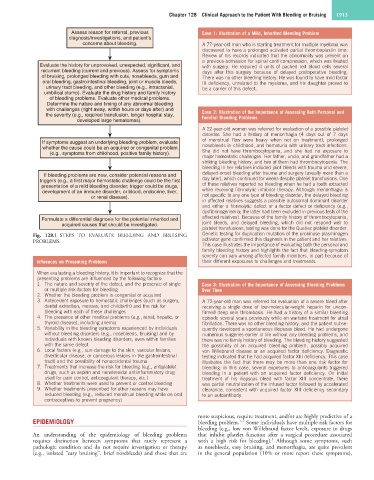
            Fig.  128.1  STEPS  TO  EVALUATE  BLEEDING  AND  BRUISING   Genetic testing for duplication mutation of the urokinase plasminogen
            PROBLEMS.                                              activator gene confirmed this diagnosis in the patient and her relatives.
                                                                   This case illustrates the importance of evaluating both the personal and
                                                                   family bleeding history and highlights the fact that bleeding-symptom
                                                                   severity can vary among affected family members, in part because of
             Influences on Presenting Problems                     their different exposures to challenges and treatments.
             When evaluating a bleeding history, it is important to recognize that the
             presenting problems are influenced by the following factors:
             1.  The nature and severity of the defect, and the presence of single   Case 3: Illustration of the Importance of Assessing Bleeding Problems
                or multiple risk factors for bleeding              Over Time
             2.  Whether the bleeding problem is congenital or acquired
             3.  Antecedent exposure to hemostatic challenges (such as surgery,   A 72-year-old man was referred for evaluation of a severe bleed after
                dental extraction, menses, and childbirth) and the risk for   receiving  a  single  dose  of  low-molecular-weight  heparin  for  uncon-
                bleeding with each of these challenges             firmed deep vein thrombosis. He had a history of a similar bleeding
             4.  The presence of other medical problems (e.g., renal, hepatic, or   episode several years previously while on warfarin treatment for atrial
                thyroid disease), including anemia                 fibrillation. There was no other bleeding history, and the patient subse-
             5.  Variability in the bleeding symptoms experienced by individuals   quently developed a spontaneous iliopsoas bleed. He had undergone
                without bleeding disorders (e.g., nosebleeds, bruising) and by   numerous surgeries earlier in life without any bleeding problems, and
                individuals with known bleeding disorders, even within families   there was no family history of bleeding. The bleeding history suggested
                with the same defect                               the  possibility  of  an  acquired  bleeding  problem,  possibly  acquired
             6.  Local factors (e.g., sun-damage to the skin, vascular lesions,   von  Willebrand  disease  or  an  acquired  factor  deficiency.  Diagnostic
                diverticular disease, or cancerous lesions in the gastrointestinal   testing indicated that he had acquired factor XIII deficiency. This case
                tract) and the possibility of nonaccidental trauma  illustrates  the  fact  that  there  may  be  more  than  one  risk  factor  for
             7.  Treatments that increase the risk for bleeding (e.g., antiplatelet   bleeding:  in  this  case,  several  exposures  to  anticoagulants  triggered
                drugs, such as aspirin and nonsteroidal antiinflammatory drug   bleeding  in  a  patient  with  an  acquired  factor  deficiency.  On  initial
                used for pain control, anticoagulant therapy, etc.)  treatment  of  his  iliopsoas  bleed  with  factor  XIII  concentrate,  there
             8.  Whether treatments were used to prevent or control bleeding  was partial neutralization of the infused factor followed by accelerated
             9.  Whether treatments prescribed for other reasons may have   clearance,  consistent  with  acquired  factor  XIII  deficiency  secondary
                reduced bleeding (e.g., reduced menstrual bleeding while on oral   to an autoantibody.
                contraceptives to prevent pregnancy)

                                                                  more suspicious, require treatment, and/or are highly predictive of a
            EPIDEMIOLOGY                                          bleeding problem.  Some individuals have multiple risk factors for
                                                                               1–3
                                                                  bleeding (e.g., low von Willebrand factor levels, exposure to drugs
            An  understanding  of  the  epidemiology  of  bleeding  problems   that  inhibit  platelet  function  after  a  surgical  procedure  associated
                                                                                          3
            requires  distinction  between  symptoms  that  rarely  represent  a   with  a  high  risk  for  bleeding).   Although  some  symptoms,  such
            pathologic  condition  and  do  not  require  investigation  or  therapy   as  nosebleeds,  easy  bruising,  and  menorrhagia,  are  quite  prevalent
            (e.g.,  isolated  “easy  bruising”,  brief  nosebleeds)  and  those  that  are   in  the  general  population  (10%  or  more  report  these  symptoms),

