


Page 2165 - Hematology_ Basic Principles and Practice ( PDFDrive )
P. 2165
1918   Part XII  Hemostasis and Thrombosis


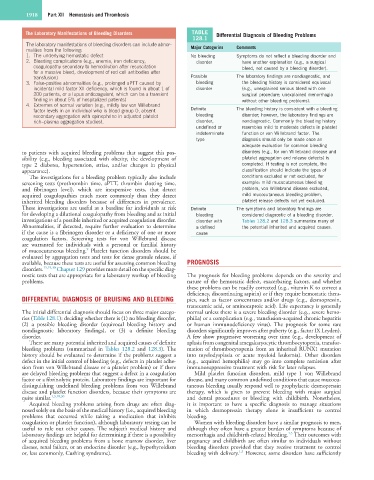
         The Laboratory Manifestations of Bleeding Disorders    TABLE   Differential Diagnosis of Bleeding Problems
                                                                128.1
          The laboratory manifestations of bleeding disorders can include abnor-
          malities from the following:                         Major Categories  Comments
          1.  The underlying hemostatic defect                 No bleeding    Symptoms do not reflect a bleeding disorder and
          2.  Bleeding complications (e.g., anemia, iron deficiency,   disorder  have another explanation (e.g., a surgical
            coagulopathy secondary to hemodilution after resuscitation          bleed, not caused by a bleeding disorder).
            for a massive bleed, development of red cell antibodies after
            transfusion)                                       Possible       The laboratory findings are nondiagnostic, and
          3.  False-positive abnormalities (e.g., prolonged aPTT caused by   bleeding   the bleeding history is considered equivocal
            incidental mild factor XII deficiency, which is found in about 1 of   disorder  (e.g., unexplained serious bleed with one
            200 patients, or a lupus anticoagulant, which can be a transient    surgical procedure; unexplained menorrhagia
            finding in about 5% of hospitalized patients)                       without other bleeding problems).
          4.  Extremes of normal variation (e.g., mildly low von Willebrand
            factor levels in an individual who is blood group O, absent   Definite   The bleeding history is consistent with a bleeding
            secondary aggregation with epinephrine in adjusted platelet   bleeding   disorder; however, the laboratory findings are
            rich–plasma aggregation studies).                    disorder,      nondiagnostic. Commonly the bleeding history
                                                                 undefined or   resembles mild to moderate defects in platelet
                                                                 indeterminate   function or von Willebrand factor. The
                                                                 type           diagnosis should only be made once an
                                                                                adequate evaluation for common bleeding
        to patients with acquired bleeding problems that suggest this pos-      disorders (e.g., for von Willebrand disease and
        sibility  (e.g.,  bleeding  associated  with  obesity,  the  development  of   platelet aggregation and release defects) is
        type  2  diabetes,  hypertension,  striae,  and/or  changes  in  physical     completed. If testing is not complete, the
        appearance).                                                            classification should indicate the types of
           The investigations for a bleeding problem typically also include     conditions excluded or not excluded, for
        screening  tests  (prothrombin  time,  aPTT,  thrombin  clotting  time,   example: mild mucocutaneous bleeding
        and  fibrinogen  level),  which  are  inexpensive  tests,  that  detect   problem, von Willebrand disease excluded,
        acquired  coagulopathies  much  more  commonly  than  they  detect      mild mucocutaneous bleeding problem,
        inherited  bleeding  disorders  because  of  differences  in  prevalence.   platelet release defects not yet excluded.
        These investigations are useful as a baseline for individuals at risk   Definite   The symptoms and laboratory findings are
        for developing a dilutional coagulopathy from bleeding and as initial   bleeding   considered diagnostic of a bleeding disorder.
        investigations of a possible inherited or acquired coagulation disorder.   disorder with   Tables 128.2 and 128.3 summarize many of
        Abnormalities, if detected, require further evaluation to determine   a defined   the potential inherited and acquired causes.
        if the cause is a fibrinogen disorder or a deficiency of one or more   cause
        coagulation  factors.  Screening  tests  for  von  Willebrand  disease
        are  warranted  for  individuals  with  a  personal  or  familial  history
                             9
        of mucocutaneous bleeding.  Platelet function disorders should be
        evaluated by aggregation tests and tests for dense granule release, if
        available, because these tests are useful for assessing common bleeding   PROGNOSIS
        disorders. 15,19,30  Chapter 129 provides more detail on the specific diag-
        nostic tests that are appropriate for a laboratory workup of bleeding    The  prognosis  for  bleeding  problems  depends  on  the  severity  and
        problems.                                             nature of the hemostatic defect, exacerbating factors, and whether
                                                              these problems can be readily corrected (e.g., vitamin K to correct a
                                                              deficiency, discontinuing aspirin) or if they require hemostatic thera-
        DIFFERENTIAL DIAGNOSIS OF BRUISING AND BLEEDING       pies,  such  as  factor  concentrates  and/or  drugs  (e.g.,  desmopressin,
                                                              tranexamic acid, or aminocaproic acid). Life expectancy is generally
        The initial differential diagnosis should focus on three major catego-  normal unless there is a severe bleeding disorder (e.g., severe hemo-
        ries (Table 128.1): deciding whether there is (1) no bleeding disorder,   philia) or a complication (e.g., transfusion-acquired chronic hepatitis
        (2)  a  possible  bleeding  disorder  (equivocal  bleeding  history  and   or  human  immunodeficiency  virus).  The  prognosis  for  some  rare
        nondiagnostic  laboratory  findings),  or  (3)  a  definite  bleeding   disorders significantly improves after puberty (e.g., factor IX Leyden).
        disorder.                                             A few show progressive worsening over time (e.g., development of
           There are many potential inherited and acquired causes of definite   aplasia from congenital amegakaryocytic thrombocytopenia, transfor-
        bleeding  problems  (summarized  in Tables  128.2  and  128.3). The   mation of thrombocytopenia from an inherited RUNX1 mutation
        history should be evaluated to determine if the problems suggest a   into  myelodysplasia  or  acute  myeloid  leukemia).  Other  disorders
        defect in the initial control of bleeding (e.g., defects in platelet adhe-  (e.g.,  acquired  hemophilia)  may  go  into  complete  remission  after
        sion from von Willebrand disease or a platelet problem) or if there   immunosuppressive treatment with risk for later relapses.
        are delayed bleeding problems that suggest a defect in a coagulation   Mild  platelet  function  disorders,  mild  type  1  von  Willebrand
        factor or a fibrinolytic protein. Laboratory findings are important for   disease, and many common undefined conditions that cause mucocu-
        distinguishing  undefined  bleeding  problems  from  von  Willebrand   taneous bleeding usually respond well to prophylactic desmopressin
        disease and platelet function disorders, because their symptoms are   therapy,  which  is  given  to  prevent  bleeding  with  major  surgical
        quite similar. 1,3,18,30                              and  dental  procedures  or  bleeding  with  childbirth.  Nonetheless,
           Acquired  bleeding  problems  arising  from  drugs  are  often  diag-  it  is  important  to  have  a  specific  diagnosis  to  manage  situations
        nosed solely on the basis of the medical history (i.e., acquired bleeding   in  which  desmopressin  therapy  alone  is  insufficient  to  control
        problems  that  occurred  while  taking  a  medication  that  inhibits   bleeding.
        coagulation or platelet function), although laboratory testing can be   Women with bleeding disorders have a similar prognosis to men,
        useful  to  rule  out  other  causes. The  subject’s  medical  history  and   although they often have a greater burden of symptoms because of
                                                                                               1,3
        laboratory findings are helpful for determining if there is a possibility   menorrhagia and childbirth-related bleeding.  Their outcomes with
        of acquired bleeding problems from a bone marrow disorder, liver   pregnancy  and  childbirth  are  often  similar  to  individuals  without
        disease, renal failure, or an endocrine disorder (e.g., hypothyroidism   bleeding  disorders  provided  that  they  receive  treatment  to  control
                                                                               1,3
        or, less commonly, Cushing syndrome).                 bleeding with delivery.  However, some disorders have sufficiently

