


Page 2174 - Hematology_ Basic Principles and Practice ( PDFDrive )
P. 2174
Chapter 129  Laboratory Evaluation of Hemostatic and Thrombotic Disorders  1927


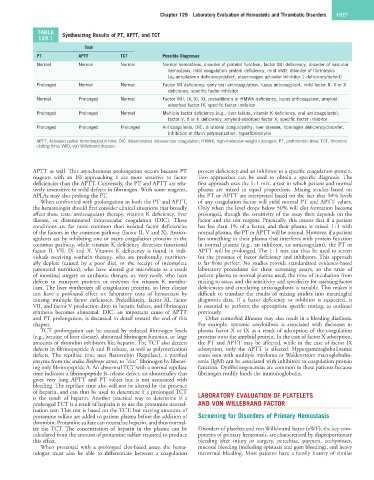
             TABLE   Synthesizing Results of PT, APTT, and TCT
              129.1
                             Test
             PT            APTT         TCT           Possible Diagnoses
             Normal        Normal       Normal        Normal hemostasis, disorder of platelet function, factor XIII deficiency, disorder of vascular
                                                        hemostasis, mild coagulation protein deficiency, mild vWD, disorder of fibrinolysis
                                                        (α 2 -antiplasmin deficiency/defect, plasminogen activator inhibitor-1 deficiency/defect)
             Prolonged     Normal       Normal        Factor VII deficiency, early oral anticoagulation, lupus anticoagulant, mild factor II, V or X
                                                        deficiency, specific factor inhibitor
             Normal        Prolonged    Normal        Factor VIII, IX, XI, XI, prekallikrein or HMWK deficiency, lupus anticoagulant, amyloid-
                                                        adsorbed factor IX, specific factor inhibitor
             Prolonged     Prolonged    Normal        Multiple factor deficiency (e.g., liver failure, vitamin K deficiency, oral anticoagulants),
                                                        factor V, X or II deficiency, amyloid-adsorbed factor X, specific factor inhibitor
             Prolonged     Prolonged    Prolonged     Anticoagulants, DIC, dilutional coagulopathy, liver disease, fibrinogen deficiency/disorder,
                                                        inhibition of fibrin polymerization, hyperfibrinolysis
             APTT, Activated partial thromboplastin time; DIC, disseminated intravascular coagulation; HMWK, high-molecular-weight kininogen; PT, prothrombin time; TCT, thrombin
             clotting time; vWD, von Willebrand disease.


            APTT as well. This asynchronous prolongation occurs because PT   protein deficiency and an inhibitor to a specific coagulation protein.
            reagents  with  an  ISI  approaching  1  are  more  sensitive  to  factor   Two  approaches  can  be  used  to  obtain  a  specific  diagnosis.  The
            deficiencies than the APTT. Conversely, the PT and APTT are rela-  first approach uses the 1 : 1 mix, a test in which patient and normal
            tively insensitive to mild defects in fibrinogen. With some reagents,   plasma  are  mixed  in  equal  proportions.  Mixing  studies  based  on
            APLAs may also prolong the PT.                        the PT or APTT are interpreted based on the fact that 50% levels
              When confronted with prolongation in both the PT and APTT,   of any coagulation factor will yield normal PT and APTT values.
            the hematologist should first consider clinical situations that broadly   Only when the level drops below 50% will clot formation become
            affect these tests: anticoagulant therapy, vitamin K deficiency, liver   prolonged, though the sensitivity of the assay then depends on the
            disease,  or  disseminated  intravascular  coagulation  (DIC).  These   factor and the test reagent. Practically, this means that if a patient
            conditions  are  far  more  common  than  isolated  factor  deficiencies   has  less  than  1%  of  a  factor,  and  their  plasma  is mixed  1 : 1 with
            of the factors in the common pathway (factor II, V and X). Antico-  normal plasma, the PT or APTT will be normal. However, if a patient
            agulants act by inhibiting one or many coagulation proteins in the   has something in their plasma that interferes with protein function
            common pathway, while vitamin K deficiency decreases functional   in normal plasma (e.g., an inhibitor, an anticoagulant), the PT or
            factor  II,  VII,  IX  and  X.  Vitamin  K  deficiency  is  found  in  indi-  APTT will be prolonged. The 1 : 1 mix can thus be used to screen
            viduals  receiving  warfarin  therapy,  who  are  profoundly  nutrition-  for the presence of factor deficiency and inhibitors. This approach
            ally  deplete  (caused  by  a  poor  diet,  or  the  receipt  of  incomplete   is far from perfect. No studies provide standardized evidence-based
            parenteral  nutrition),  who  have  altered  gut  microbiota  as  a  result   laboratory  procedures  for  these  screening  assays,  so  the  ratio  of
            of intestinal surgery or antibiotic therapy, or, very rarely, who have   patient plasma to normal plasma used, the time of incubation from
            defects  in  transport  proteins  or  enzymes  for  vitamin  K  metabo-  mixing to assay, and the sensitivity and specificity for assessing factor
            lism. The liver synthesizes all coagulation proteins, so liver disease   deficiencies and circulating anticoagulants is variable. This makes it
            can  have  a  profound  effect  on  laboratory  tests  of  hemostasis  by   difficult  to  translate  the  results  of  mixing  studies  into  meaningful
            causing  multiple  factor  deficiency.  Prekallikrein,  factor  XI,  factor   diagnostic  data.  If  a  factor  deficiency  or  inhibitor  is  suspected,  it
            VII, and factor V production drop in hepatic failure, and fibrinogen   is  essential  to  perform  the appropriate specific  testing,  as outlined
            synthesis  becomes  abnormal.  DIC,  an  important  cause  of  APTT   previously.
            and PT prolongation, is discussed in detail toward the end of this    Other comorbid illnesses may also result in a bleeding diathesis.
            chapter.                                              For  example,  systemic  amyloidosis  is  associated  with  decreases  in
              TCT  prolongation  can  be  caused  by  reduced  fibrinogen  levels   plasma factor X or IX as a result of adsorption of the coagulation
            (e.g., because of liver disease), abnormal fibrinogen function, or large   proteins onto the amyloid protein. In the case of factor X adsorption,
            amounts of thrombin inhibitors like heparin. The TCT also detects   the PT and APTT may be affected, while in the case of factor IX
            defects in fibrinopeptide A and B release, as well as polymerization   adsorption,  only  the  APTT  is  affected.  Hypergammaglobulinemic
            defects.  The  reptilase  time  uses  Batroxobin  (Reptilase),  a  purified   states seen with multiple myeloma or Waldenström macroglobulin-
            enzyme from the snake Bothrops atrox, to “clot” fibrinogen by liberat-  emia (IgM) can be associated with inhibitors to coagulation protein
            ing only fibrinopeptide A. An abnormal TCT with a normal reptilase   function. Dysfibrinogenemias are common in these patients because
            time indicates a fibrinopeptide B–release defect, an abnormality that   fibrinogen readily binds the immunoglobulin.
            gives  very  long  APTT  and  PT  values  but  is  not  associated  with
            bleeding. The reptilase time also will not be altered by the presence
            of heparin, and can thus be used to determine if a prolonged TCT
            is  the  result  of  heparin.  Another  practical  way  to  determine  if  a   LABORATORY EVALUATION OF PLATELETS
            prolonged TCT is a result of heparin is to use the protamine neutral-  AND VON WILLEBRAND FACTOR
            ization test. This test is based on the TCT, but varying amounts of
            protamine sulfate are added to patient plasma before the addition of   Screening for Disorders of Primary Hemostasis
            thrombin. Protamine sulfate can neutralize heparin, and thus normal-
            ize  the TCT. The  concentration  of  heparin  in  the  plasma  can  be   Disorders of platelets and von Willebrand factor (vWF), the key com-
            calculated from the amount of protamine sulfate required to produce   ponents of primary hemostasis, are characterized by disproportionate
            this effect.                                          bleeding  after  injury  or  surgery,  petechiae,  purpura,  ecchymoses,
              When  presented  with  a  prolonged  clot-based  assay,  the  hema-  mucosal bleeding (including epistaxis and gum bleeding), and heavy
            tologist  must  also  be  able  to  differentiate  between  a  coagulation   menstrual bleeding. Most patients have a family history of similar

